How I Hit 10,000 Steps a Day Without Leaving My Apartment (My Full Walking Pad Routine)

Updated August 2026
Affiliate disclosure: Some links on this page are affiliate links. If you purchase through them, MiniHomeGym may earn a commission at no extra cost to you. This does not affect our editorial judgment or product recommendations.
I get the same question every time I mention my step count: "Wait, how are you getting 10,000 steps a day at home when you barely leave your apartment?" Here's the honest answer — right now my system runs on three short walking pad sessions plus a few habits that make movement automatic instead of optional. But I didn't always own a walking pad, and you don't need one to start today. Below is both versions: the no-gear approach I used for months, and the walking pad system I use now. Save this one — the breakdown is basically a printable schedule.
Quick Answer: How Do You Get 10,000 Steps a Day at Home?
Split your steps into short movement blocks instead of one long walk. With a walking pad, three 30-minute sessions at varying speeds get you to roughly 7,000 steps; add 2,000–3,000 steps of everyday movement (calls, kitchen trips, stretch breaks) and you land around 9,000–10,000 by evening. No pad yet? Stairs, indoor laps, and pacing during calls can get you most of the way there — see the no-equipment breakdown below.
No Walking Pad? Here's How I Got Steps Before I Had One
Before I bought a pad, I didn't have some elaborate system — I just made ordinary movement count instead of letting it disappear into "I sat all day and didn't notice." A few things that actually moved the needle:
- Stairs, on purpose. If your building has them, five or six round trips during a break adds up fast — way faster than it feels like it should.
- Indoor laps during calls. Any call that doesn't need a screen is a walking call. I'd loop my apartment the same way people pace when they're on hold.
- Chores as movement, not chores. Laundry to the far corner, dishes put away one at a time instead of stacked and carried — small, deliberate, adds real steps.
- A 20-minute indoor walking workout video in the morning, before my brain had a chance to talk me out of it.
This is what fitness researchers call NEAT — non-exercise activity thermogenesis, basically all the movement that isn't a dedicated workout. It's most of your daily step count whether you have equipment or not, which is why the tactics above work even in a small apartment with zero gear. If you eventually want to speed this up, our full apartment gym setup guide walks through low-footprint equipment options, walking pads included.
Why 10,000 Steps Is Still Worth Chasing (Without the Wellness Lecture)
Consistent daily walking supports cardiovascular health, steadies your mood, and helps keep metabolism from stalling out during long sitting stretches. You've heard this before, so I won't belabor it.
Quick real talk, though: 10,000 isn't a number pulled from a clinical trial. It started as a marketing name for a 1960s Japanese pedometer, the Manpo-kei — literally "10,000-step meter." Since then, research has actually found solid health benefits start well below that mark, with a lot of the heart and longevity gains landing somewhere around 7,000–8,000 steps for most people, based on recent large-scale step-count research. I still aim for 10k because it's a clean, motivating number that keeps me consistent — not because I think the 500 steps between 9,500 and 10,000 are doing something magical. If your realistic number some days is 7,000, you're not failing. You're still getting real benefits. If weight loss is part of your goal too, I broke down exactly how I structure walks for that in my walking pad weight loss guide.
Before my walking pad, I was hitting maybe 2,000 steps on a full work day. That's not a guess — I checked. It was sobering enough that I built an actual system instead of relying on willpower.
The Daily Step Breakdown — Serah's Actual System
This whole routine is built around my actual desk setup — if you want the full walkthrough of how the pad integrates with my workday, I detailed it in my home office walking pad setup. Here's the schedule itself:
Morning Session (7:00–7:30am)
A brisker pace while I'm still fresh — 2.5 mph, no multitasking beyond a podcast. This is the session that sets the tone for whether I hit my number later.
Midday Session (12:00–12:30pm)
A moderate 2 mph during my lunch break — slow enough that I can actually eat something between laps without feeling rushed.
Afternoon Session (3:00–3:30pm)
A slow 1.5 mph while I clear Slack and email — slow enough to type without looking like I'm typing on a treadmill, because I am.
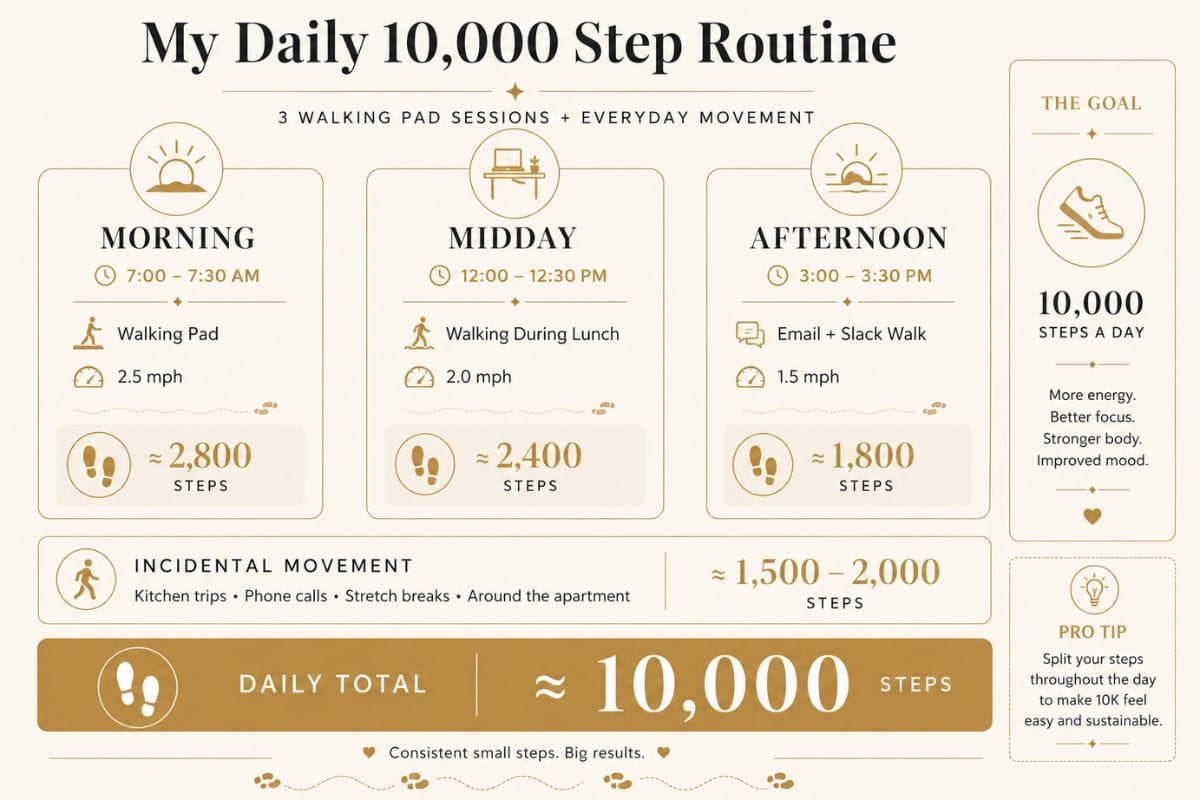
That's about 7,000 steps from the pad alone, plus 2,000–3,000 incidental, landing me at roughly 9,000–10,000 most days.
Honest note: I don't always hit that. On heavy focus days — back-to-back calls, deadline writing — I get closer to 6,000. That's still three times what I was getting before, so I don't stress about the days that fall short.
The Walking Pad That Makes This Possible
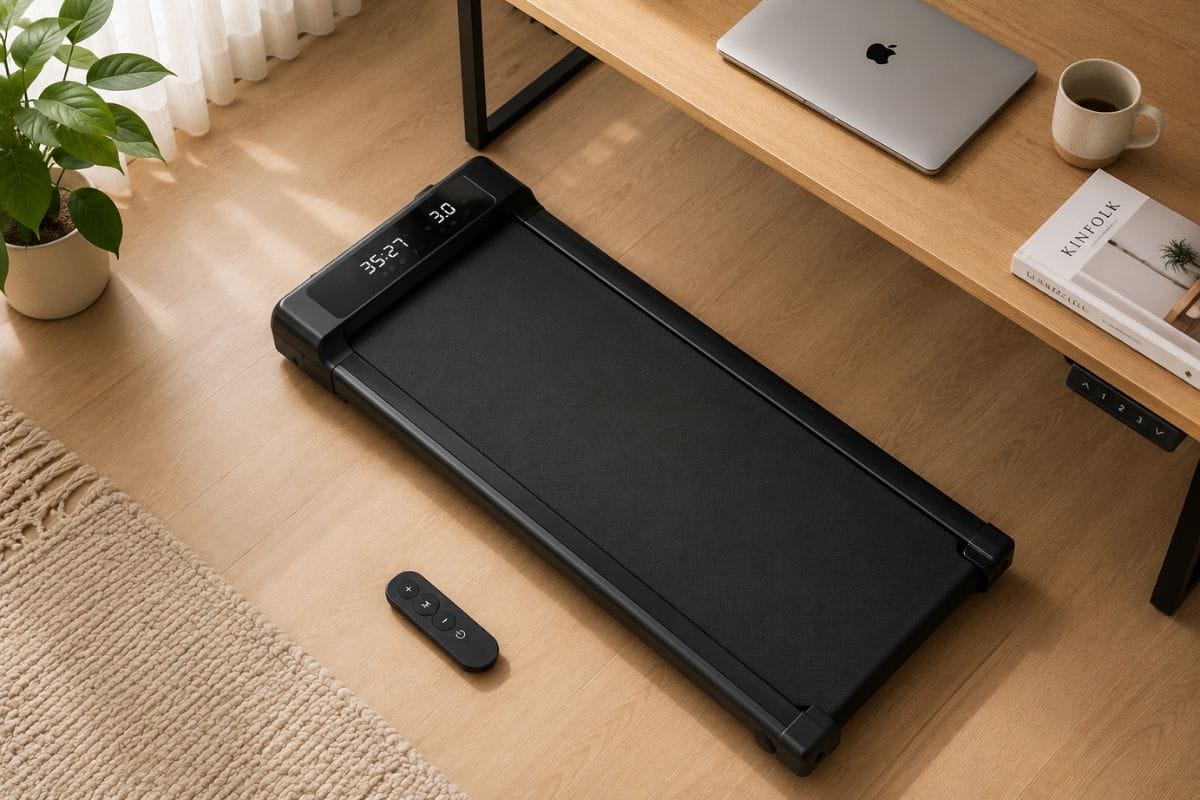
This routine only works because the pad fits into my workday instead of interrupting it. The WalkingPad C2 is quiet enough to walk on during calls without anyone asking if I'm in a wind tunnel, slides under my desk between sessions so it's never in the way, and the companion app tracks steps accurately enough that I trust the numbers above without cross-checking against a separate pedometer. I go deeper on noise levels and daily performance in my full C2 review.
If you want a slightly wider belt for a more natural stride — especially if you're taller or have a longer gait — the WalkingPad A1 Pro is the upgrade option worth considering. I compared the two side by side in my A1 Pro review if you're trying to decide which fits your space.
How to Build Up to 10,000 Steps (If You're Starting From Scratch)
Don't start at 10k. Start at 20 minutes once a day and make it non-negotiable. A basic phone step counter or a cheap pedometer is enough to track progress here — you don't need a smartwatch.
- Week 1: 3,000–4,000 steps/day (one 30-minute session)
- Week 2–3: 5,000–6,000 steps/day (two sessions)
- Week 4+: 8,000–10,000 steps/day (three sessions + incidental movement)
If you're still deciding which pad to buy before committing to this routine, my renter-tested walking pad picks breaks down the quietest, most apartment-friendly options.
What to Watch or Listen To (The Secret to Actually Doing It)
This is the most underrated piece of the whole system. If you're staring at a blank wall, 30 minutes feels endless. If you've got something pulling your attention, it disappears.
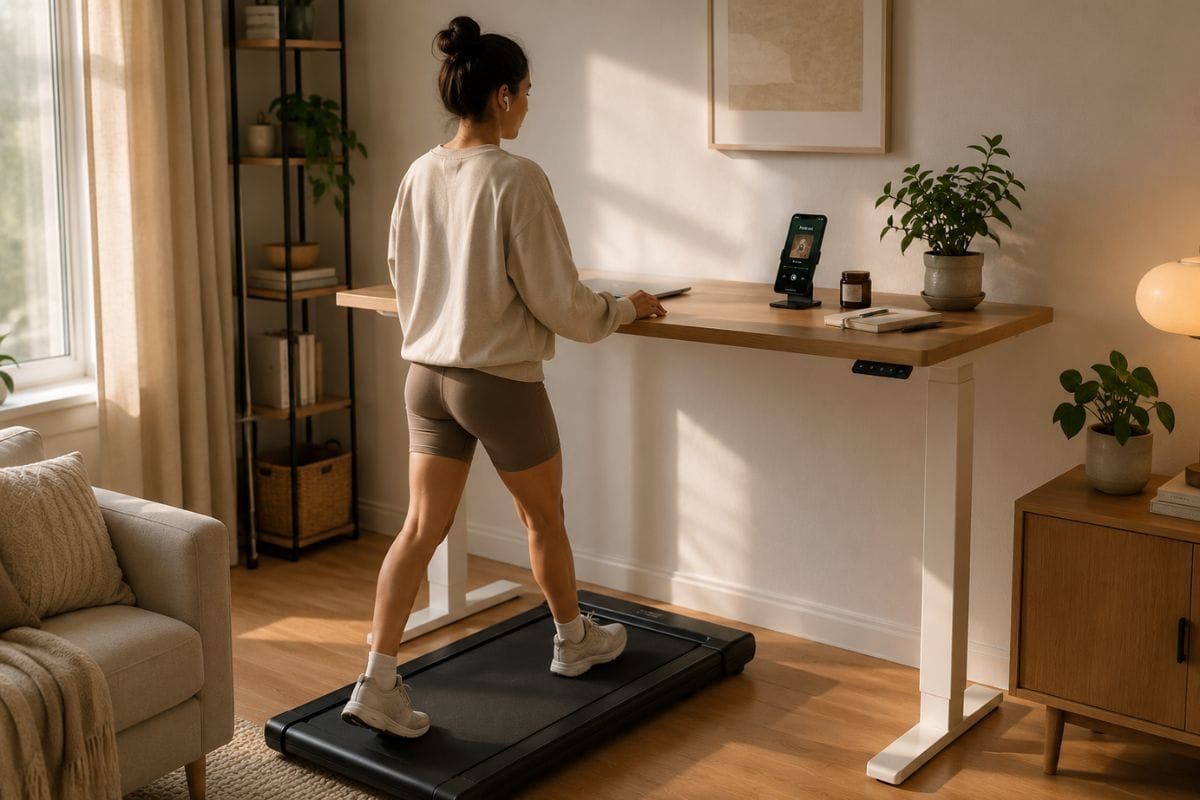
My actual rotation: true crime and culture podcasts for the morning session (something that doesn't need visuals), a low-focus reality show for midday, and audiobooks for the afternoon walk when my brain's too fried for anything plot-heavy. I only listen to true crime on my walking pad now — no other time. It's turned the session into something I look forward to instead of something I have to talk myself into. If you're pairing this with a standing desk setup, my standing desk and walking pad combo guide covers how I arranged mine.
FAQ
How many minutes of walking is 10,000 steps?
At an average pace of 2–3 mph, 10,000 steps takes roughly 90–100 minutes total. Splitting that into three 30-minute sessions throughout the day, like the routine above, makes it far more manageable than one long walk.
Can I get 10,000 steps on a walking pad?
Yes — a walking pad is one of the most reliable ways to hit 10,000 steps from home, since you control speed and duration precisely and can walk during calls, emails, or TV without leaving your apartment.
Do you need a walking pad to hit 10,000 steps at home?
No. Stairs, indoor laps, phone-call pacing, and short walking workout videos can get you most of the way there with zero equipment — see the no-equipment breakdown above. A walking pad just makes it faster and more consistent once you're ready for it.
Is 10,000 steps a day realistic for someone who works from home?
It's realistic with a system, not by accident. WFH days have almost no built-in movement, so hitting 10k requires deliberately scheduled walking sessions plus incidental movement — exactly the structure outlined above.
Is 10,000 steps actually necessary, or just a marketing number?
A bit of both. The 10,000 figure started as a 1960s pedometer brand name, not a medical target, and research shows meaningful benefits well below it. That said, it's still a solid, motivating target — you just don't need to hit it exactly to be doing your body real good.
What speed on a walking pad equals 10,000 steps per hour?
Around 2.5–3 mph typically produces 5,000–6,000 steps per hour for most people, meaning roughly 90 minutes total at that pace gets you to 10,000 steps.
Whether you're starting with stairs and a phone call or going straight for a pad, the same principle holds: short, scheduled movement blocks beat one long walk you never quite get around to.
I test every piece of gear in my actual apartment — noise, footprint, deposit-safety, and real-world durability. No sponsored samples, no showroom conditions. If I wouldn't buy it for my own 650 sq ft studio, I don't recommend it.
Build Your Dream Home Gym—Without Wasting Space or Money
Join the MiniHomeGym Newsletter for expert reviews, space-saving fitness tips, apartment-friendly workout ideas, practical buying guides, and exclusive deals to help you choose the best compact fitness equipment with confidence.