WalkingPad C2 Review (2026): Is This the Best Apartment Walking Pad?

Quick Verdict — WalkingPad C2
Rating: 8/10
Best for: WFH renters who want a quiet, fold-flat treadmill for walking pace and nothing else.
Not for: Anyone who wants to jog, run, or train above 3.7 mph.
Price: $399
Check current price →Specs at a Glance
First Impressions — Unboxing to First Walk
The box arrived in better shape than I expected. No drama, no crushed corners. The C2 ships mostly assembled — you're really just attaching the handle bar and tightening two bolts. It took me 8 minutes start to finish, and I was moving slowly because I was taking photos.
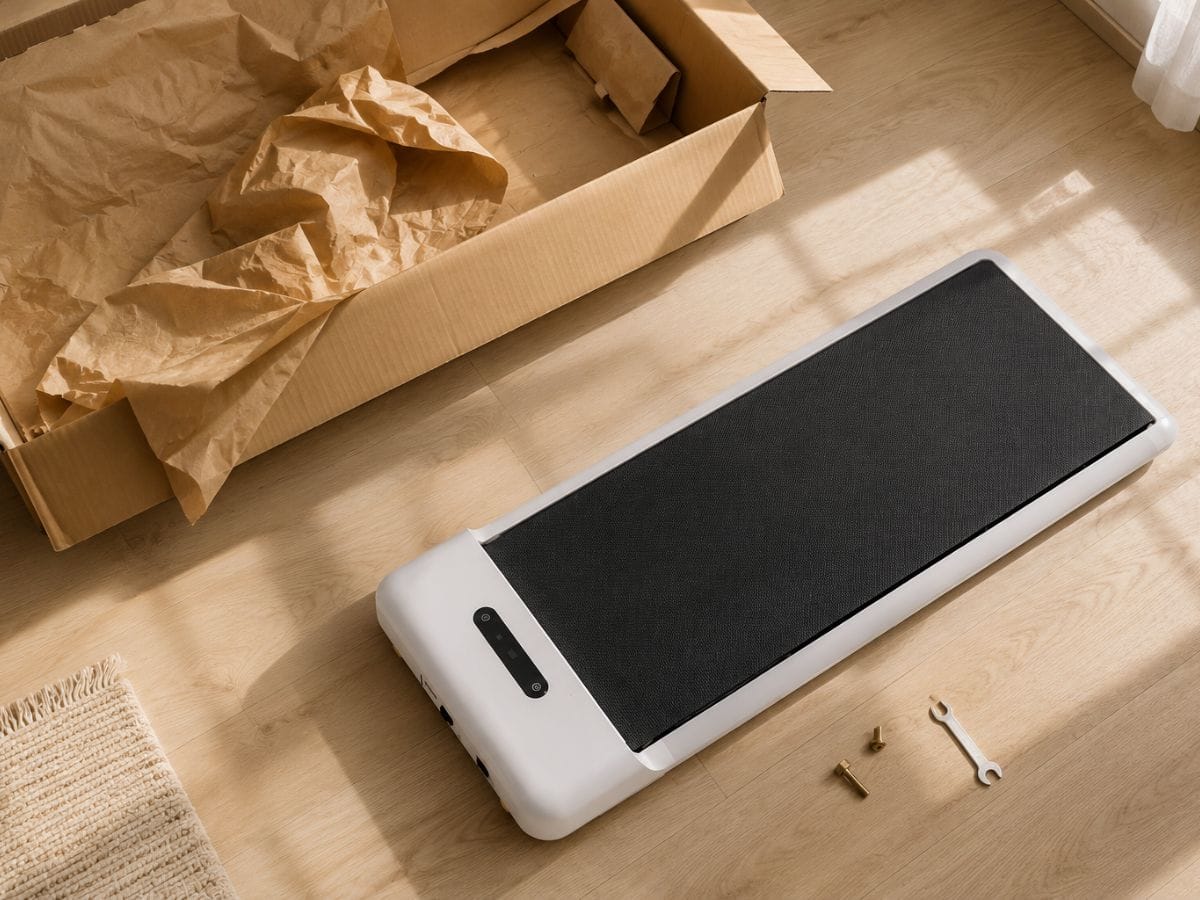
Moving it solo was the first honest moment. At 28.7 lbs, the C2 is manageable but not light. There's a built-in handle at the front, and once you figure out the angle — tip it up, drag it on the rear wheels — it actually moves fine. But if you imagined effortlessly gliding it across your apartment like a yoga mat, adjust that expectation now. It requires intention.
My first walk was at 2.0 mph while answering emails, and two things surprised me: how smooth the belt felt underfoot (no harsh texture, no vibration through the soles) and how immediately I noticed the quiet. I genuinely expected it to be louder. The motor hum reminded me of a white noise machine more than a treadmill. What matched expectations exactly was the size — I'd measured my space twice and it fit where I planned, with room to spare.
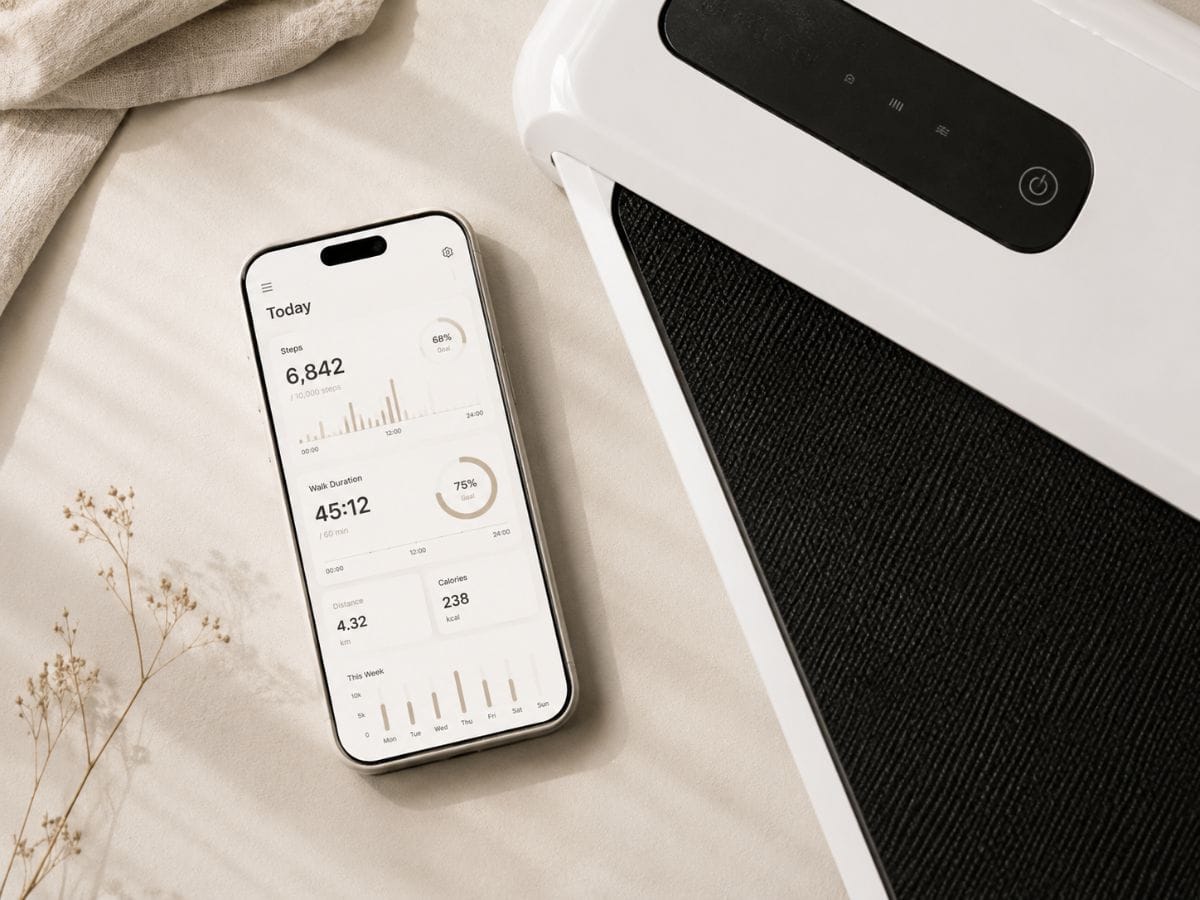
The KS Fit app connected on the second try. First pairing failed silently. Closed the app, reopened, paired again — done. Not a dealbreaker, but worth knowing.
The Apartment Tests
a. The Noise Test
I walked at 2.5 mph while my partner was on a video call about ten feet away, door open. He didn't mute himself once. That's my real benchmark — not a decibel reading from a spec sheet, but whether the person sharing my 650 square feet notices. He noticed the first time I used it, said it sounded like a faint hum. By week two, he'd stopped mentioning it entirely.
For context: it's quieter than my dishwasher on eco mode. It's roughly the same volume as my building's HVAC running. At 3.5 mph — near max speed — the noise does bump up noticeably, mostly from foot strike rather than motor. At walking pace, it's genuinely apartment-friendly. The caveat is thin floors. I don't know what my downstairs neighbor hears. I haven't gotten a complaint in three months, but I also try to stay under 3.0 mph and I always use the mat. If noise is your primary concern across all your cardio options, the full roundup of quiet treadmills for apartments is worth a read before you decide.
b. The Floor Test
My apartment has original hardwood floors — the kind my landlord would absolutely notice if they were scratched. Before the C2 arrived, I ordered a 3mm rubber gym mat and put it down on day one. After 90 days, I pulled the mat back and inspected. Zero marks. No indentations, no scuffs, no discoloration. The mat itself had minor compression marks from the C2's feet, but that's the mat doing its job.
If you skip the mat on hardwood, I genuinely don't know what happens long-term. The C2's feet are rubber, not bare plastic, so it's not like dragging metal across wood. But I wouldn't test it. A basic yoga mat works in a pinch; a proper rubber gym mat is better. Budget an extra $20–30 and don't think about it again.
c. The Storage Test
Before I ordered, I measured the clearance under my bed: 6.5 inches at the lowest point (there's a slight frame overhang on one side). The C2 folds to 5.1 inches. That's a 1.4-inch gap — not a lot, but enough.
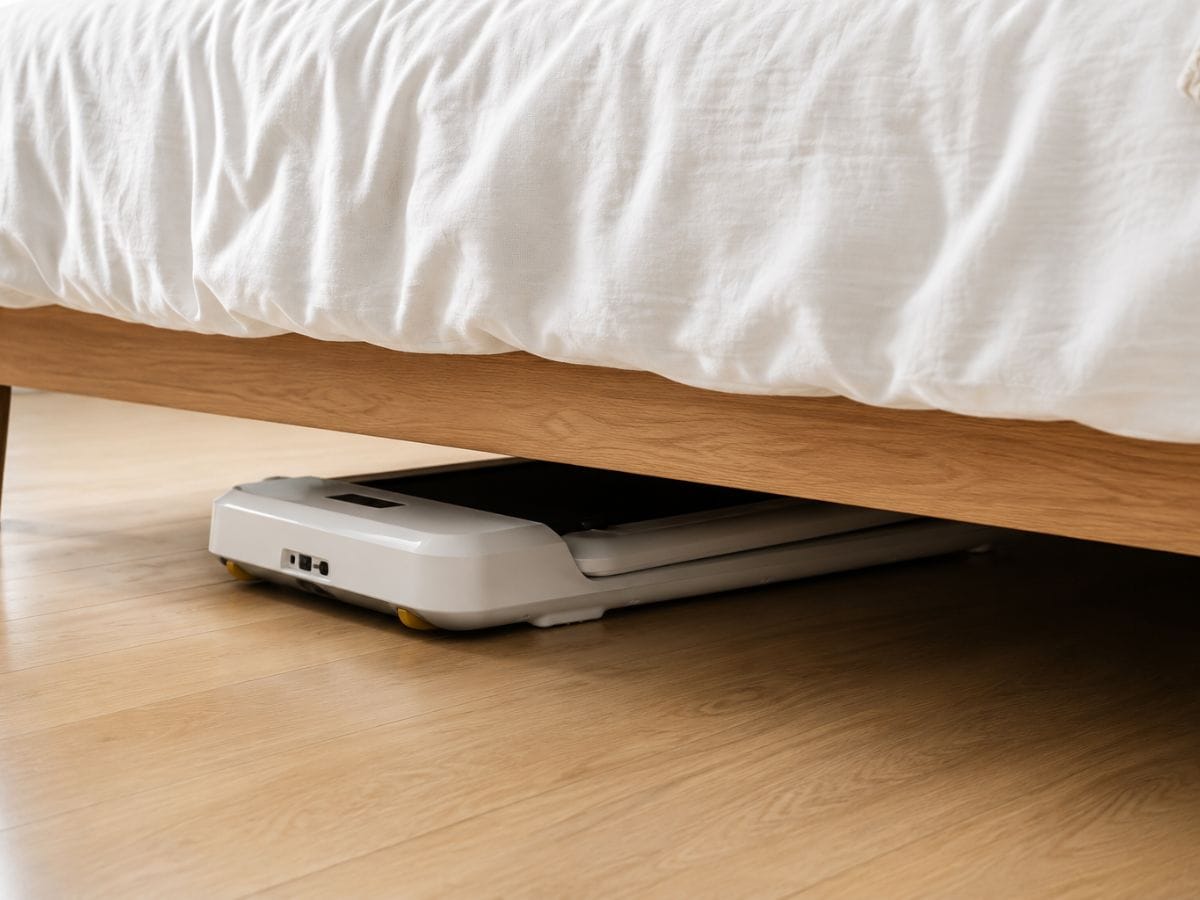
In practice, sliding it under and out works best on the longer axis, so you need about 53 inches of clearance lengthwise too. My bed is against a wall, which means I can only slide it in from one end. It fits, but it's not effortless — I have to lift the front slightly to clear the frame, then push. It takes about 20 seconds. I do it every single evening, so the minor friction is real. If you have a platform bed with less than 5.5 inches of clearance, this won't work for you. Measure twice. For more on making fitness gear disappear in a small apartment, the under-bed storage ideas that actually work post covers it well.
d. The Daily Use Test
I used the C2 five to six times a week across twelve weeks — mostly 30–45 minute sessions between calls, occasionally a longer 60-minute evening walk. Here's what held up: everything structural. The belt hasn't stretched or shifted. The motor sounds identical to day one. The handle bar is still tight. The foot sensors (which auto-start the belt when you step on in auto mode) still work accurately.
What degraded slightly: the app. KS Fit occasionally fails to sync step data — I'd finish a 40-minute walk and the session would show as 12 minutes. It's happened maybe six times over three months. Not constant, but annoying enough that I now use a separate step counter and treat the app as a nice-to-have rather than a fitness record. Also: I stopped skipping morning movement entirely once the C2 was in my space. That's not a small thing. The zero-friction setup (fold down, step on, go) removed the mental barrier that used to make me skip "just this once."
What I Liked
The noise level is genuinely impressive. I've tested walking pads where I had to time my sessions around my neighbor's schedule. With the C2 at conversational walking speeds, I've used it during quiet Sunday mornings, during calls, and at 6:30 AM without anxiety. The brushless motor design is doing real work here — it doesn't have the mechanical clatter of older belt-driven machines. This alone justified the price for me as an apartment renter.
The fold-flat form factor is actually flat. At 5.1 inches folded, the C2 slides under my bed rather than leaning against a wall or eating closet space. I've had two other compact fitness machines that claimed to store "out of the way" and then lived as visual clutter for six months. The C2 disappears every evening. That changes your relationship with a piece of equipment — you use it more when you're not stepping around it all day.
The belt feel is comfortable for long sessions. I've done multiple 60-minute walks on the C2, and I never felt like the belt was fighting my stride. Some budget walking pads have a spongy or uneven surface that creates fatigue in the arches. The C2's belt has a slight give that feels close to walking on a track surface, not a sidewalk. My feet don't ache after an hour at 2.5 mph. That's not guaranteed on every machine at this price point — the renter-tested walking pad comparison breaks down how it stacks up against the field.
What Annoyed Me
The KS Fit app is unreliable for tracking. I want to be clear about this: the treadmill itself functions perfectly whether the app is open or not. But if you're buying the C2 partly because you want to log your walks, know that the app will occasionally drop sessions, fail to sync, or simply show wrong numbers. I've tried reinstalling, re-pairing, keeping my phone screen on — the issue comes and goes without explanation. WalkingPad's app has a reputation for this across reviews, and three months in I can confirm it. It's not a dealbreaker if you use a fitness tracker or phone step counter as your primary log. It is a dealbreaker if the in-app data is the only fitness logging you planned to do.
The max speed of 3.7 mph is a real ceiling, not a marketing caveat. I knew this before I bought it and I still found myself frustrated by it around week six. There were mornings I wanted to push to a light jog — 4.0, 4.5 mph — and couldn't. The C2 tops out where jogging starts. Over three months I made peace with it, but if you're someone who naturally craves progression in your cardio, the hard cap will bother you. The side-by-side breakdown of walking pads vs. foldable treadmills might help you decide whether walking-only works for your goals before you commit.
The weight distribution makes solo transport awkward. 28.7 lbs sounds manageable — and it is — but the weight is front-heavy. When you tip it up to roll it on the rear wheels, the nose wants to pull down. Getting it into position under the bed requires a slightly awkward crouch-and-push maneuver that I've done over 200 times now and still haven't made graceful. A second set of wheels at the front or a more balanced weight distribution would fix this completely. It's the kind of thing that should have been caught in product testing.
Who Should Buy the WalkingPad C2
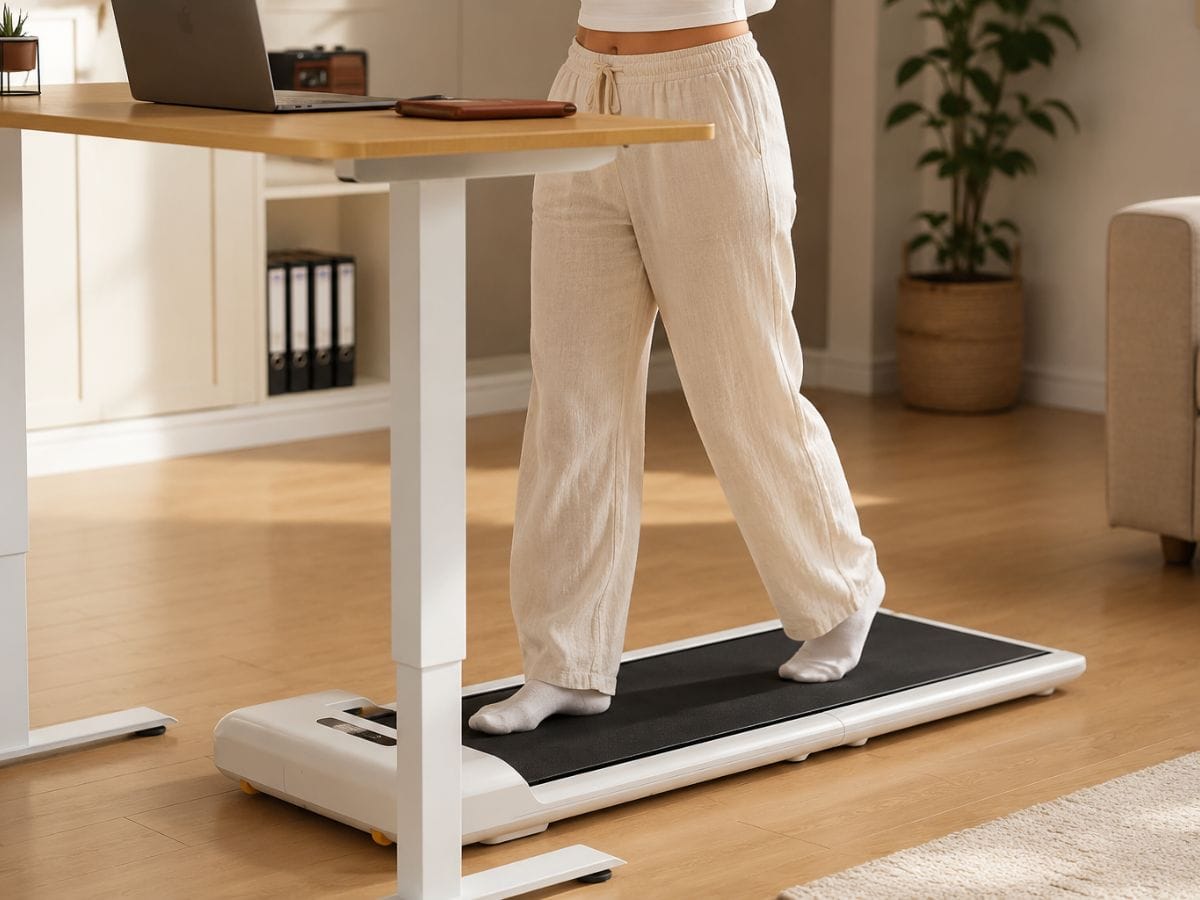
The WFH walker. If you have a standing desk or even just a laptop on a counter and you want to accumulate steps during the workday without leaving your apartment, the C2 is nearly purpose-built for you. The noise level is low enough for calls, the auto-mode speed control is smooth enough that you can type without your wrists bouncing, and the fold-down setup takes seconds. This is the use case where the C2 performs best, and it's the use case I rely on it for most. If you're still building out the full setup, the standing desk and walking pad combo guide is the place to start.
The step-goal chaser. If your goal is hitting 8,000–10,000 steps a day and you're tired of pacing your hallway or blocking time for outdoor walks, the C2 turns passive time — a podcast, a show, a phone call — into active time. The belt is comfortable enough for long, slow sessions. You don't have to think about it. You just step on and walk.
The renter who ruled out every other treadmill. Maybe you looked at folding treadmills and gave up because they're still 70 lbs and 60 inches upright when stored. Maybe you looked at other walking pads and hesitated on quality. If the C2's spec sheet matches your apartment — under-bed clearance above 5.5 inches, space for a 4×5 foot footprint during use — this is one of the most thoughtfully designed options at this price. It's why it landed on the best walking pads for apartment living list.
Who Should Skip It
- Anyone who wants to run. The C2 caps at 3.7 mph. That's a brisk walk, not a jog. If jogging is part of your fitness plan now or something you want to build toward, look at a different category entirely — the C2 will frustrate you within weeks.
- Users close to or above 220 lbs who plan intense daily use. The weight limit is 220 lbs. If you're near that threshold and plan high-frequency, high-intensity sessions, the longevity of the belt and motor becomes a real question over a 1–2 year horizon. The warranty only covers 12 months.
- Anyone who needs incline training. The C2 is flat. No incline, no simulation, no workaround. If incline walking is part of your cardio strategy — for calorie burn, glute activation, or injury rehab — this machine literally cannot help you with that goal.
Frequently Asked Questions
Is the WalkingPad C2 quiet enough for apartments?
At walking speeds (1.5–3.0 mph), yes — genuinely. I measured it subjectively as quieter than my dishwasher on eco mode, and my partner has taken calls ten feet away without issue. Foot strike adds some noise above 3.0 mph, but at the speeds most apartment walkers actually use, the C2 is one of the quietest options in this category. If you have extremely thin floors or noise-sensitive downstairs neighbors, use a rubber mat and stay under 3.0 mph.
Does the WalkingPad C2 fit under a bed?
The C2 folds to 5.1 inches in height. You need at least 5.5 inches of clearance to slide it in and out comfortably — 6 inches or more is better. Measure the lowest point under your bed frame before ordering, not the average clearance. You also need about 53 inches of lengthwise space to fully slide it in. Platform beds and storage beds with low-profile bases may not work. Standard bed frames with legs typically do.
Can you run on the WalkingPad C2?
No. The maximum speed is 3.7 mph, which is a fast walk. Running typically starts at 5.0 mph or above. If jogging or running is part of your fitness goals — even occasionally — the C2 is the wrong machine. It's designed specifically for walking, and the frame, belt, and motor reflect that. For a full breakdown of options that do allow jogging, the walking pad vs. foldable treadmill comparison lays it out clearly.
Is the WalkingPad C2 worth $399?
For renters who genuinely need a quiet, fold-flat walking solution — yes. The build quality is solid, the noise level is legitimately apartment-friendly, and the form factor solves the storage problem that kills most compact fitness equipment. The caveats: the app is unreliable for tracking, and the 3.7 mph ceiling is real. If those two limitations don't conflict with how you'd actually use it, $399 is fair for what you get. If app-based metrics are important to you, factor in the frustration cost.
WalkingPad C2 vs A1 Pro — which should I buy?
The A1 Pro is the older model; the C2 is the current-generation upgrade. The C2 has a brushless motor (quieter and more durable), better belt cushioning, and a slightly higher speed ceiling. The A1 Pro is often available at a lower price point when on sale, which is its main argument. For most buyers choosing between the two today, the C2 is the cleaner buy unless the A1 Pro is meaningfully cheaper. See the full WalkingPad A1 Pro vs C2 head-to-head for a spec-by-spec breakdown.
Final Verdict
Three months in, the WalkingPad C2 is still part of my daily routine — which is the only review metric I actually trust. It does exactly what it promises: quiet, compact, walk-only movement that disappears under my bed every night. The app situation is genuinely frustrating and the weight balance is clunky. But the machine itself has never skipped, never squealed, and never given me a reason to leave it folded. If you're a renter who needs a walking solution that doesn't pick fights with your neighbors, your floors, or your floor plan — this is the one.
See it on WalkingPad.com →
I test every piece of gear in my actual apartment — noise, footprint, deposit-safety, and real-world durability. No sponsored samples, no showroom conditions. If I wouldn't buy it for my own 650 sq ft studio, I don't recommend it.
Build Your Dream Home Gym—Without Wasting Space or Money
Join the MiniHomeGym Newsletter for expert reviews, space-saving fitness tips, apartment-friendly workout ideas, practical buying guides, and exclusive deals to help you choose the best compact fitness equipment with confidence.