Is a Walking Pad Worth It for Working From Home? My 6-Month Honest Answer

Is a walking pad worth it for WFH?
Yes — if you work from home and sit most of the day, a walking pad is worth it. It adds 5,000–8,000 passive steps during work hours, costs $399–$499, and pays for itself in roughly 18 months vs a gym membership. The WalkingPad C2 is the best option for apartment-based remote workers.
Who This Answer Is For
This is for you if you work from home, sit for six to nine hours a day, and live in an apartment or small home without a dedicated workout room. If that's you, it's worth skimming our full guide to under-desk walking pads once you're done here. You've read the reviews. You've watched the videos. You've had the tab open for two months and still haven't clicked buy. That hesitation is the whole reason I'm writing this.
This isn't for you if you're training for a race, already have a home gym with real cardio equipment, or naturally hit 10,000 steps without trying. A walking pad solves a very specific problem — the sitting problem — and if you don't have that problem, skip it.
The Honest Case for Yes
The Step Problem Is Real
Before I owned a walking pad, I tracked a normal WFH day out of curiosity. I checked my phone at 6pm and had walked 1,400 steps. That's it. Meetings, emails, deep work, lunch made three feet from my desk — none of it moved my body. I wasn't lazy. I was just optimized, by my own convenience, out of movement entirely.
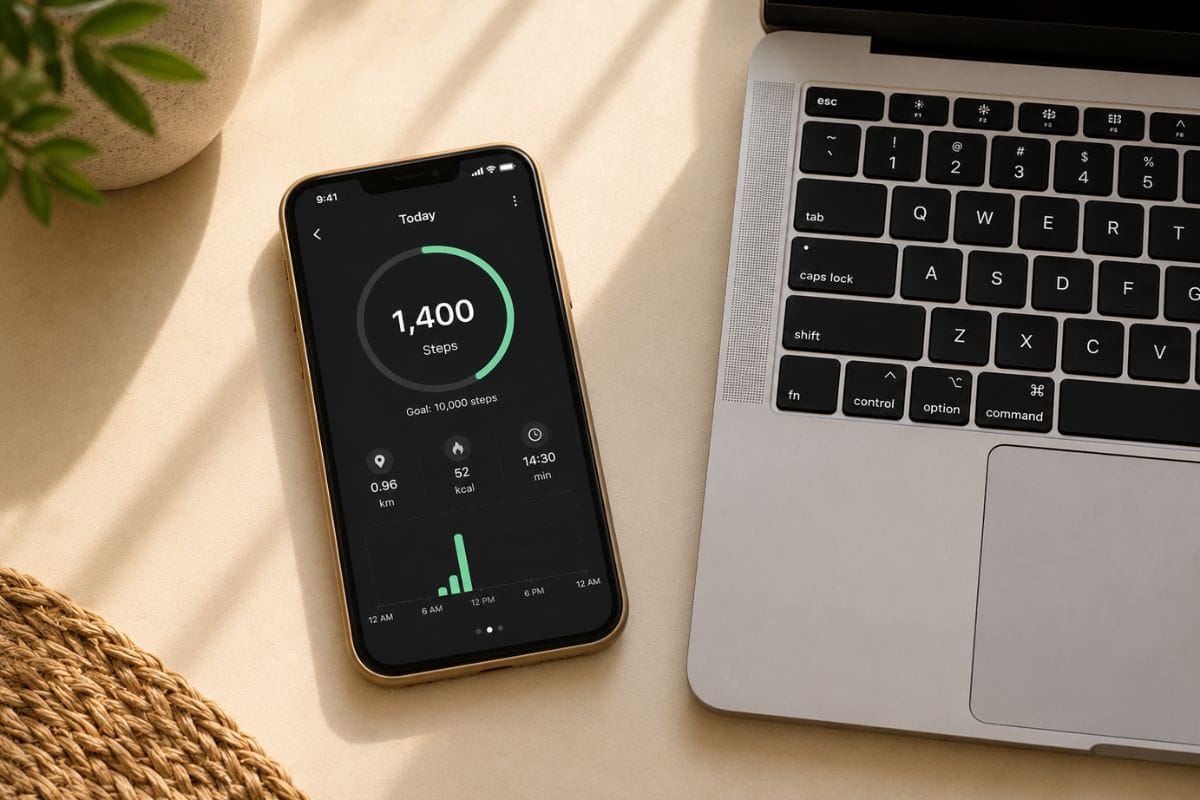
This is the part people underestimate about remote work. When you commuted to an office, you got a baseline of movement for free — the walk to the train, the walk from the parking lot, the walk to a colleague's desk instead of a Slack message. WFH deletes all of that without you noticing, because every one of those "wasted" walks was quietly doing something for your body. You don't lose the steps on purpose. You lose them by being efficient. If you're curious what fixing this actually looks like day to day, here's how I hit 10,000 steps without leaving my apartment. If you work from home, 1,400–2,000 steps a day is probably closer to your reality than the 7,000–10,000 you assume you're getting, and no amount of willpower fixes it, because the problem isn't motivation — it's that your day genuinely doesn't require you to walk anywhere.
The Math Works
The WalkingPad C2 runs $399. A comparable gym membership costs $40–60 a month, which puts the break-even point around 8 to 10 months. But that comparison actually undersells the walking pad, because it isn't just cheaper over time — it removes the commute. There's no drive to the gym, no parking, no fifteen minutes lost getting there and back. The "cost" of a gym membership was never just the monthly fee; it was the friction, and friction is the actual reason most gym memberships go unused after February.
Think about what a gym membership really requires: changing clothes, driving there, finding parking, waiting for equipment, driving home, showering again. That's realistically 60–90 minutes of overhead for a 30-minute workout. A walking pad requires none of that overhead, because it sits three feet from where you already are, during hours you're already awake and already working. You're not adding a new block of time to your day — you're filling dead time that used to just be your chair.
The Habit Is Easier Than Any Other Form of Exercise
There's no class to book, no schedule to protect, no gym bag to pack. It works during your existing work hours, not instead of them — you're not trading time, you're reclaiming dead time you were already sitting through. And it quietly removes the lie most WFH people tell themselves: "I'll exercise after work." You won't, most days. By 6pm you're tired, dinner needs making, and the version of you that had energy for a workout existed at 10am, not now. I know because I told myself that lie for years before I owned this thing. If you want to see exactly how I built this into my desk setup, here's my exact walking pad home office setup.
The reason most exercise habits fail isn't laziness — it's that they compete with your day instead of fitting inside it. A gym session, a run, a class: all of them ask you to carve out a separate block of time and energy on top of everything else you're already doing. A walking pad doesn't compete with your day. It happens during a call you were sitting through anyway, during the hour you're reading emails, during the stretch of writing where you'd normally be still. If you're also considering a standing desk, pairing a standing desk with a walking pad is worth building at the same time. The habit doesn't require discipline in the way most exercise does, because there's nothing to talk yourself into — you just turn it on before your first meeting and it runs in the background of your actual job.
The Honest Case for No (Or Not Yet)
I'd be lying if I said this was right for everyone, so here's the real list of reasons to hold off. If you need to run, this isn't your equipment — walking pads max out around 3.7 mph, which is a brisk walk at best, not a jog; if speed is the priority, our walking pad vs treadmill comparison breaks down which one actually fits your goals. If you live in a house with a yard, outdoor walking is free, and a machine solves a problem you don't have. If you're already disciplined about taking a daily walk — actually doing it, not just meaning to — the gap this fills may not exist for you at all. And if money is tight right now, there are better $400 decisions to make than solving a fitness problem that isn't currently costing you anything. A walking pad is a good answer to a specific problem. It's not a good answer to "I should probably exercise more" in the abstract.
What 6 Months of Daily Use Actually Looks Like
Month one was pure novelty — I used it twice a day, morning and afternoon, mostly because it was new and I wanted to justify the purchase to myself. By months two and three, that settled into a rhythm: one longer walking session, usually mid-morning, and one lighter session layered under work in the afternoon. By months four and five, it stopped being a decision entirely. I didn't think about turning it on any more than I think about turning on my monitor.
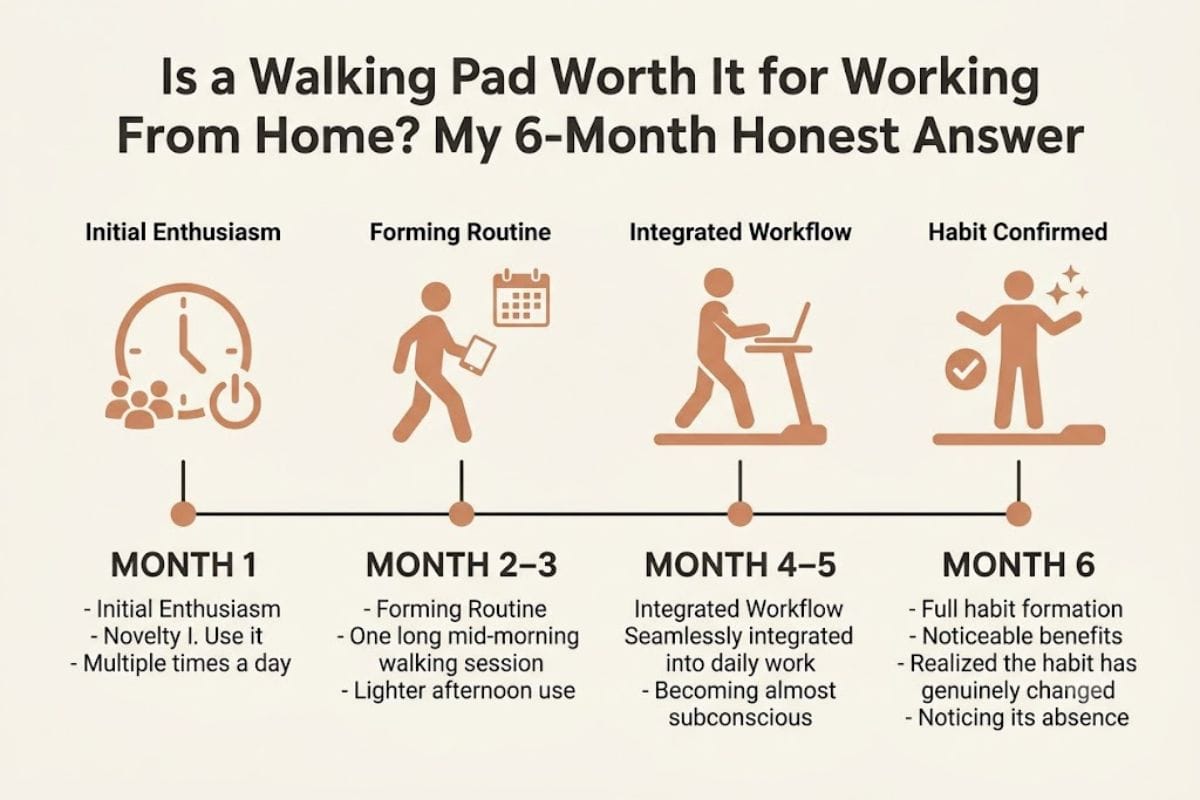
Month six is when it became obvious the habit had actually changed something, because I noticed its absence. On the two days it was folded away for a deep clean, I felt sluggish by 3pm and my lower back was tighter than usual by evening — the exact thing I'd bought it to fix in the first place. That was the moment it stopped feeling like a purchase and started feeling like a fixture, the same way you'd notice if your desk chair disappeared.
Mechanically, it's held up with no issues. The belt still runs smooth with no slipping or noise change, and the remote's battery has needed exactly one replacement in six months. Nothing has needed repair or replacing. The one thing I'd genuinely do differently is buy the desk mat at the same time as the pad, not three weeks later — I underestimated how much of a difference standing on a proper mat makes on your knees and lower back during longer sessions, and I spent those first three weeks more sore than I needed to be.
Would I buy it again? Yes, without hesitating. It's one of the only purchases in the last few years that's still in daily use six months later instead of quietly gathering dust in a corner.
The ROI Breakdown (For the Data-Brained Reader)
- Cost: $399 (WalkingPad C2)
- Daily steps added: ~6,000
- Minimum lifespan: 18 months
- Total steps generated: ~3,240,000
- Cost per 1,000 steps: ~$0.12
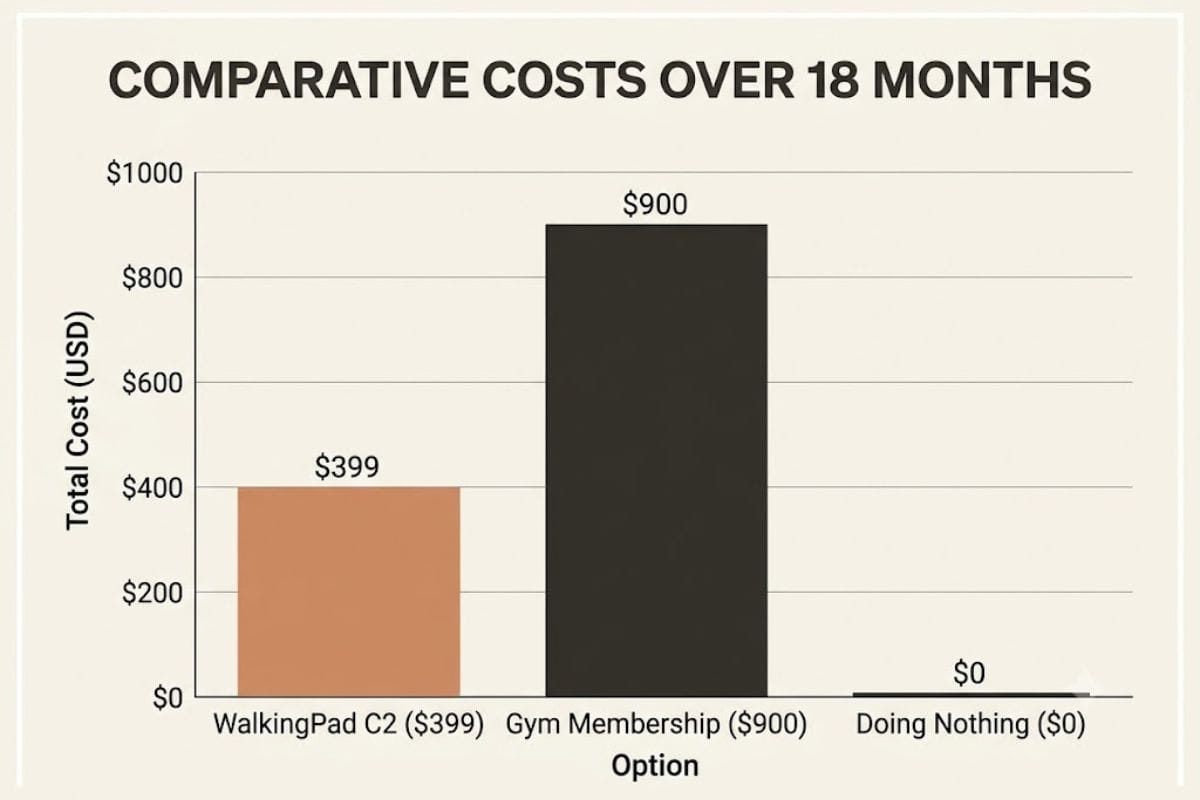
For comparison:
- Gym membership: $50/month = $900 over 18 months, and still requires a commute
- Personal trainer: $60–100 per session
- Doing nothing: $0 upfront, but ~1,500 WFH steps a day and the compounding cost of a sedentary routine
The walking pad isn't the cheapest option on day one. It's the cheapest option by month eighteen, and it's the only one that doesn't ask you to leave your apartment to use it. For the full breakdown of specs and long-term durability, the full WalkingPad C2 review covers everything I didn't fit here.
FAQ
Is a walking pad worth it for someone who works from home?
Yes, for most WFH workers. It directly solves the specific problem of a sedentary workday by adding thousands of steps during hours you're already sitting at a desk, without requiring extra time.
How many steps can you get on a walking pad while working?
Most people add 5,000–8,000 steps during a normal workday, depending on walking speed and how many hours they keep it running under the desk versus in dedicated sessions.
Is a walking pad better than a gym membership for WFH workers?
For consistency, yes. It removes the commute and scheduling friction that cause most gym memberships to go unused, and it typically pays for itself within 8–10 months.
What are the downsides of a walking pad?
Top speed tops out around 3.7 mph, so it's not built for running. It also requires floor space to store, and the value depends on you actually being sedentary enough to need it.
Which walking pad is best for a home office?
The WalkingPad C2 is the best fit for apartment-based remote workers due to its compact folded footprint and quiet motor. The A1 Pro is worth considering if you want a wider belt.
Final Verdict
Yes, with conditions. If you work from home, sit most of the day, and know your real step count is embarrassingly low, buy it now — this is exactly the problem it solves. If you already walk daily, run for cardio, or have a tight budget with no fitness gap to close, wait. You don't need it yet, and that's an honest answer, not a sales pitch.
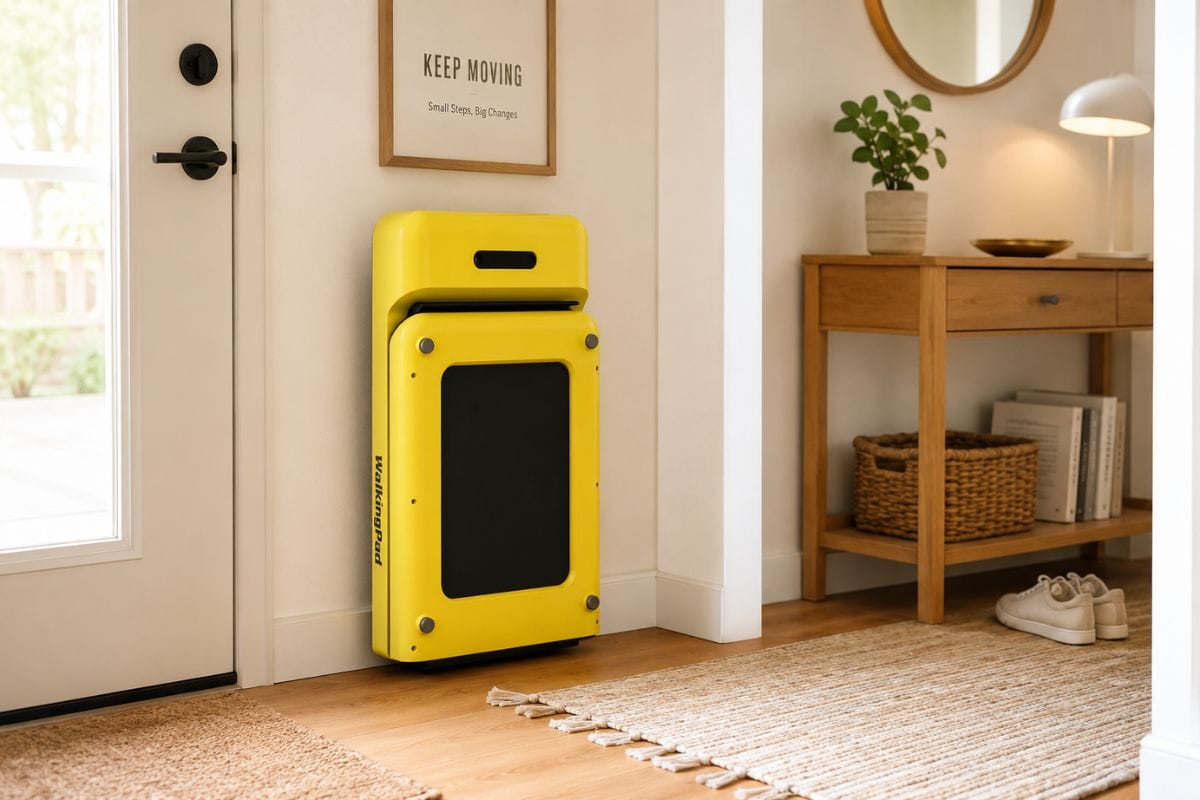
This is the one I use and recommend — WalkingPad C2 →
Want a wider belt? Check out the WalkingPad A1 Pro review for the upgrade option.
I test every piece of gear in my actual apartment — noise, footprint, deposit-safety, and real-world durability. No sponsored samples, no showroom conditions. If I wouldn't buy it for my own 650 sq ft studio, I don't recommend it.
Build Your Dream Home Gym—Without Wasting Space or Money
Join the MiniHomeGym Newsletter for expert reviews, space-saving fitness tips, apartment-friendly workout ideas, practical buying guides, and exclusive deals to help you choose the best compact fitness equipment with confidence.