Under Bed Storage Ideas
for Small Apartments & Home Gyms
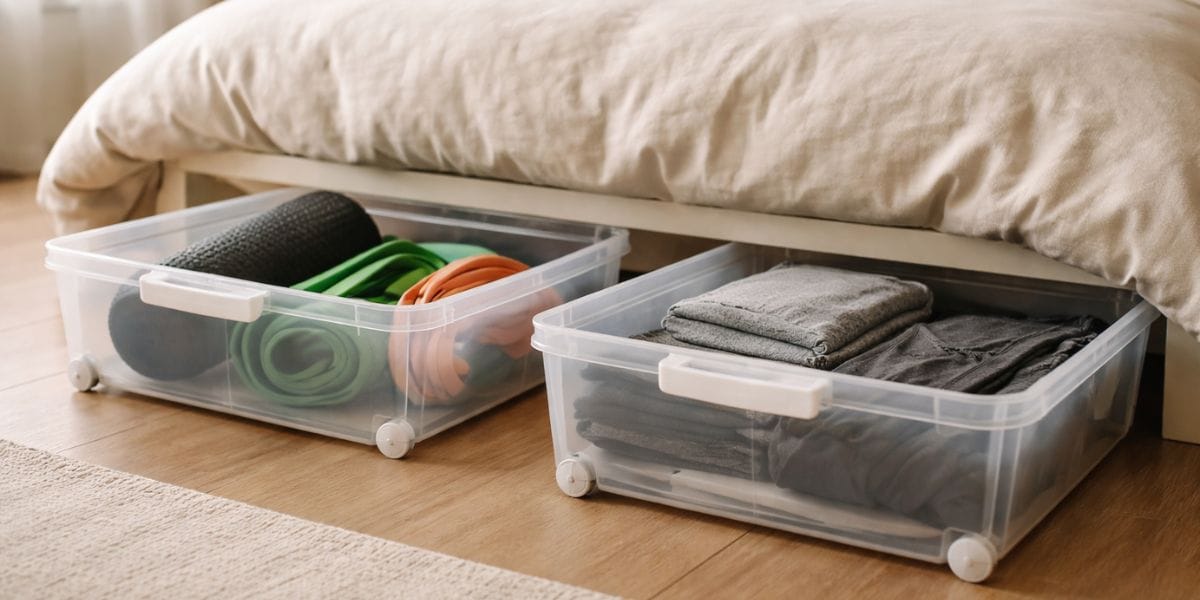
Rolling bins slide out in seconds — the most practical under bed storage format for apartment gym owners who need daily access to equipment.
The best under bed storage ideas don't just hide clutter — they give you back space you didn't know you had. In a studio apartment or a compact home gym, that's not a small thing. It's the whole game.
Most apartments have 28–42 sq ft of unused volume sitting beneath the bed right now. That's enough room to store an entire season's worth of clothes, your workout equipment, and your shoe collection — without touching a single wall or buying a single shelf. According to U.S. Census Bureau housing data, the median newly-built apartment in the United States is around 941 sq ft — meaning the under-bed zone alone represents 3–5% of total usable floor space in the average unit.
This guide covers everything: what under bed storage actually is, honest pros and cons, terms to know before you buy, the Access-Frequency Method for setting it up, a clearance calculator, five product picks, and a full FAQ. No filler. Just what works in real apartments.
Under bed storage ideas refer to bins, drawers, vacuum bags, and rolling organisers that use the clearance space beneath a bed frame for organised, accessible storage. The best systems for small apartments use rolling bins (6" clearance), zippered fabric organisers (5.5"), or vacuum bags (3") depending on your bed height and what you're storing. The right choice depends almost entirely on three variables: your bed clearance, how often you need to access the contents, and whether you're storing gym gear, clothing, or seasonal items.
What Is Under Bed Storage?
Under bed storage is any system designed to turn the empty gap beneath your bed frame into organised, functional space. That includes rolling bins, fabric organisers, bamboo drawers, vacuum compression bags, and purpose-built drawer inserts — each suited to different clearance heights and storage needs.
In modern apartments and small home gym setups, it's one of the most reliable storage strategies because it costs almost nothing to implement and produces immediate results: cleaner floors, a roomier-feeling space, and a dedicated home for gear that would otherwise pile up in corners.
The product category has matured significantly. Today's options range from ventilated rigid drawers to locking-wheel fabric bins, bamboo sliding systems, and vacuum bags — a far cry from the shoeboxes-under-the-bed approach most people grew up with.
Benefits of Under Bed Storage
The case is straightforward: it uses space that already exists in your apartment without adding a single square foot of visible bulk to the room.
- ◈ Reclaims 28–42 sq ft instantly. The dead air beneath a queen bed is one of the most underused surfaces in any apartment. No renovation, no landlord permission, no tools required.
- ◈ Zero visual footprint. Unlike shelves or dressers, under bed systems don't change how the room appears. If anything, a clear floor makes a room feel larger — a principle supported by research on clutter and perceived spaciousness.
- ◈ Apartment gym–ready. Resistance bands, foam rollers, jump ropes, and ab wheels fit perfectly in a single rolling bin. Equipment gets a dedicated zone instead of the floor corner.
- ◈ Renter-friendly by default. No tools, no wall damage, fully portable. Every piece moves out on lease-end day without any touch-up required.
- ◈ Low entry cost. Functional systems start at $18. A full modular setup for clothing and gym gear rarely exceeds $90 total for a queen bed.
Under bed storage is one of the top-ranked strategies for small home gym setups because it keeps equipment off the floor during the hours you're not working out — which matters when your gym is also your bedroom. See: How to Store Workout Equipment in a Small Apartment → and The Complete Apartment Gym Setup Guide →
The Real Pros & Cons
Here's the unfiltered breakdown — what works, what doesn't, and the conditions that determine whether this is the right solution for your specific setup.
- +Maximum space reclamation — no other storage method recovers usable volume without altering your floor plan.
- +Invisible to guests — stored items disappear completely, making the room feel larger and more considered.
- +Modular by nature — mix categories freely: one bin for gym gear, one for shoes, one for off-season clothes.
- +Renter-approved — nothing drilled, glued, or permanent. Fully reversible on move-out day.
- +Scales with budget — start with one $20 bin, build to a full modular system over time without a single sunk cost.
- –Clearance is non-negotiable — platform beds under 5" make most products unusable. Always measure first.
- –Bending to access — not practical for daily-use items if you have mobility limitations.
- –Dust and humidity risks — open bins collect dust; sealed plastic can trap moisture in humid climates. Product selection matters.
- –Weight limits apply — cheap casters crack under heavy loads. No rolling bin is rated for iron plates or loaded dumbbells over 15 lbs.
- –Requires a labelling system — without clear labels, unlabelled bins get overlooked. Discipline is part of the setup.
Myth vs. Reality: "It's only useful for clothes"
"Under bed storage is basically just a place to shove extra blankets and sweaters. It's not a real organisational solution for an active person."
Under bed space is one of the most versatile storage zones in an apartment. For small home gym setups, it's ideal for resistance bands, yoga blocks, foam rollers, jump ropes, and light weights — keeping equipment immediately accessible without occupying a single inch of floor space during rest hours.
Who This Is NOT For
Under bed storage isn't universal. Know when to skip it — or solve for the limitation before you buy.
- A platform bed owner with under 5" clearance — bed risers fix this for $18–$25 (see our guide to the best bed risers for apartments), but if you're not open to raising your frame, most products in this category won't fit.
- A heavy lifter storing plates or loaded barbells — under bed systems aren't load-rated for iron weight stacks. A dedicated weight storage rack is the safer option.
- Mobility-limited — rolling bins with pull handles help, but access still requires bending or crouching. A bed frame with built-in drawers (lift-top or pull-out) solves this ergonomically.
- Living in a high-humidity climate without ventilation — sealed plastic bins in tropical environments without desiccants can develop mould within weeks. Breathable fabric bins or ventilated rigid systems are the safer default.
Terms to Know Before You Buy
These six terms appear on every product listing. Understanding them before you click Add to Cart prevents returns.
Best Rolling Under Bed Storage Bins Do Vacuum Bags Actually Work? Bed Frames with Built-In Storage Best Bed Risers for Apartments
The Access-Frequency Method: Step-by-Step Setup
The Access-Frequency Method is a simple framework: every item you store under the bed gets assigned to one of three tiers based on how often you reach for it. Weekly-access items go into rolling bins at the foot of the bed. Monthly-access items go into fabric organisers or sliding drawers. Seasonal items go into vacuum bags toward the back. This single principle eliminates the "mystery bin" problem where nothing gets found and nothing gets used.
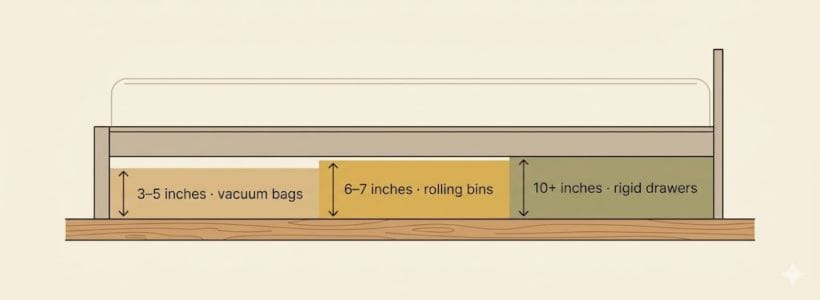
The three clearance zones. Measure at the head, foot, and centre of your bed — use the smallest number. Most apartments with standard frames fall in the 6–9" range.
-
01Measure your clearance — exactly
Tape measure from floor to lowest bed frame point at three positions: head, foot, and middle. Use the smallest number as your maximum bin height. Never estimate by eye — a 6" bin in a 5.75" space won't fit.
Target zones: 7–9" for rolling bins · 10–14" for rigid drawers · 3–5" for vacuum bags only -
02Raise the bed if needed
Under 6" clearance? Bed risers cost $15–$25 and open up the entire product category. They represent better value than a new frame at $150+. Check our full bed risers guide for weight-rated options.
-
03Sort items into three tiers by access frequency
Weekly-access items: gym gear, gym shoes, current-season clothing. Monthly-access: bedding extras, spare shoes, infrequently used equipment. Seasonal: winter coats, off-season workout clothes, spare bedding sets. Each tier maps to a different container type.
This is the core of the Access-Frequency Method — the tier determines the bin type, not the other way around. -
04Match container type to tier
Weekly access → rolling bins with handles (IRIS or SONGMICS). Monthly access → fabric bins or sliding bamboo drawers. Seasonal → vacuum bags or zippered fabric organisers. Never mix tiers in one bin — it defeats the system within weeks.
-
05Position by access frequency, not category
Weekly bins go toward the foot of the bed — the easiest reach point. For apartment gym setups, keep workout gear on the side facing open floor so you can pull without moving furniture. Seasonal bags go toward the head of the bed where clearance is tightest.
-
06Label before closing
Adhesive labels, luggage tags, or a phone photo inventory stored in your notes app. A colour-coded system (gold tag = gym, white = clothing, green = seasonal) makes retrieval instant and keeps the system running long-term.
Clearance Calculator: Find Your Best Option
Enter your measurements below to get a personalised product recommendation. Takes 30 seconds.
Product Comparison: All 5 Picks at a Glance
Use this table to match the right system to your clearance height and storage goal. Scroll right on mobile. Prices based on Amazon listings, April 2026 — check for current pricing.
| Product | Best For | Min. Clearance | Est. Price | Space Gain | Gym Ready |
|---|---|---|---|---|---|
| IRIS Rolling Bin (×2) Best Overall | Gym gear + everyday access | 6" | ~$32 | High | ✓ Yes |
| Simple Houseware Fabric Organiser | Clothes, bedding, off-season | 5.5" | ~$21 | High | Partial |
| SONGMICS Rolling Organiser Gym Pick | Heavy gym gear, 33 lb rated | 7" | ~$38 | High | ✓ Best |
| Space Saver Vacuum Bags (6-pk) | Seasonal clothing + bedding | 3" | ~$26 | Highest | ✗ No |
| StorageWorks Bamboo Drawer | Shoes, folded clothes, aesthetic | 8" | ~$65 | Medium | Partial |
Top 5 Under Bed Storage Picks for Apartments
Selected for real-apartment performance, value, and gym-gear compatibility. Every pick has been evaluated for small-space usability — not just how it looks in a product photo.
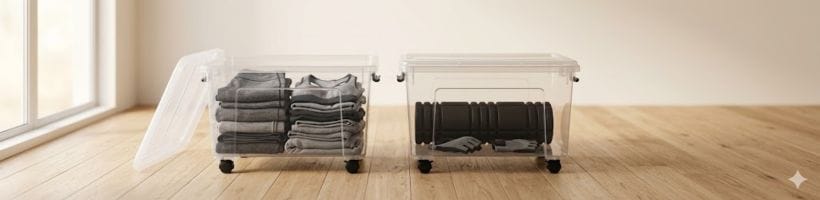
- 34.5"L × 17.75"W × 6"H per bin
- 6" clearance minimum
- 20 lb capacity per bin
- 4 smooth-rolling casters
- Clear polypropylene sides
- Flip-top lid with side latches
Why it earns the top spot: Clear sides let you see contents without opening — genuinely useful at 6am when you're pulling out a foam roller before a workout. Two bins side-by-side cover the width of a queen bed and together hold gym gear, shoes, and off-season basics without overlap.
vs fabric bins: IRIS handles moisture better and maintains shape under load. Trade-off: rigid plastic takes up the same volume empty as full — unlike fold-flat fabric alternatives that store away when not in use.
- 30"L × 18"W × 5.5"H
- 5.5" clearance minimum
- Full zipper top + side window
- Breathable Oxford fabric
- Reinforced dual carry handles
- Folds flat when empty
Why it works: Breathable Oxford fabric lets clothing and light workout gear air out rather than trapping odours. The side window means no guessing about contents. Folds flat when not in use — a genuine space advantage over rigid bins when the season changes.
vs IRIS rolling bins: Half the price, better airflow, fold-flat convenience. No wheels — manual sliding only. Best for clothing; use IRIS or SONGMICS for gym gear you reach for daily.
- 40"L × 20"W × 7"H
- 7" clearance minimum
- 33 lb weight capacity
- Locking casters (4 total)
- Hinged flip lid with latch
- Non-woven fabric + wire frame
Why it's the gym pick: The 33 lb load rating (per manufacturer spec) is the highest in this price bracket. Wide enough to hold light dumbbells, all resistance bands, a jump rope, a foam roller, and an ab wheel in one pull-out bin — the kind of complete kit that makes a morning workout actually accessible.
vs IRIS (#1): SONGMICS wins on load capacity and width but needs 7" vs IRIS's 6". If your clearance is 7"+, this is the gym gear bin. If 6–6.9", default to IRIS.
- 3 large + 3 jumbo bags
- 3" clearance (compressed)
- Double-seal zipper + one-way valve
- Hand pump included
- For: clothing, bedding, pillows only
- Not for: shoes, electronics, gym gear
Why it works for tight spaces: For platform beds with 3–5" clearance, vacuum bags are often the only option that fits. A queen-size comforter that fills half a shelf compresses to roughly the thickness of a yoga mat. Best for seasonal clothing, spare bedding, and off-season workout gear you access once a season.
vs fabric bins: Vacuum bags win on compression but require re-sealing every time you open them. Use bags for seasonal items (access once or twice a year). Use bins for everything else.
- 36"L × 16"W × 8"H per drawer
- 8" clearance minimum
- Natural bamboo frame + fabric
- Smooth bamboo slide rails
- Full zipper + window panel
- 25 lb capacity per drawer
Why it's worth the premium: The only pick in this list that looks deliberate rather than improvised. Bamboo rails slide silently and resist warping better than metal casters on hardwood. The rigid structure keeps folded clothes and shoes organised even when partially empty — no bin collapse on the sides.
vs IRIS rolling bins (#1): Twice the price but notably cleaner aesthetic. Best for folded clothes and a capsule wardrobe setup. Not the gym gear pick — SONGMICS handles that. This is for when the room's visual coherence matters as much as the storage function.
DIY & No-Buy Alternatives
If you're between paycheques, just moved in, or want to test the system before committing to purpose-built products, these low-cost or zero-cost options work surprisingly well — especially for short-term use or light loads.
-
Shoebox methodStandard cardboard shoeboxes on their sides with the open face forward make serviceable pull-out bins for low-clearance beds. Reinforce with packing tape, label the front, and they hold gym accessories or folded gym clothes without issue. Free. Works for 6–12 months before the cardboard softens.
-
Repurposed cratesWooden or plastic produce crates from hardware stores or secondhand shops ($3–$8 each) fit under most frames with 8"+ clearance. Rough interiors benefit from a fabric liner to protect clothing. No casters, but they slide on hardwood with minimal resistance.
-
IKEA SAMLA binsIKEA's SAMLA series (from ~$5) are transparent rigid plastic bins without casters — stackable, cheap, and available in sizes that fit most bed frames at 6"+. Not as accessible as rolling bins but dramatically better than opaque cardboard. Available in 5L, 11L, and 22L variants.
-
Large ziplock bagsFor ultra-low clearance (3–4") with no budget for vacuum bags, extra-large ziplock freezer bags ($6–$10 for a box) compress well enough for off-season workout clothes. Not airtight enough for long-term pest protection, but functional for seasonal rotation in a clean, dry apartment.
The DIY options above work best as a temporary or test solution. Once you've confirmed under bed storage fits your routine, an investment in rolling bins or fabric organisers pays back in durability and ease of access within the first month.
Seasonal Rotation Strategy
The under bed zone is most effective when you treat it as a living system rather than permanent storage. A twice-yearly rotation keeps the space from becoming a forgotten catch-all.
The Two-Swap System
Run one swap at the start of warm months (April–May) and one at the start of cold months (October–November). At each swap: pull every bin out fully, reassess what's in each one, vacuum the floor beneath the bed, replace any desiccant packs, and re-label if categories have shifted. The whole process takes about 20 minutes.
Warm-month configuration: Vacuum bags hold heavy winter workout gear (thermal layers, heavier resistance bands), a winter coat if closet space is limited, and spare bedding. Rolling bins hold current gym gear, summer shoes, and in-use clothing.
Cold-month configuration: Vacuum bags hold summer items — swimwear, lighter layers, off-season athletic gear. Rolling bins hold current cold-weather gear and whatever you're accessing weekly for workouts.
The swap also serves as a natural audit: anything that sits in both the warm and cold bin without ever being used is a candidate for donation. Under bed storage works best when it contains things you actually use — not things you're keeping out of inertia.
Pre-Purchase Checklist
Run through this before you buy anything. Two minutes here prevents a return trip.
- Measured bed clearance at head, foot, and centre of frame — used the smallest number.
- Decided on bed risers (or confirmed clearance is already 6"+).
- Sorted items into three tiers — weekly, monthly, and seasonal using the Access-Frequency Method.
- Matched container type to access tier — rolling bins for weekly, fabric or drawers for monthly, vacuum bags for seasonal.
- Checked weight capacity of chosen product — especially if storing light dumbbells or denser gym equipment.
- Made a humidity plan — desiccant packs ordered if using sealed plastic in a humid space.
- Labels ready — physical tags, adhesive labels, or a phone photo inventory planned before bins are closed.
- Decided on bin placement — most-used nearest foot of bed, least-used toward head. Gym bin on open-floor side.
Frequently Asked Questions
The minimum useful clearance is 5–5.5 inches for flat fabric bins and vacuum storage bags. Rolling bins typically require 6–7 inches, and rigid bamboo or wood drawer systems need at least 8–10 inches.
If your bed sits lower than 5 inches, bed risers ($15–$25) can add 3–8 inches of clearance and unlock the entire product category. Always measure at three points — head, foot, and centre — and use the smallest measurement as your ceiling.
For small apartment gym setups, the SONGMICS Rolling Organiser is the top pick. Its 33 lb weight capacity (per manufacturer spec) is among the highest in this price range, and it's wide enough to hold resistance bands, a foam roller, a jump rope, an ab wheel, and light dumbbells in one bin.
If your clearance is exactly 6" (not 7"), the IRIS Rolling Bin set is the best alternative — 20 lbs per bin, clear sides for visibility, and designed for the most common apartment bed heights.
It depends on the platform bed's clearance. Most standard platform beds sit 4–6 inches off the floor, which is borderline for most storage systems. Some low-profile models sit directly on the floor with zero clearance — those are incompatible with any under bed product.
The fix is bed risers. A set of 3-inch risers costs $15–$25 and brings most platform beds into the 7–9 inch range where rolling bins and fabric organisers function well. Some platform bed frames also include built-in drawers — worth prioritising if you're shopping for a new frame and storage is a key need.
Yes — for the right use case. Vacuum bags offer the highest compression available for soft items. A queen-size comforter that normally fills half a closet shelf compresses to under 3 inches flat. For anyone with low-clearance beds (3–5") or a large volume of seasonal clothing, they're unbeatable.
The trade-off: vacuum bags require re-sealing every time you open them, making them practical only for items accessed once per season. They are not suitable for gym shoes, electronics, or anything that needs airflow. For frequent-access items, rolling bins or fabric organisers remain the better solution.
For dust: choose containers with zippered or latched lids rather than open-top bins. Fabric bins with full-zipper closures are the most dust-resistant budget option. Rigid bins with snap lids (like IRIS) are also effective.
For moisture: avoid sealed plastic containers in humid climates without desiccant packs inside. Silica gel packs ($8–$12 for a bulk pack) absorb ambient humidity and protect clothing, leather, and gym shoes from mould or mildew. Replace or recharge (dry at low heat in the oven) every 2–3 months. Breathable Oxford fabric bins naturally allow airflow and are the better default for anything that needs ventilation — including gym gear and shoes.
Several free or near-free options work well as a starting point. Reinforced shoeboxes slid open-face first function as pull-out bins for gym accessories or folded clothes. Wooden produce crates ($3–$8 secondhand) fit under beds with 8"+ clearance and hold more weight. IKEA SAMLA transparent bins (~$5 each) are rigid, stackable, and available in sizes designed for under-bed use.
These DIY options work best as a short-term or test solution. Once you've confirmed under bed storage fits your routine, purpose-built rolling bins or fabric organisers pay back their cost quickly in durability and ease of access.
Get the Small Space Gym Setup Guide
Weekly finds for apartment gym owners — compact equipment, storage ideas, and space setups that actually work in 400–700 sq ft.
No spam. Unsubscribe anytime. Sent weekly.