Best Kettlebell for Home Gym: 2026 Buying Guide & Picks

This guide contains affiliate links. If you buy through them, we may earn a commission at no extra cost to you. Our picks are based on our own testing and research, not on which brands pay us — see our testing methodology below.
Quick Answer
The best kettlebell for most home gyms is the REP Fitness Powder Coat Kettlebell ($29–$204) — a flat rubber base that stores safely on any shelf, a consistent handle across every weight, and a range wide enough to grow with you. If floor space is your top constraint, the REP Fitness Adjustable Kettlebell replaces six fixed bells in the footprint of one. A single 8–16 kg bell, a 4'×6' rubber mat, and about 36 sq ft of floor space is enough for a complete kettlebell home gym.
Jump to: Top picks · Comparison table · What is a kettlebell · Benefits & limitations · Weight chart · Best for women · Kettlebell vs dumbbell · Setup guide · Beginner routine · Safety · FAQ
Best Kettlebells for a Home Gym in 2026
Quick answer
We evaluated each kettlebell below on handle diameter and finish, base stability, coating durability, price-per-kg, and how easily it stores in a small space. The REP Fitness Powder Coat Kettlebell is our top pick overall; the sections below break down every option by use case.
How we picked these
We spent time with each of these models across swings, presses, and get-ups, on both hardwood and rubber-matted flooring, and cross-checked handle diameter, base material, and current pricing against manufacturer specs. Full write-up in our testing methodology.
Pick #1 — Best overall · Editor's Pick
REP Fitness Powder Coat Kettlebell
The benchmark for home gym cast iron — flat rubber base, consistent 35mm handle, lifetime-grade build
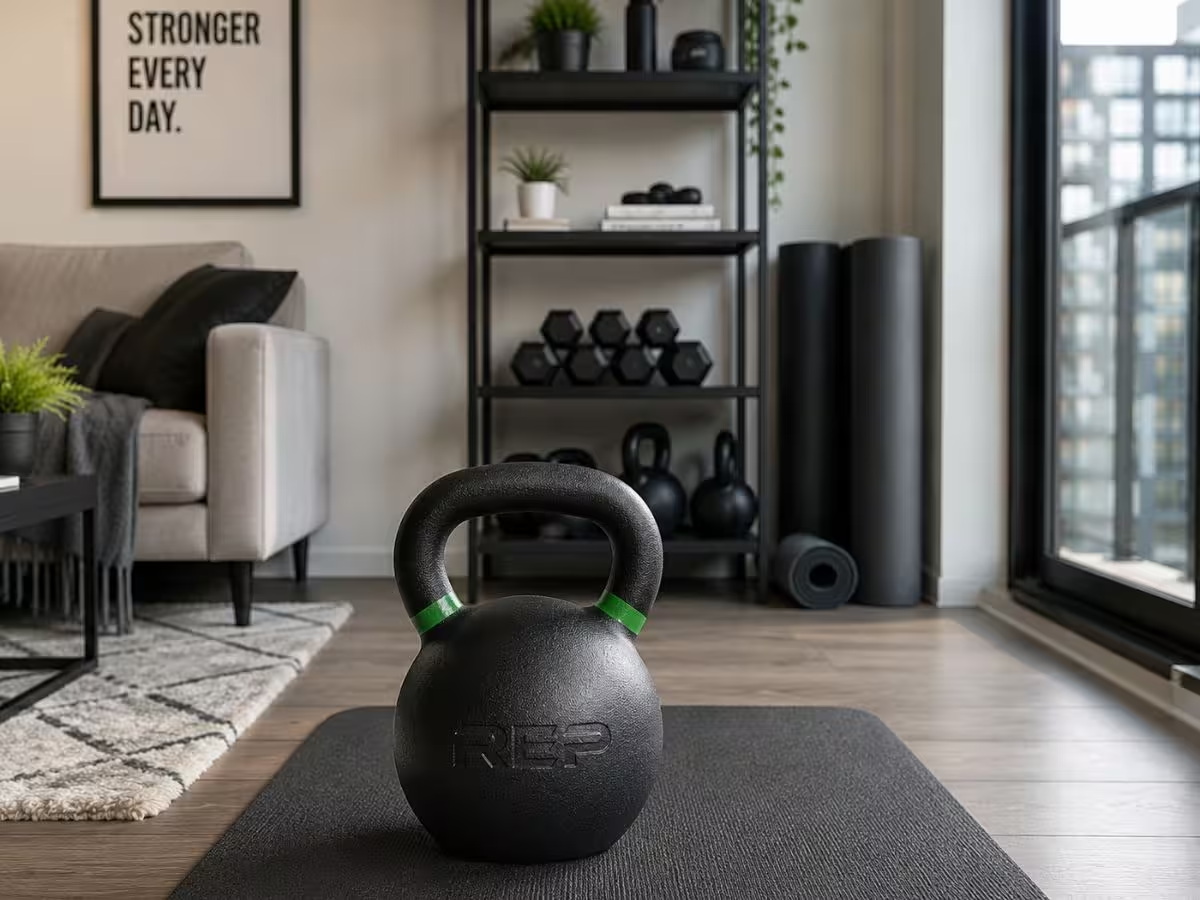
This is the bell we reach for first when testing swings for reps. The rubber base protects floors without an extra mat during storage, and the powder coat handle holds grip through a sweaty set without roughing up your palms. It's also the easiest of the five to justify buying twice — once you outgrow your starting weight, the next size up feels identical in hand.
Pros
- Rubber base — floor & shelf safe
- Consistent 35mm handle at every weight
- Wide range scales with you
- Excellent powder coat grip
Cons
- Size grows with weight, not competition-spec
- Heavier sizes (32 kg+) get pricey
Check today's Amazon price & Prime delivery eligibility
Pick #2 — Best adjustable
REP Fitness Adjustable Kettlebell
Six weights in one unit — the space-saving upgrade for serious home gym training
If you want the full write-up on adjustable models specifically, see our dedicated adjustable kettlebell guide. In short: this single unit replaces six fixed bells worth $300+ and six square feet of storage, and the dial-lock mechanism felt secure through every set we ran, though we wouldn't drop it from height.
Pros
- Replaces 6 bells — peak space efficiency
- Feels close to a traditional bell
- Beginner-to-advanced weight range
Cons
- Not rated for dropping (locking mechanism)
- Higher upfront cost than one fixed bell
Check live pricing on Amazon or REP Fitness
Pick #3 — Best budget
Amazon Basics Cast Iron Kettlebell
Straightforward, durable, and available next-day — the zero-friction way to start
For a first kettlebell you're not sure you'll stick with, this is the lowest-risk entry point. The painted finish means it's worth pairing with a little chalk (see our accessories guide) once your hands start sweating through longer sets, and we'd still recommend a mat underneath even though it lacks a rubber base of its own.
Pros
- Lowest entry price
- Prime next-day shipping
- Durable cast iron
Cons
- Painted surface — chalk recommended
- No rubber base (add a mat)
- Handle widens with heavier bells
16 kg (men) / 12 kg (women) — check Amazon pricing
Pick #4 — Best handle quality
Kettlebell Kings Powder Coat
Premium handle finish, lifetime warranty — when form and longevity matter most
The recessed powder coat handle is the most comfortable of everything we tested during high-rep swing work, and the lifetime warranty is a genuine differentiator. Stock has been inconsistent through 2026, so treat pick #1 as the reliable fallback if this one is sold out.
Pros
- Best handle for high-rep ballistics
- Lifetime warranty
- Used by coaches & competitive athletes
Cons
- Inconsistent stock in 2026
- 20–30% more expensive than REP
KettlebellKings stock is limited — Amazon backup available
Pick #5 — Best beginner adjustable
Bowflex SelectTech 840
Six bells, one dial — the fastest beginner upgrade from zero gym to full setup
The fastest weight change of anything in this guide, and the built-in JRNY programming is a genuine help for someone who doesn't yet know how to structure a session. Its 40 lb ceiling and plastic housing mean it's a starting point, not an end point, for most trainees.
Pros
- Fastest adjustment of any model tested
- JRNY app with built-in programming
- Excellent beginner weight range
Cons
- Plastic housing — cannot be dropped
- Max 40 lbs caps out advanced users
- Doesn't replicate traditional bell feel
Amazon or Bowflex deals often drop 15–20% in sales
What Is a Kettlebell?
Quick answer
A kettlebell is a cast-iron or steel weight shaped like a cannonball with a flat base and a looped handle. Unlike a dumbbell, its centre of mass sits beyond the hand, creating a swinging arc that recruits stabiliser muscles — one of the reasons it packs so much training value into so little floor space.
A brief history
Kettlebells — called girya in Russian — appeared in Russian trade markets in the 1700s, originally used to counterbalance goods on scales. Farmers and merchants who handled them daily noticed dramatic increases in strength and endurance.
By the 1900s, the Soviet military had standardised kettlebell training across its ranks, and the USSR held its first national kettlebell championship in 1948. The sport of girevoy — competitive kettlebell lifting — still exists today.
Western fitness culture adopted the kettlebell in the early 2000s, largely through the work of strength coach Pavel Tsatsouline. Today it's a cornerstone piece of equipment for anyone training in a compact space.
Benefits of Kettlebell Training
Quick answer
Kettlebells deliver cardiovascular conditioning, strength, and mobility in a single tool that stores in a closet, which is why they're one of the highest-value pieces of equipment per square foot you can buy.
Full-body conditioning with one tool
A single kettlebell replaces a rack of dumbbells for most functional training needs. The swing alone trains the entire posterior chain — glutes, hamstrings, and lower back — while simultaneously elevating your heart rate into the aerobic zone.
Metabolic efficiency
Research from the American Council on Exercise found that a kettlebell snatch workout burns roughly 20 calories per minute — comparable to running a 6-minute mile — from a single stationary tool.
Grip and stabiliser strength
The offset centre of mass forces your wrists, forearms, and shoulder stabilisers to work throughout every rep, producing functional strength that transfers to real-world tasks like carrying bags or lifting heavy objects.
Joint-friendly loading
Ballistic kettlebell movements are hinge-based, loading the hips and posterior chain without the spinal compression of heavy barbell squats — appropriate for most fitness levels, including people returning from lower-back issues.
Kettlebell Weight Chart: Pood, Kg & Lb
Quick answer
A "pood" is a traditional Russian unit equal to about 16.38 kg (36 lb). Most listings round it to 16 kg. Use the chart below to convert between pood, kilograms, and pounds when comparing bells across different retailers.
Different exercises also call for different weights on the same bell. As a rough guide once you've settled on a starting size: use your working weight for swings and deadlifts, drop one size for single-arm presses and get-ups, and drop two sizes when you're first learning the snatch.
Best Kettlebell for Women
Quick answer
Most women new to kettlebell training do well starting at 8 kg for grinds (press, get-up) and 12 kg for swings, since the hip-hinge swing recruits much larger muscle groups than an overhead press. The REP Fitness Powder Coat line covers this range in small, well-spaced increments, which makes it our top pick here too.
The most common mistake we see is choosing one bell that's "medium" for everything. Because swings use the hips and legs while presses and get-ups isolate a single arm and shoulder, a lot of women find it worth owning two bells sooner than the "one bell for a year" guidance below would suggest — an 8 kg for grinds and a 12–16 kg for swings covers nearly every standard program. If you're deciding between fixed and adjustable, the REP Adjustable Kettlebell (9–18 kg) spans both ranges in one unit.
Pros, Cons & Limitations
Quick answer
Kettlebells excel at ballistic, full-body training in a tiny footprint, but they're a poor substitute for barbell specificity or muscle-isolation work — and they're not the right tool for everyone. Here's an honest breakdown.
Advantages
- Stores in 1 sq ft of space
- One tool covers strength, cardio, and mobility
- Ballistic training without a barbell
- Cast iron lasts decades — one-time buy
- No spotter needed for home training
- Flat base stands still between sets
Limitations
- Progressing means buying another bell
- Swings take 2–4 weeks of practice
- Floor vibration — a concern in apartments
- Poor for muscle isolation (curls, chest flyes)
- 40 kg+ bells are bulky to store
- Form coaching often needed at the start
Myth vs. Reality
Myth
"You need multiple kettlebells to get a real workout. One bell isn't enough."
Reality
A single appropriately-weighted bell supports 6–12 months of structured training. Pavel Tsatsouline's entire Simple & Sinister program runs on one bell. Start with one and only add a second when you've genuinely outgrown it.
Who this is NOT for
- Competitive bodybuilders — isolation work for hypertrophy is better served by dumbbells and cables.
- Powerlifters — you can't replicate barbell specificity with a kettlebell.
- Apartment dwellers with strict noise rules — swings create impact through the floor. A rubber mat is mandatory, not optional.
- Anyone with an active wrist, shoulder, or lower-back injury — consult a physio before starting ballistic work.
- Anyone unwilling to learn technique first — results require correct movement patterns; a few hours of form work upfront is non-negotiable.
Essential Kettlebell Terms to Know
These definitions are written for anyone comparing kettlebells for the first time. Knowing these terms prevents expensive mistakes when shopping online.
Ballistic movement
Any exercise where the bell is accelerated explosively and briefly becomes "weightless" at the top — the swing, clean, and snatch. These define kettlebell training and separate it from dumbbell work.
Grind
A slow, controlled movement under constant tension — the Turkish get-up and press. Grinds build absolute strength and are a good starting point for beginners.
Pood
A Russian unit equal to ~16.38 kg (36 lb). You'll still see bells listed as "1 pood" (16 kg), "1.5 pood" (24 kg), and "2 pood" (32 kg) — see the full conversion chart above.
Competition bell (sport bell)
Standardised body dimensions regardless of weight — every bell from 8 kg to 48 kg is the same external size. Ideal for learning consistent technique.
Cast iron kettlebell
The classic form: heavier bells are physically larger than lighter ones. The most accessible, affordable, and beginner-appropriate type available.
Gravity-cast vs. sand-cast
Most affordable bells are gravity-cast in a reusable mold, which is fast and cheap but can leave a visible seam. Sand-cast (or "single-piece cast") bells use a one-time mold, producing a smoother, seamless surface — typically found on premium bells like Kettlebell Kings' line. The difference affects hand feel more than performance.
Weight accuracy / calibration
Reputable manufacturers calibrate bells to within about 1% of the stated weight; budget imports can be off by a pound or more. If precise loading matters to your training, look for a stated calibration tolerance in the product listing, or buy from a brand — like the picks above — with a track record of consistent weights.
Adjustable kettlebell
One shell with removable plates — typically 8–32 kg. Maximum space efficiency: one unit replaces 4–6 fixed bells.
E-coat / powder coat
Protective finish over cast iron. Powder coat provides the best grip texture for ballistic work; e-coat is smoother but more rust-resistant, which is better for humid storage environments.
Turkish get-up (TGU)
A full-body movement from lying to standing with a bell held overhead — and back down. It develops shoulder stability, hip mobility, and core strength simultaneously.
Kettlebell vs. Dumbbell vs. Adjustable for a Home Gym
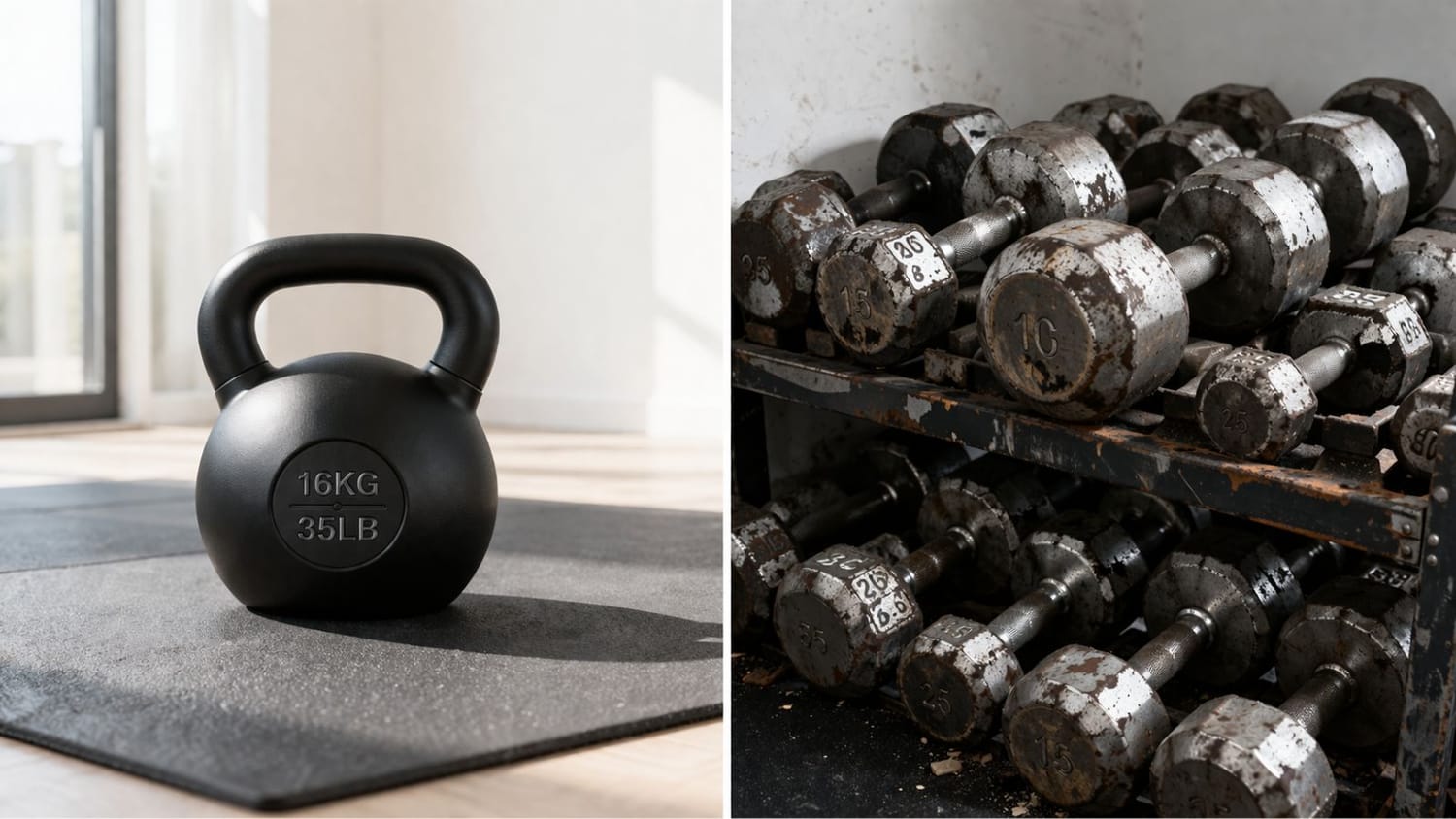
Every factor below is weighted for the realities of compact, apartment-based training. For a deeper look at dumbbells specifically, see our adjustable dumbbell guide.
How to Build Your Kettlebell Setup
Quick answer
A complete kettlebell home gym needs one appropriately-sized bell, a 4'×6' rubber mat, and about 36 sq ft of clear floor space. Total cost: $60–$200. Setup time: under 10 minutes.
Choose your starting weight
Men: 16 kg (35 lb). Women: 8–12 kg (18–26 lb) — see the weight chart above. Strength-training background? Go one increment heavier. Complete beginner? Go one lighter.
Lay your rubber mat first
A minimum 8mm rubber mat absorbs swing impact, protects floors, and defines your training zone. See the flooring section below for hardwood, concrete, and carpet-specific advice.
Clear a 6'×6' movement corridor
The swing projects the bell 4–5 feet forward. You need clear space in front, not to the sides. Moving a coffee table temporarily creates a complete training space in seconds.
Master three movements first
Deadlift, swing, goblet squat — in that order. Two weeks here prevents months of bad habits.
Plan your progression before you plateau
When 5 sets of 20 swings feel genuinely easy (typically 6–10 weeks), add the next bell weight. Budget $50–$100 for your second bell before you need it, not after.
Add accessories in priority order
Chalk, a storage rack, and a second bell — see the full breakdown below.
Storage & Accessories
A single bell doesn't need a rack, but once you own two or three, a compact kettlebell storage rack keeps them off the floor and out of the way — most small-footprint models hold 2–4 bells in under 2 sq ft. Beyond that, three accessories are worth owning:
Gym chalk (~$8) — improves grip on painted or budget bells during high-rep or sweaty sets.
Doorframe pull-up bar (~$25) — adds vertical pulling, the one movement pattern kettlebells cover least well.
A second, same-weight bell — unlocks double-bell presses, squats, and carries once single-bell work feels easy.
Flooring, Noise & Injury Prevention
Quick answer
Concrete slab floors handle kettlebell impact best; hardwood and floating floors need a thicker mat (12mm+); carpet over concrete is usually fine with a standard 8mm mat. Most kettlebell injuries come from poor swing hip-hinge form or rushing overhead work before technique is solid — not from the equipment itself.
Flooring by surface type
Ground-floor concrete slabs transmit the least vibration to neighbors and tolerate an 8mm mat comfortably. Hardwood and floating floors (common in upper-floor apartments) benefit from a thicker 12–15mm mat or a double layer, since the wood itself resonates. Carpet over concrete is generally fine as-is, though a firmer mat underneath still protects against dropped bells.
Common injuries and how to avoid them
Most kettlebell injuries fall into two categories: lower-back strain from squatting a swing instead of hinging at the hips, and shoulder irritation from moving to snatches or overhead presses before grip and shoulder stability are established. Both are addressed the same way — spend your first two to three weeks on deadlifts and swings exclusively, film your form from the side, and only progress to overhead ballistic work once your hip hinge is consistent. If you have an existing wrist, shoulder, or lower-back issue, get clearance from a physiotherapist before starting.
This is general information, not medical advice. If you're training around an existing injury or chronic pain, talk to a physiotherapist or doctor before starting a kettlebell program.
Your 30-Minute Beginner Kettlebell Workout
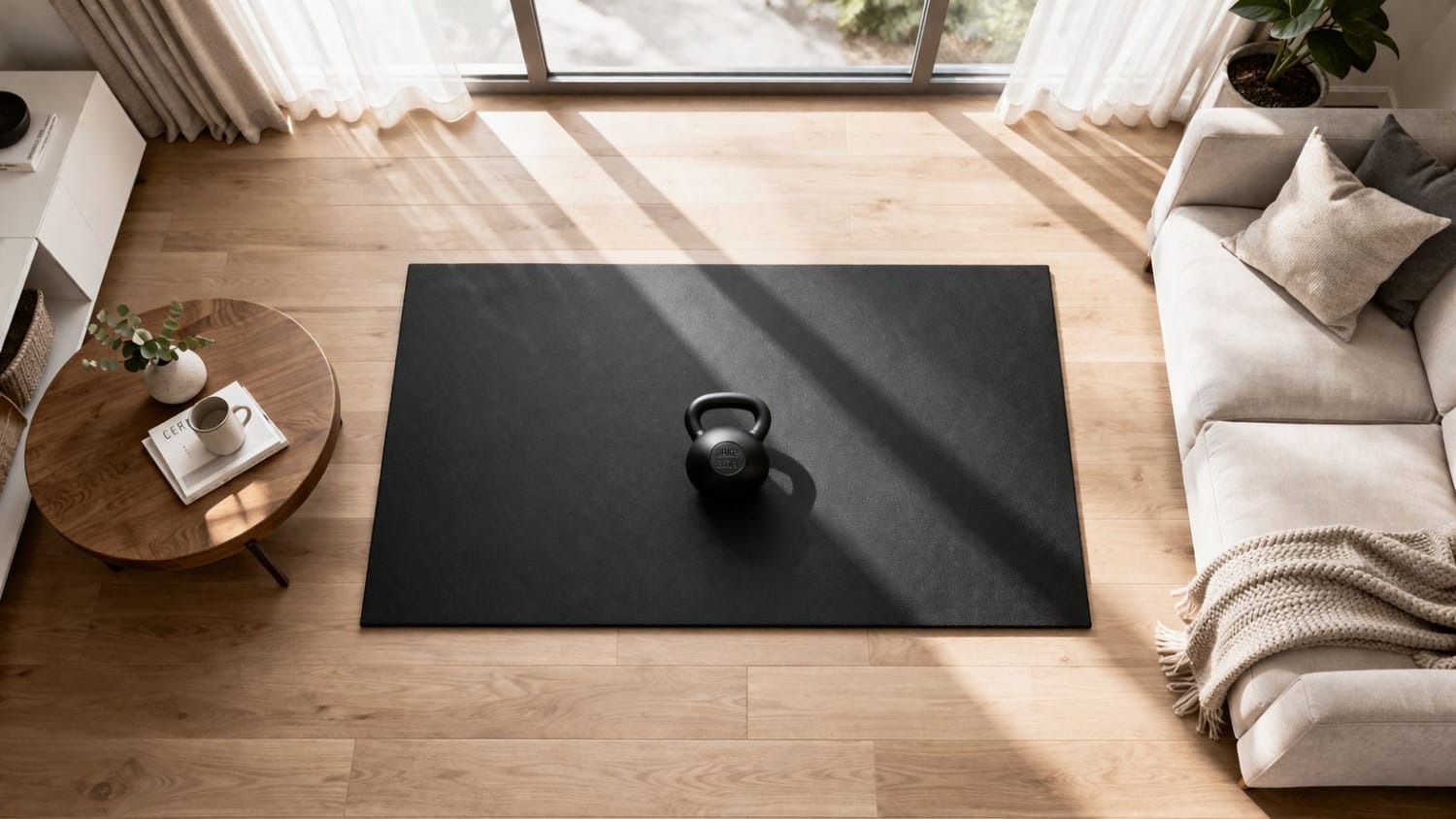
Setup shown: this layout uses exactly 36 sq ft. Moving the coffee table turns a standard living room into a full training zone.
Quick answer
Three sessions a week, one bell, 30 minutes. The swing, goblet squat, and deadlift cover your entire posterior chain, quads, and core — no bench, no barbell, no floor space beyond a 4'×6' mat.
Run this three times a week (Monday / Wednesday / Friday) for 8 weeks before adding a second bell or increasing weight. When you hit 5 sets of 20 swings with clean form, you're ready for the next size up. Full swing form breakdown here if you want the step-by-step technique cues.
Before You Buy: The Complete Checklist
Work through every item below before clicking "add to cart."
Your pre-purchase checklist
Starting weight confirmed — men 16 kg / women 8–12 kg, adjusted for current fitness level
Bell type chosen — cast iron (best value), competition (best technique), or adjustable (best space efficiency)
Handle finish checked — powder coat preferred; avoid raw iron for prolonged ballistic use
Base type confirmed — flat rubber base for apartment use; standard flat iron is fine with a mat
Rubber mat sourced — minimum 4'×6', 8mm thick (12mm+ for hardwood/floating floors)
Training space measured — at least 6'×6' of clearance when furniture is temporarily moved
Storage location decided — shelf, closet, under desk, or corner; confirm the bell fits with handle up
Budget confirmed for progression — plan for a second bell at the next weight in 3–6 months ($50–$120)
Beginner resources lined up — swing form guide saved; first 4-week program planned
Noise risk assessed — apartment dwellers: mat thickness matched to floor type, controlled set-downs practiced before the first session
Frequently Asked Questions
I test every piece of gear in my actual apartment — noise, footprint, deposit-safety, and real-world durability. No sponsored samples, no showroom conditions. If I wouldn't buy it for my own 650 sq ft studio, I don't recommend it.
Build Your Dream Home Gym—Without Wasting Space or Money
Join the MiniHomeGym Newsletter for expert reviews, space-saving fitness tips, apartment-friendly workout ideas, practical buying guides, and exclusive deals to help you choose the best compact fitness equipment with confidence.