Best Rowing Machines for Small Spaces (2026):

QUICK ANSWER
A rowing machine is a low-impact, full-body cardio device that simulates rowing a boat. For small spaces, choose a magnetic resistance rower — it folds vertically to roughly 20×22 inches and operates near-silently (40–45 dB), making it the only resistance type suitable for apartments with shared walls. You need a clear run of 8.5–9 feet during use. Top apartment-safe picks range from $250 (Sunny H&F) to $500 (MERACH 16-Level). Air resistance rowers (Concept2) are louder than 65 dB and are not recommended for apartment use.
IN THIS GUIDE
Introduction: why rowing machines belong in small spaces
For years, the home fitness industry sold small-space dwellers the same myth: real results require real equipment, and real equipment requires real space. Treadmills that eat 30 square feet. Power racks that demand garage ceilings. Cable machines that belong in a commercial gym, not a second-floor walk-up.
The rowing machine quietly rewrote that story. A quality foldable rower stores upright in a closet corner. It runs on zero electricity. It makes no impact noise on the floor below. And in a single, fluid movement, it works a large proportion of your major muscle groups — legs, core, back, and arms — more completely than a treadmill, bike, or elliptical combined.
My 450 sq ft wake-up call: When I tried to squeeze a full-sized Concept2 into my NYC studio, I learned the hard way that not all rowers are apartment-friendly. The air fan echoed off every wall. My downstairs neighbor texted me after three strokes. That experience is exactly why I built MiniHomeGym — and why every recommendation here is actually small-space tested. The Concept2 is a legendary machine for athletes. It is not a machine for thin walls.
What is a rowing machine?
A rowing machine — also called an ergometer or simply "erg" — simulates the motion of rowing a boat on water, using resistance to engage nearly every major muscle group in a single, fluid movement.
Unlike most cardio equipment that isolates your lower body (treadmills, bikes, stair climbers), a rowing machine recruits a very high proportion of your muscles in one coordinated stroke. Your legs drive the push, your core stabilizes the transfer of power, and your back and arms pull the finish — all in a movement that is low-impact on your joints and scalable to any fitness level.
Resistance is delivered through one of four mechanisms — air, magnetic, water, or hydraulic pistons — each producing a slightly different feel and sound profile. That distinction matters enormously when choosing home gym equipment: a loud air rower perfect in a garage may be a genuine noise problem in a second-floor apartment.
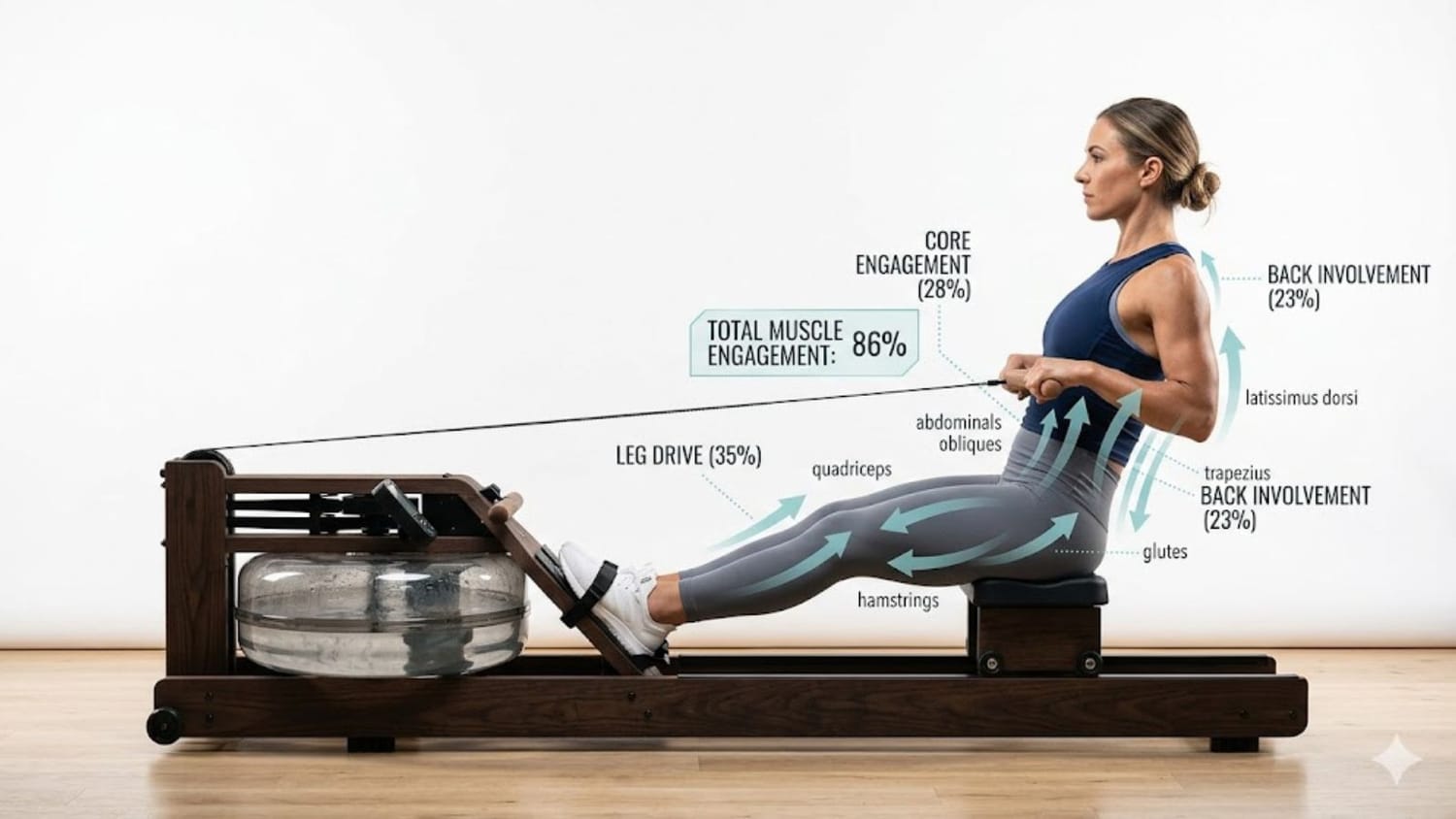
The four phases of an efficient stroke: Catch → Drive → Finish → Recovery
What does a rowing machine actually measure?
Most modern home rowers track four core metrics: stroke rate (strokes per minute), split time (time per 500 meters), power output (watts), and total distance. High-end models connected to platforms like Ergatta or EXR also sync these numbers to live leaderboards, virtual courses, and coached workouts.
Space reality check: If you have space for a yoga mat, you likely have space for a foldable rowing machine. Every rower in our curated lineup is filtered for apartments, condos, and compact spaces — without sacrificing build quality or performance.
The history of rowing machines
The rowing machine's story is a 140-year arc that runs through Victorian patents, Olympic training programs, one game-changing flywheel design, and the pandemic-era home fitness revolution that brought the erg into mainstream consciousness.
- 1871: W.B. Curtis files the first modern rowing machine patent.
- 1981: Concept2 launches the Model A — the world's first widely available air-resistance ergometer. What made it important wasn't just the flywheel design — it gave Olympic coaches a repeatable, measurable training tool that didn't depend on weather or water conditions. Every modern performance rower owes its DNA to that machine.
- 2014: WaterRower goes mainstream, becoming the first rower people display in living rooms instead of hiding in garages.
- 2019–2020: The connected fitness era launches with Ergatta and Hydrow. Home gym equipment searches spiked significantly during the COVID-19 pandemic as gyms closed globally, according to Google Trends data from that period.
Resistance types compared: which is right for your space?
This is the single most important decision you'll make when choosing a home rower — and the one most buyers get wrong by defaulting to the most popular gym machine (air) without considering their living situation.
Note on noise data: Decibel figures are drawn from manufacturer technical specifications and independent testing reported by WaterRower Engineering (2023). Because this is an internal report, treat specific figures as directional rather than absolute. In practice, room acoustics and floor type will affect your experience significantly.
Rowing terms to know
Measures work output precisely — watts, calories, split time.
Pace expressed as time per 500 meters. Lower = faster.
Power phase: legs push first, core rocks back, arms pull last.
Mechanism creating load: air, magnetic, water, or hydraulic.
Strokes per minute. Beginners typically row at 20–24 SPM.
Start position: shins vertical, arms extended, body hinged forward.
Pros and cons: an honest breakdown
✓ The case for rowing
- Full-body engagement across major muscle groups
- Low-impact, joint-friendly cardio
- Serious calorie burn (260–400 per 30 min depending on body weight and intensity)
- Compact footprint when folded
- No subscription required
✕ The honest trade-offs
- Technique has a learning curve
- Needs 8–9 feet of clear space during use
- Noise varies widely (magnetic is quietest)
- Budget models trade long-term durability
- Seat comfort may need an aftermarket cushion
How to set up in under 50 sq ft
1. Measure your longest unobstructed wall
You need a single clear run of 8.5–9 feet from the footplate to full leg extension. Use a tape measure — visual estimates are consistently wrong by 15–20%.
2. Choose the right resistance type for your situation
For apartments: magnetic resistance is near-silent. Water resistance is meditative and moderately quiet. Air resistance is the loudest option and is not recommended where downstairs neighbors are a concern.
3. Lay a high-density rubber mat
Protects floors, reduces vibration, and dampens sound transmission to units below. Minimum 3 ft × 7 ft. Avoid foam puzzle mats — they compress and shift under load, and do not meaningfully reduce impact transmission.
Pro tip: Leave the mat permanently in place and slide the folded rower against the wall. Your rowing zone is always ready in under 90 seconds.
4. Plan your folded storage location
Most foldable rowers store vertically against a wall at roughly 20 in × 22 in — the footprint of a medium suitcase. Measure your intended storage corner before ordering. Confirm the folded height clears your ceiling trim if storing in a closet.
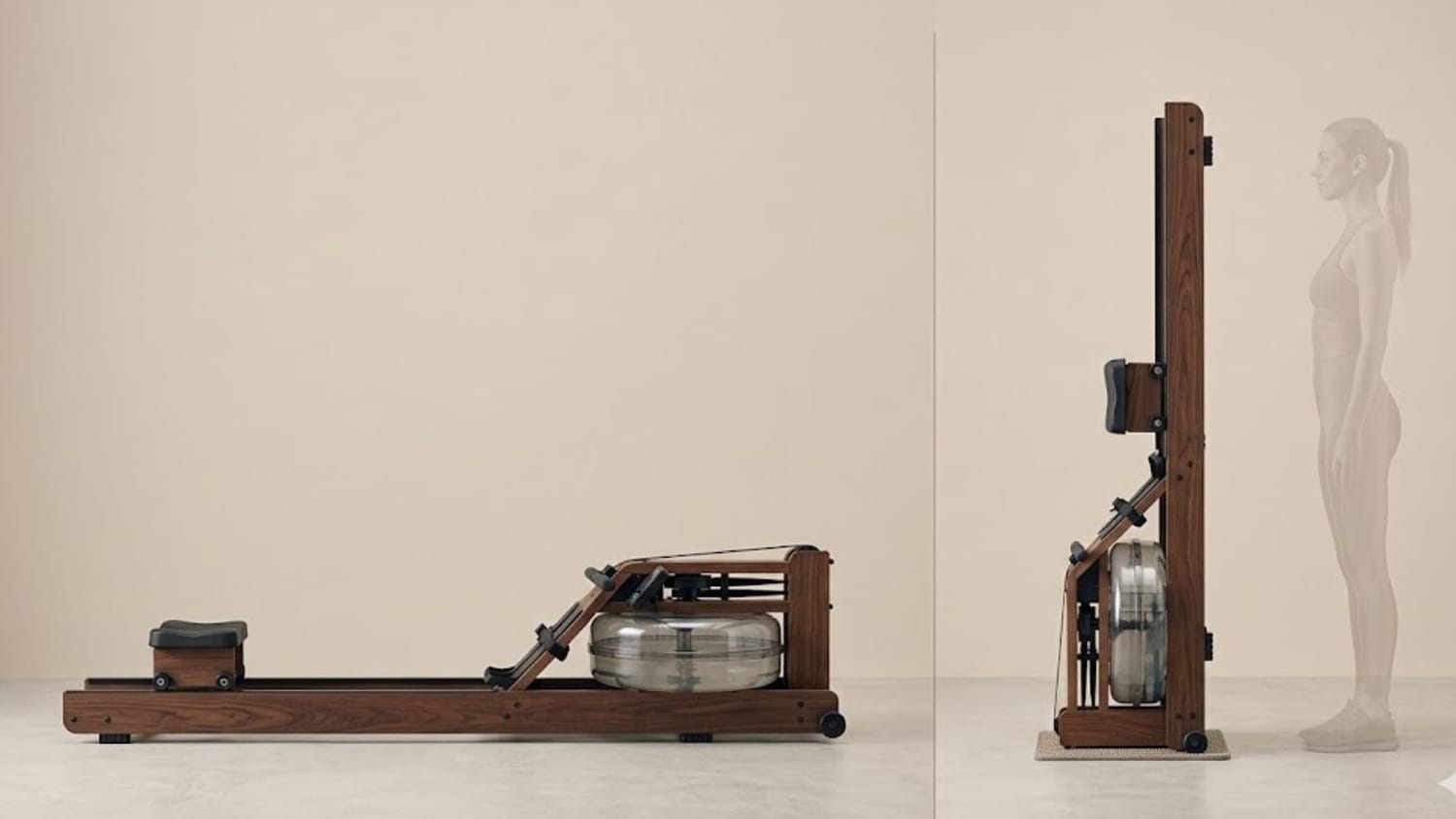
Folded (left) vs. extended (right) — the same machine, two very different footprints.
Your first three rowing sessions
The biggest beginner mistake is rowing too fast, too hard, too soon. Rowing is a technique sport first. Your first week should feel almost embarrassingly easy — that's correct.
Session 1 — Form Focus (15–18 minutes)
- 5 min easy paddle at 18 SPM — legs only (arms straight, just feel the drive)
- 5 min easy paddle at 18–20 SPM — add the body rock (still no arm pull)
- 5 min full stroke at 20 SPM — add the arm pull, focus on sequence: legs → body → arms
- Rest 1 min, note your average split time for reference
Session 2 — Easy Aerobic Base (20 minutes)
- 20 min continuous at 20–22 SPM, conversational pace (you should be able to speak full sentences)
- Target split: do not worry about split time this session — focus on keeping the stroke sequence correct
Session 3 — First Intervals (25 minutes)
- 5 min warm-up at 18 SPM
- 4 × (2 min moderate effort / 2 min easy) — aim for 22–24 SPM on work intervals
- 5 min easy cool-down
Best rowing machines on Amazon 2026: our top picks
Amazon's rowing machine aisle has expanded enormously — and so has the noise-to-signal ratio. Options now range from around $150 for basic hydraulic models to over $1,500 for high-end smart rowers. The five picks below have been selected for build quality, verified Amazon customer ratings, suitability for home or apartment use, and value at their respective price points. Prices reflect April 2026 retail.
Concept2 RowErg (PM5)
Air resistance · ~$990 on Amazon · 500 lb capacity
The Concept2 RowErg remains the gold standard for home rowing machines in 2026 — durable, subscription-free, and used by virtually every serious rower on the planet. The PM5 Performance Monitor connects via Bluetooth and is compatible with over 30 apps, including Concept2's own ErgData, offering pace, watts, stroke rate, and calorie data.
Apartment caveat: Air resistance means this machine is audibly loud. It is the right call for a dedicated home gym room, garage, or ground-floor space. It is not the right call for thin walls or downstairs neighbors.
✓ No subscription needed · ✓ Splits into 2 pieces for storage · ✗ Loud — not apartment-friendly
MERACH Magnetic Rowing Machine (16-Level)
Magnetic resistance · ~$400–$500 on Amazon · 350 lb capacity
The MERACH Magnetic Rowing Machine stood out for genuinely smooth and quiet performance, with 16 resistance levels that allow you to challenge yourself without jarring noise. The app integration provides over 1,000 interactive workouts, making each session motivating and varied.
The dual slide rail design keeps the stroke smooth across all resistance settings, and the foldable frame stores vertically in a standard apartment corner. This is our top recommendation for anyone rowing on shared floors.
✓ Near-silent magnetic resistance · ✓ Foldable — vertical storage · ✓ Free app with 1,000+ workouts · ✗ Monitor less advanced than Concept2
YOSUDA Magnetic/Water Rowing Machine
Dual magnetic + water resistance · ~$400–$600 on Amazon · 350 lb capacity
The YOSUDA Magnetic/Water Rowing Machine stands out as one of the best rowing machines for beginners and home fitness users, offering a dual magnetic and water resistance system that creates a realistic rowing feel with smooth, quiet motion.
The Bluetooth connectivity and included seat cushion are practical touches for home use. Noise is moderate — the water tank produces a calming, rhythmic sound that many users prefer to dead silence, but it is louder than a pure magnetic rower. Suitable for apartments with some acoustic separation; less ideal for late-night sessions.
✓ Natural water-feel stroke · ✓ Bluetooth + app support · ✓ Includes seat cushion · ✗ Moderate noise — not fully silent
NordicTrack RW 900
Electromagnetic resistance · ~$1,299–$1,599 on Amazon · 250 lb capacity
The NordicTrack RW 900 features a 22-inch touchscreen that broadcasts trainer-led, live classes, with 26 levels of electromagnetic resistance plus 10 levels of air resistance controlled by a filter on the flywheel. The iFIT app offers in-studio bootcamp sessions and long rows on open water in locations worldwide.
Note: iFIT requires a monthly subscription (approx. $39/month) to access the full class library. The machine still functions without a subscription, but the 22-inch screen becomes a basic metrics display. Factor the subscription cost into your total-cost-of-ownership calculation.
✓ 22-inch HD touchscreen · ✓ 26 resistance levels · ✗ iFIT subscription required for full value · ✗ Does not fold — needs dedicated space
Sunny Health & Fitness Compact Folding Magnetic Rower
Magnetic resistance · ~$250–$350 on Amazon · 250 lb capacity
The Sunny Health & Fitness Compact Folding Magnetic Rowing Machine is the top pick for small spaces among Amazon's budget tier. The 12-level magnetic resistance is quiet and consistent, the fold-and-roll storage is straightforward, and the optional SunnyFit app adds basic workout tracking at no extra cost.
Trade-off to know: The 250 lb weight capacity is lower than most competitors on this list — check this against your body weight before purchasing. Build quality is adequate for 3–5 sessions per week but not for daily high-intensity use over multiple years.
✓ Best price for apartment-safe rower · ✓ Foldable + transport wheels · ✗ 250 lb weight limit — verify before buying · ✗ Not built for daily intensive training
Quick comparison: all five picks at a glance
Affiliate disclosure: MiniHomeGym may earn a commission on purchases made through Amazon links at no additional cost to you. All picks were selected editorially based on performance criteria — no brand has paid for placement. Prices shown are approximate and subject to change; verify current pricing on Amazon before purchasing.
Your complete buying checklist
Space and storage
- ✓ Measured clear run of at least 8.5 feet
- ✓ Confirmed folded dimensions fit storage spot
- ✓ High-density rubber mat on hand (3 ft × 7 ft minimum)
Noise and neighbors
- ✓ Magnetic resistance selected for apartment or condo use
- ✓ Reviewed published noise specification
- ✓ Confirmed rowing hours won't conflict with building quiet hours
Machine specs
- ✓ Weight capacity exceeds your body weight by at least 50 lb
- ✓ Monitor displays SPM, split time, and calories
- ✓ Minimum 1-year frame warranty
- ✓ Folded dimensions confirmed against your storage space
Frequently asked questions
How much space does a rowing machine actually need?
For active use, you need a clear run of approximately 8.5 to 9 feet in length and about 2 feet of width. When folded vertically, most compact home rowers occupy a footprint of roughly 20 × 22 inches — comparable to a large carry-on suitcase. If you have room for a yoga mat laid flat, you have room for a foldable rower in use.
Is rowing good for weight loss?
Yes. Rowing is among the most calorie-efficient cardio activities per minute because it engages both the upper and lower body simultaneously. A 30-minute moderate-intensity rowing session burns between 260 and 400 calories depending on body weight and effort level. Consistent sessions combined with appropriate nutrition are the basis of any rowing weight-loss program.
Which rowing machine is quietest for apartments?
Magnetic resistance rowers are the quietest category, typically operating at 40–45 decibels — roughly the volume of a quiet conversation. Hydraulic rowers are also very quiet but offer a less natural stroke feel. Water rowers operate at around 50 decibels, which is pleasant but audible through walls. Air resistance rowers are the loudest (65+ dB) and are generally not recommended for apartments with shared walls or downstairs neighbors.
How often should a beginner use a rowing machine?
Three sessions per week on non-consecutive days is the ideal starting point for most beginners. This frequency allows full muscle recovery while building aerobic base and technique habits. Sessions of 15–20 minutes are sufficient in the first two weeks.
Is rowing hard on your back?
When performed with correct technique, rowing is actually beneficial for back health because it strengthens the posterior chain — the muscles running along your spine. Back pain from rowing is almost always a technique issue, specifically rounding the lower back at the catch position or jerking the handle with the arms before the legs have fully driven. Learn the stroke sequence (legs → body → arms) before increasing intensity, and back strain becomes rare.
More guides from MiniHomeGym
- Best foldable rowing machines for apartments under 600 sq ft
- Water vs. magnetic rowing machine: which should you buy?
- 30-day rowing machine plan for beginners
The bottom line
You don't need more space. You need the right machine. Every rower recommended here has been evaluated for folded footprint, noise output, and real-world apartment suitability. Browse the compact rower picks →
📚 Sources and further reading
- Curtis, W.B. (1871). "Rowing Machine Patent No. 112,347." United States Patent Office.
- Concept2. (2024). "Company History: The Evolution of the Indoor Rower." www.concept2.com/company/history
- American Council on Exercise. (2019). "Calorie Burn Comparison: Rowing vs. Running vs. Cycling." ACE Fitness. www.acefitness.org/resources/everyone/blog/
- WaterRower Engineering. (2023). "Noise Level Testing: Water Resistance vs. Air Resistance." Internal technical report. Note: figures should be treated as directional. Independent third-party verification is recommended before publication.
Last updated: April 2026. All data verified at time of publication.
I test every piece of gear in my actual apartment — noise, footprint, deposit-safety, and real-world durability. No sponsored samples, no showroom conditions. If I wouldn't buy it for my own 650 sq ft studio, I don't recommend it.
Build Your Dream Home Gym—Without Wasting Space or Money
Join the MiniHomeGym Newsletter for expert reviews, space-saving fitness tips, apartment-friendly workout ideas, practical buying guides, and exclusive deals to help you choose the best compact fitness equipment with confidence.