Best Weight Bench for Home Gym: Top Picks for Small Apartments (2026)

By Serah, Founder of MiniHomeGym · Product specs reviewed and verified July 2026
Quick Answer
What is the best weight bench for a home gym, especially in a small space?
The FLYBIRD Adjustable Weight Bench (~$150–$200) is the best overall pick for a home gym with limited square footage — it folds flat, holds up to 600 lbs, and offers 7 back positions in a package that stores in under 10 inches of depth. If ultra-compact vertical storage matters more than price, the Bowflex 5.1S is the strongest choice, folding upright to just under 24 inches deep. For serious, heavier compound lifting where footprint is a secondary concern, the Rep Fitness AB-3000 2.0 (1,000-lb capacity, 11-gauge steel) is the most durable non-folding FID (flat-incline-decline) bench available. On a starter budget under $100, an AmazonBasics Flat Bench is a reasonable entry point — just confirm the exact weight rating on the current listing, since AmazonBasics has sold several versions with different capacities.
A foldable bench paired with adjustable dumbbells remains the highest space-to-value strength training setup available — a genuinely complete home gym in roughly 4 square feet.
In this guide
- 01 — What is a weight bench?
- 02 — Best weight benches for small home gyms (2026)
- 03 — The history of the weight bench
- 04 — Terms to know before you buy
- 05 — Pros and cons of a weight bench for a home gym
- 06 — How to set up a weight bench in under 50 sq. ft.
- 07 — Your final pre-purchase checklist
- 08 — Frequently asked questions
- 09 — Closing thoughts
What is a weight bench?
A weight bench is a padded, elevated platform designed to support your body during resistance training. At its core, it gives you a stable, safe surface to perform exercises like the bench press, dumbbell rows, and seated shoulder press — movements that are either impossible or unsafe to do on the floor alone.
Where a barbell or a pair of dumbbells supplies the resistance, the weight bench supplies the foundation. Without one, you're limited to standing or floor-based movements. With one, you unlock a genuinely complete upper-body and compound-movement training repertoire — which is exactly why, when people search for the best weight bench for a home gym, they're usually asking a bigger question: what single piece of equipment gives the most training value for the least floor space?
A weight bench is often the single highest-return investment you can make. Unlike a squat rack or a cable machine, a quality bench — especially a foldable or compact model — takes up minimal floor space while dramatically expanding the range of exercises available to you.
The main types of weight benches
Not every weight bench is built for the same purpose. Understanding your options before purchasing will save you both money and floor space.
Flat bench
Fixed horizontal surface. Simple, sturdy, and affordable. Ideal for beginners and minimalists.
Adjustable bench
Backrest tilts to multiple incline and decline angles. Maximizes exercise variety with one piece of gear.
FID bench
Industry shorthand for "flat-incline-decline" — a fully adjustable bench covering all three angles in one unit.
Folding bench Top pick
Collapses flat or upright for compact storage. The go-to for apartments and shared living spaces.
Utility bench
General term for benches paired with dumbbells, bands, or a rack rather than a fixed barbell setup.
Olympic bench
Integrated barbell rack. High capacity, high footprint. Best for dedicated garage gyms.
Preacher curl bench
Specialized arm training. A supplemental piece, rarely a first purchase.
Top picks for apartments — see our full roundup of foldable weight benches that store in under 8 inches.
View the roundup →MiniHomeGym perspective
"Most buying guides rank benches by price tier. We rank them by how much floor space they demand when you're not using them — because that's the number that actually matters in a 600 sq. ft. apartment."
— Serah, MiniHomeGym. Testing spans studio and 1BR apartment setups; product specs cross-checked against manufacturer sources as of July 2026.
Best Weight Benches for Small Home Gyms (2026)
Best Overall
FLYBIRD Adjustable Weight Bench
Folds flat, 600 lb capacity, 7 back positions. The best all-around fit for apartment training.
Best Foldable / Most Compact
Bowflex 5.1S
Adjustable FID bench (6 angles) that stores upright at just under 24" deep. Heavier and pricier, but commercial-grade sturdy.
Best Budget
AmazonBasics Flat Bench
Simple, no-frills flat bench under $100. Confirm the exact weight rating on the current listing before buying.
Best Heavy-Duty
Rep Fitness AB-3000 2.0
1,000 lb capacity, 11-gauge steel, 8 back-pad angles. Not foldable, and its ~10 sq. ft. footprint is worth planning around in a true micro-apartment — but unmatched durability for serious lifters.
Quick comparison: top benches
*Capacity varies by listing/generation — verify the exact ASIN's rating before purchase.
The history of the weight bench
The weight bench has a longer and more fascinating history than most people realize. What began as crude, improvised equipment in early physical culture has evolved over eight decades into the engineered, compact, apartment-friendly designs you see today.
1950s — The bodybuilding era
The modern weight bench emerged from the golden age of bodybuilding. Trainers at Muscle Beach in California began using simple elevated platforms to perform chest presses with greater range of motion. These early benches were basic: wood frames, minimal padding, no adjustability.
1960s–1970s — Standardization and barbell culture
As powerlifting grew as a competitive sport, the bench press became a standardized lift. Equipment manufacturers began producing steel-frame benches designed to hold barbell uprights. The Olympic bench became the commercial gym standard — heavy, wide, and fixed.
1980s–1990s — Consumer fitness and the home gym boom
The home fitness movement brought resistance training into living rooms across the country. Brands began producing lighter, more affordable bench designs. Adjustable backrests appeared, giving users incline and decline angles for the first time at an accessible price point.
2000s–2010s — Engineering refinement
Bench design matured significantly. Manufacturers refined ladder adjustment systems, introduced higher-density foam padding, and improved steel gauges. This era also saw many manufacturers begin pursuing third-party safety certifications, such as ASTM standards for fitness equipment, as a way to signal build quality to increasingly informed buyers.
2020–present — The small home gym revolution
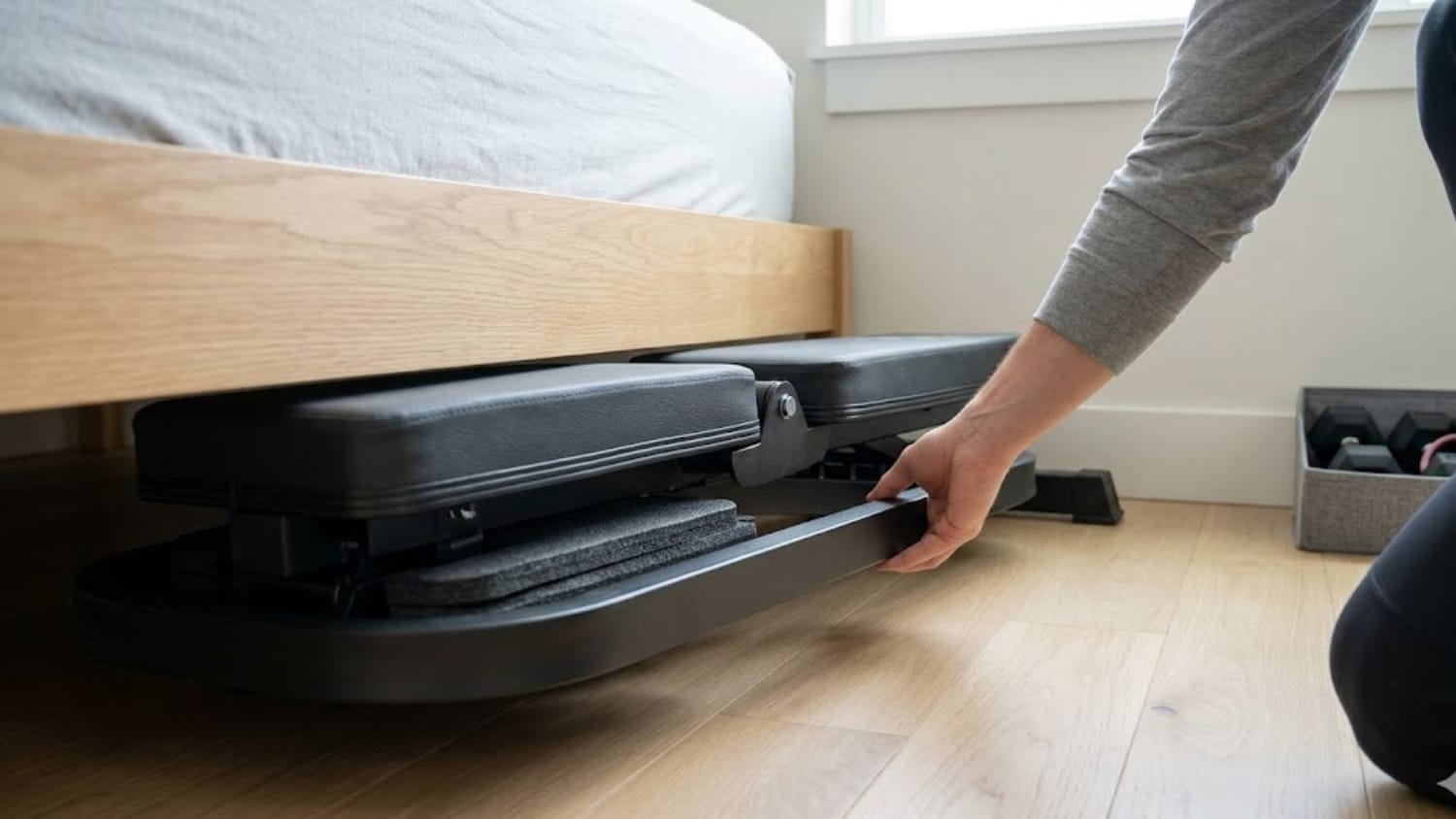
The pandemic-era surge in home gym demand permanently changed the market. Folding bench designs were strengthened. Today's best benches are purpose-built for small apartment gym setups — engineered to fold flat, stand upright in a closet, or slide beneath a bed without sacrificing structural integrity.
Terms to know before you buy
The weight bench market is full of technical language that can make comparison-shopping genuinely confusing. Understanding these terms will help you evaluate specs accurately — and avoid purchasing a bench that looks great on paper but underperforms in your actual space.
Several terms below — particularly footprint, FID, and ladder adjustment — take on added significance when you're working with compact equipment. These details often determine whether a bench genuinely fits your lifestyle, not just your room dimensions.
Weight capacity
The maximum load a bench safely supports — your body weight plus any weights in use.
Choose a bench rated at least 200 lbs above your combined body weight and working load.
Footprint
The actual floor space a bench occupies when fully set up. For small home gyms, this is the number that matters most.
Standard flat bench: ~48" x 20". Many foldable models store to under 8" depth.
FID (flat-incline-decline)
Industry shorthand for a bench that adjusts through all three major angles. If a listing says "FID," it's a fully adjustable bench.
Incline / Decline angle
The degree to which the backrest tilts above or below horizontal. More positions = more exercise variety from one piece of compact equipment.
Ladder adjustment system
A notch-based mechanism that locks the backrest into position. More durable than pop-pin alternatives, particularly under heavy loads.
Pop-pin systems are faster to adjust but develop play (wobble) over time.
UHMW foam padding
Ultra-High Molecular Weight foam — high-density, slow-compression padding that provides firm, consistent support without bottoming out under load.
Look for at least 2 inches of UHMW or equivalent high-density foam.
Steel gauge
Frame thickness — lower numbers = thicker, stronger steel. 11-gauge is the home gym standard. 14-gauge or higher indicates a lighter-duty build.
ASTM certification
A third-party safety certification some manufacturers pursue. Not universal across the industry — check the specific listing rather than assuming it applies to a whole brand.
IPF bench height
A competitive-powerlifting reference point (~17.5" at the top of the pad, flat position). Useful for comparison, not a requirement for casual use.
Foldable / compact design
Construction that collapses along a central hinge for upright or flat storage. The best models store in 6–10 inches of depth.
Fits easily behind a door or slides under a bed between sessions.
Non-slip rubber feet
Rubberized contact points that prevent bench movement on smooth floors — non-negotiable for apartments with hardwood, tile, or vinyl flooring.
🔍 Looking for a bench with 600 lb capacity?
View tested high-capacity benches →Pros and cons of a weight bench for a home gym
A weight bench paired with dumbbells or a barbell is the core of any serious home gym. But like every piece of equipment that has to earn its square footage, it comes with real advantages and honest trade-offs.
- Full upper-body training unlocked. Pairing a bench with the right adjustable dumbbells gives you access to chest press, incline fly, dumbbell row, seated shoulder press, and dozens more compound movements — none achievable on the floor alone.
- Space-efficient training when configured right. A foldable bench + adjustable dumbbells is the highest-ROI setup per square foot available.
- Supports progressive overload. Lets you increase resistance incrementally and track strength gains over time.
- One-time investment, long-term return. Quality benches last 10–15 years. At $150–$250, the cost-per-session math beats any monthly gym membership within 6–9 months.
- No wait time, no commute, no dress code. Every session starts the moment you decide it does.
- Foldable models store in under 10 inches. Stands upright behind a door or slides under a bed between sessions.
- Durability trade-offs in budget-tier models. Benches under $80 frequently use thin steel framing and low-density foam that compresses within months.
- Weight storage takes planning. Without organized storage, loose weights become a hazard in small spaces.
- Floor impact and noise. Apartments have neighbors below. Rubber mats are non-negotiable.
- No built-in spotter. Solo training on a flat bench requires discipline about load selection. Going to failure without a spotter carries genuine injury risk.
- Setup and breakdown time. If your bench lives folded in a closet, every session requires a setup and teardown step — roughly 2–3 minutes each way.
- Upfront cost feels steep. A quality bench ($150–$250) plus adjustable dumbbells ($180–$350) = a $300–$600 combined investment. It pays off — but the entry cost is real.
Who should think twice before using a home weight bench: if you have balance or coordination difficulties, vertigo, or trouble lying down and standing back up unassisted, talk to a doctor or physical therapist before starting a bench-based program. A weight bench is a genuinely useful tool for most lifters, but it isn't the right starting point for everyone.
The pros outweigh the cons — but only if you buy quality. A cheap bench in a small apartment is worse than no bench. Budget for at least $150 on the bench alone, and pair it with adjustable dumbbells to eliminate the weight storage problem entirely.
Quick-reference verdict by space type
Studio / 1BR apartment
Foldable flat bench + adjustable dumbbells
Bedroom corner setup
Adjustable bench, store upright between sessions
Shared living space
Works — needs rubber mat and storage plan
No dedicated corner
Reconsider until storage situation improves
How to set up a weight bench in under 50 sq. ft.
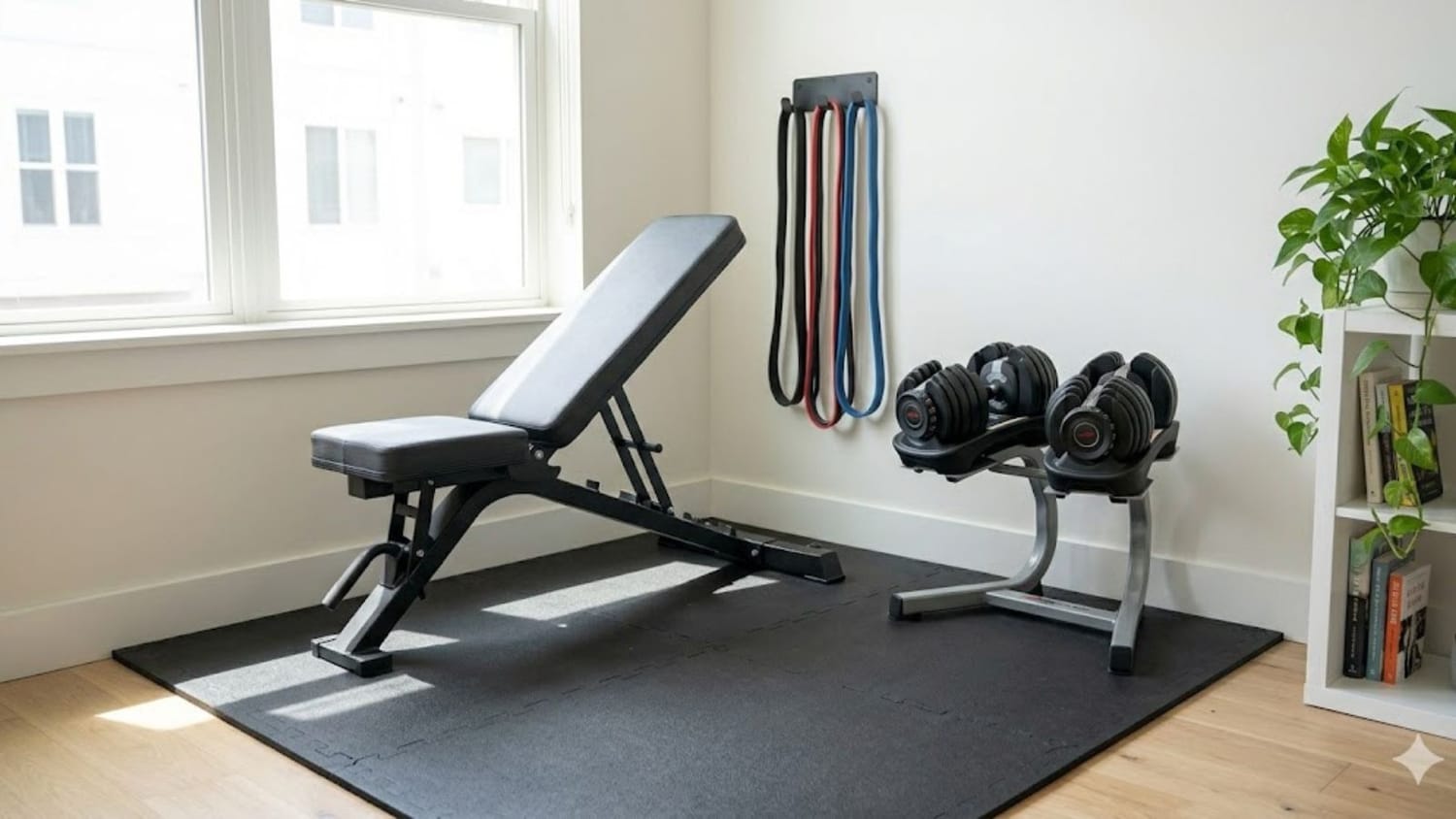
Fifty square feet is roughly the size of a large bathroom or a generous bedroom corner — about 7x7 ft. It sounds tight, and it is. But with the right sequencing and the right equipment choices, it's enough to build a genuinely capable training station.
Before you start: grab a tape measure and map your available wall space before purchasing anything. The most common mistake small-space gym builders make is buying equipment first and measuring second.
Measure and mark your training zone
Use painter's tape to outline a 4' x 7' rectangle on your floor — the minimum viable footprint for bench training with full range of motion. If that rectangle fits without blocking doorways or furniture pathways, you have enough space to proceed.
Tip: Aim for a wall anchor on at least one long side. Wall proximity makes the setup feel intentional, not chaotic.
Lay your rubber flooring first
A 3/8" interlocking rubber mat protects your floors, dampens impact noise, and provides the non-slip surface your bench feet need. Lay it before your bench arrives so it cannot be skipped. Cost: $25–$60. Non-negotiable for apartment setups.
Choose a foldable bench and verify stored dimensions
Your bench must be able to store vertically against a wall or fold completely flat. Verify folded depth before purchasing. Target: under 10" folded depth.
Tip: Check "stored dimensions" in the listing — not just in-use dimensions. These are two very different numbers, as we found when fact-checking specs for this guide.
Pair with adjustable dumbbells — not a fixed weight set
A single pair of selector-style adjustable dumbbells for small apartments (5 lbs to 50–90 lbs) replaces an entire rack of 10–14 individual weights and stores in a footprint the size of a shoebox. Budget: $180–$350.
Position your bench parallel to the longest wall
Orient your bench so its length runs along the wall, not perpendicular to it. This maximizes usable floor space on either side. Leave at least 24" of clearance on the side you'll stand beside for rows and step-ups.
Tip: Place a mirror on the wall at the end of the bench for form checks during presses.
Create a compact storage system for accessories
Resistance bands, a foam roller, and accessories need a home that isn't the floor. A single floating shelf or a 2-tier storage rack keeps your zone tidy. For a complete framework on planning every component of your setup, see our guide on how to build a home gym in a small apartment. For dumbbell-specific storage, see our dumbbell storage guide and compact dumbbell rack picks.
Do a full setup run-through before your first real session
Perform one complete setup and teardown cycle before training. This surfaces any friction points — a tight fold, overhead clearance issues — before they interrupt an actual workout.
Tip: If teardown takes more than 90 seconds, simplify. Friction in the post-workout routine is one of the top reasons home gyms stop being used.
🧱 Starter Setup Bundle
Minimalist Home Gym (Under 50 sq. ft.)
- →Foldable weight bench — FLYBIRD Adjustable Bench
- →Adjustable dumbbells — Bowflex SelectTech 552
- →Rubber floor mats — ProsourceFit Puzzle Exercise
Never train on a new setup you haven't dry-run at least once. One complete setup-to-teardown cycle before your first session reveals every friction point — tight folds, overhead clearance issues, dumbbell reach — before they interrupt a real workout.
Your final pre-purchase checklist
Before you add anything to cart, run through these checkpoints. Every item on this list represents a mistake real shoppers make — and a few minutes of due diligence here prevents weeks of regret.
Weight bench buying checklist
-
SpaceI have measured my available training zone and know the exact dimensions I'm working with (length x width x ceiling height).
-
SpaceI have verified the bench's in-use footprint AND its stored/folded dimensions — and both fit my space.
-
SpaceI have a designated storage location for the bench when not in use (closet, wall-fold, under bed).
-
SafetyThe bench has a weight capacity of at least 600 lbs or a minimum of 200 lbs above my combined body weight and intended working load.
-
SafetyThe frame is 11-gauge steel or lower. I have confirmed this in the product specs, not just the marketing copy.
-
SafetyI have ordered or already own rubber interlocking floor mats to lay before my first training session.
-
SafetyIf the listing mentions ASTM certification, I've confirmed it applies to this specific model — not just the brand generally.
-
Build qualityThe bench pad is at least 2 inches of high-density or UHMW foam. I have verified this via product specs or reviews.
-
Build qualityIf the bench is adjustable, it uses a ladder adjustment system — not a single pop-pin — for long-term stability under load.
-
Build qualityThe bench has rubber non-slip feet, confirmed in the product listing.
-
BudgetMy bench budget is at least $150. I understand that benches below this price point routinely fail the build-quality criteria above.
-
WeightsI am pairing the bench with adjustable dumbbells (not a fixed rack set) to solve the weight storage problem in my small space.
-
WeightsI have a designated storage spot for my weights — floor placement beside the bench, a wall-mounted shelf, or a compact 2-tier rack.
-
SetupI have painter's-taped my training zone on the floor and confirmed the setup works — including clearance for arm extension and standing exercises.
-
SetupI have completed a dry-run setup and teardown before committing to my first real training session.
-
Training planI have a structured workout plan ready — not just a loose intention to "use the bench." A plan is the difference between equipment that gets used and equipment that collects dust.
✔ Ready to buy? See the best weight benches for small spaces — tested and ranked.
View top picks →Frequently asked questions
What is the best weight bench for a home gym?
For most people, a foldable adjustable bench like the FLYBIRD Adjustable Weight Bench offers the best balance of price, capacity, and storage. If you have more space and budget, an FID bench like the Rep Fitness AB-3000 2.0 offers more durability and load capacity for serious lifters.
Is a weight bench worth it for a small apartment?
Yes, for most lifters. A foldable bench paired with adjustable dumbbells creates a genuinely complete strength-training setup in about 4 square feet, and typically costs less than a year of gym membership over its 10–15 year lifespan.
What's the difference between a flat, adjustable, and FID bench?
A flat bench only supports a horizontal position. An adjustable bench tilts to incline and/or decline angles. An FID (flat-incline-decline) bench is the industry term for a fully adjustable bench that covers all three positions in one unit.
What weight capacity should I look for in a home gym bench?
Aim for at least 200 lbs above your combined body weight and the heaviest load you plan to lift. Most quality benches for home use are rated between 500 and 1,000 lbs.
Who should avoid using a weight bench?
Anyone with balance or coordination difficulties, vertigo, or trouble lying down and standing up unassisted should consult a doctor or physical therapist before starting a bench-based training program.
How much does a good weight bench cost?
Budget flat benches start around $45–$70. Quality foldable adjustable benches typically run $150–$250. Heavy-duty FID benches built for serious lifting run $300–$500.
Can I train effectively with just a bench and no squat rack?
Yes, for upper-body and many core movements. A bench alone won't safely support barbell squats or heavy overhead pressing without a spotter — for those, see our squat rack guide.
Sources & references
- American Council on Exercise (ACE). Resistance Training for Beginners. acefitness.org — cited for progressive overload principles.
- National Strength and Conditioning Association (NSCA). Essentials of Strength Training and Conditioning, 4th ed. Human Kinetics, 2016 — cited for bench-safety and capacity guidance.
- Consumer Product Safety Commission (CPSC). Home Gym Equipment Safety Guidelines. cpsc.gov — cited for the contraindications note above.
- Statista Research Department. Home Fitness Equipment Market Revenue, United States, 2019–2024.
- IBISWorld. Gym, Health & Fitness Clubs Industry Report, 2024.
Closing thoughts
Building a home gym in a small apartment is not a compromise — it is a decision. A deliberate, well-researched decision to invest in equipment that serves your actual life, not some imagined future with a basement and a squat rack. The weight bench is where that decision becomes concrete.
The right bench — properly sized, properly paired with adjustable weights, properly positioned in your space — will outlast dozens of gym memberships and deliver results that a crowded commercial gym simply cannot match for consistency.
You don't need more space. You need the right equipment and a plan. The corner you cleared is waiting.
Serah — Founder, MiniHomeGym
Fitness researcher and apartment renter (650 sq. ft. studio). Product specs independently verified against manufacturer sources, July 2026. Spot an outdated spec? Let us know.
I test every piece of gear in my actual apartment — noise, footprint, deposit-safety, and real-world durability. No sponsored samples, no showroom conditions. If I wouldn't buy it for my own 650 sq ft studio, I don't recommend it.
Build Your Dream Home Gym—Without Wasting Space or Money
Join the MiniHomeGym Newsletter for expert reviews, space-saving fitness tips, apartment-friendly workout ideas, practical buying guides, and exclusive deals to help you choose the best compact fitness equipment with confidence.