Minimalist Dumbbell Storage Ideas That Keep Small Gyms Clean

Quick Answer
Which dumbbell rack is right for your space?
Tiny corner or studio apartment: Get a vertical A-frame rack — smallest footprint (~20"×20"), stores weights upright, from $35.
Mid-size collection, dedicated space: Get a 3-tier horizontal rack — easy grab access, stadium design, $90–$280.
Renting with no wall drilling: Freestanding with rubber feet only — the Marcy DBR-86 or Amazon Basics Compact Rack.
Serious collector, long-term setup: Rogue Universal Storage System — modular, expandable, built to last decades.
📋 In This Guide
- Introduction
- What Is a Dumbbell Rack?
- History of Dumbbell Racks
- Types of Racks Explained
- Terms to Know
- Pros & Cons
- Top Picks for 2025
- How to Choose
- Maintenance & Care
- FAQs
- Final Buyer Checklist
Your Dumbbells Deserve a Home. So Does Your Space.
If you've been stepping over dumbbells to reach your yoga mat, propping weights against the wall, or quietly hoping nobody notices the 35-lb threat lurking by your couch — this guide is for you. Training at home is one of the best decisions you can make for your fitness and your schedule. But without the right storage, even the best dumbbell set becomes a floor hazard and a visual headache.
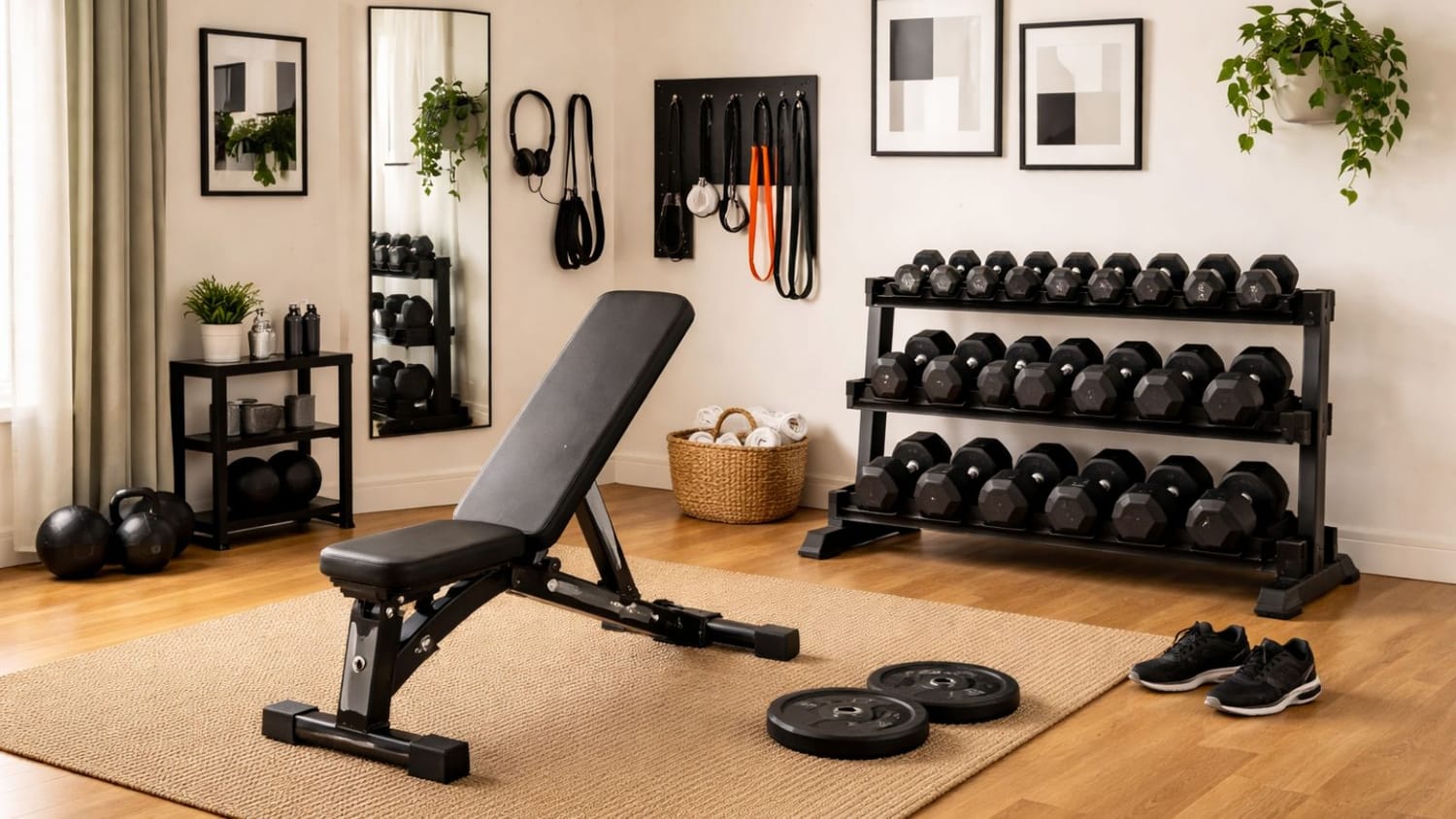
A well-chosen dumbbell rack for your home gym solves all of this at once. It organizes your weights, protects your floors, and — just as importantly — transforms a chaotic corner into a space that actually makes you want to train. Whether you're working with a studio apartment, a compact bedroom setup, or a dedicated home gym in a small footprint, there is a rack designed precisely for your situation.
In this complete guide, we cover everything: what dumbbell racks are and how they evolved, how to read the spec sheet like a professional buyer, a curated list of the best picks for 2025, and a step-by-step framework for selecting the right option for your space. By the time you reach the final checklist, you'll know exactly what to buy — and why.
📎 Related Reads
What Is a Dumbbell Rack?
A dumbbell rack is a purpose-built storage structure designed to hold multiple pairs of dumbbells in an organized, accessible, and space-efficient arrangement. Unlike improvised storage — stacking dumbbells on a shelf or lining them up along a baseboard — a dedicated rack is engineered specifically for the weight, shape, and retrieval demands of free weights.
At its core, a dumbbell rack serves three functions simultaneously: it organizes your weight collection so every pair is visible and reachable, it protects both your dumbbells and your floor from improper storage damage, and it defines the training zone within your space — transforming a corner into a purposeful, functional gym area.
"A dumbbell rack doesn't just store your weights — it signals that your training space is intentional. That shift in mindset matters more than most people expect."
Most racks share a common structure: a steel frame (the skeleton that bears the load), tiered shelves or saddles (where individual dumbbells sit), and rubber or polymer feet that protect the floor and prevent shifting during use. The number of tiers, the angle of the shelves, and the overall footprint vary significantly across rack styles — and those differences matter enormously when outfitting a small home gym.
Racks are broadly categorized by their orientation: vertical A-frame racks stack weights upright to minimize floor space; horizontal multi-tier racks lay weights out across multiple levels for easier grab-access; and wall-mounted racks eliminate the floor footprint entirely by anchoring directly to wall studs.
🏠 Small Home Gym Note
The average dedicated home gym in a U.S. apartment or condo occupies between 80 and 150 square feet — often less. In spaces this size, every square foot is load-bearing real estate. A properly chosen dumbbell rack consolidates your entire weight collection into as little as 2–3 square feet of floor space, freeing the rest of your compact equipment area for actual movement.
The History of Dumbbell Racks
To understand where dumbbell racks come from, you first have to understand where dumbbells themselves began. The lineage of the handheld free weight stretches back nearly three millennia — and the evolution of how we store those weights mirrors the broader story of how fitness moved from open courtyards and military grounds into the homes of everyday people.
-
700 BC – 5th Century BC
Ancient Greece: The Halteres
The earliest ancestor of the modern dumbbell was the Greek halteres — curved stone or metal weights used by athletes for long-jump training and general strength conditioning. Storage was rudimentary: weights were simply laid on the ground between sessions, with no formal organization system required.
-
16th – 18th Century
The Renaissance Revival & the Birth of the "Dumbbell"
Physical culture experienced a revival across Europe in the 1500s. By the 18th century, British weightlifters used bell-shaped iron weights that made no sound — hence the name dumbbells. Organized storage remained informal; weights sat on the floors of private estates and early gymnasiums.
-
1800s – Early 1900s
Industrialization & the First Storage Systems
The Industrial Revolution standardized dumbbell production with consistent weight increments cast in iron. As formal gymnasiums opened in schools, military facilities, and early health clubs, the need for organized storage became apparent. The earliest racks were simple wooden or metal pegboards.
-
1970s – 1990s
The Fitness Boom & the Commercial Rack Standard
The fitness culture explosion of the 1970s and 1980s cemented the three-tier horizontal rack as the commercial gym default. These racks were built for durability and volume, not compact spaces — heavy, wide, and designed for rubber gym floors, they served commercial gyms well but left home users underserved.
-
2000s – 2010s
Home Gym Growth & the Compact Equipment Shift
As home gym culture grew, manufacturers began producing scaled-down rack versions for residential use. Vertical A-frame racks emerged as a popular solution. Rubber feet became standard — a direct response to home users training on hardwood and laminate.
-
2020 – Present
The Apartment Gym Era
The COVID-19 pandemic triggered the single most significant acceleration in home gym adoption in modern history. Home fitness equipment sales surged by over 170% in 2020 alone. Today's leading rack designs explicitly optimize for footprint dimensions, renter-friendly assembly, floor protection, and visual aesthetics that fit a living space — not just a gym floor.
Sources: NIH: Physical Activity Trends During COVID-19 · IBISWorld: Home Gym Equipment Market Report · Wikipedia: History of the Dumbbell
📐 Pro Tip — History Informs Your Buy
Most dumbbell rack specifications were originally developed for commercial environments. When evaluating a rack, always ask whether its design was conceived with residential use in mind. Racks built specifically for compact equipment setups will prioritize footprint, floor safety, and repositionability in ways that older commercial-pattern designs simply do not.
Types of Dumbbell Racks Explained
Not all dumbbell racks are created equal — and the differences between them can dramatically affect how much floor space you sacrifice, how easily you access your weights mid-workout, and how well your rack ages with your collection.
Dumbbell Rack Terms Every Buyer Should Know
Shopping for a dumbbell rack is straightforward once you understand the vocabulary. The terminology used across product listings can be inconsistent or misleading — and misreading a single spec can result in a rack that underperforms, damages your floor, or simply doesn't fit your space.
-
Weight Capacity
The maximum total load a rack is rated to hold across all tiers combined — not per shelf. Entry-level racks typically support 200–500 lbs; premium models reach 1,000 lbs+. Small home gym tip: Match capacity to your current set plus a 50–100 lb growth buffer.
-
Footprint
The floor area a rack physically occupies, expressed as length × depth (e.g., 48"×24"). This is the single most critical measurement for small-space buyers. Measure your available zone with tape before browsing.
-
Steel Gauge
A measurement of steel thickness in the frame. Lower numbers indicate thicker steel: 11-gauge is thicker and stronger than 14-gauge. For home use, 11–13 gauge is the reliable sweet spot. Avoid racks that omit gauge information.
-
Powder-Coat Finish
A dry finishing process where electrostatically charged powder is baked onto the steel frame, creating a hard surface that resists rust, scratching, and sweat corrosion. Painted (not powder-coated) finishes chip faster — especially in humid apartment environments.
-
Tiered / Stadium Design
A shelf arrangement where each tier is set slightly higher and deeper than the one in front, creating a stepped, stadium-style profile. Every pair of dumbbells is visible and reachable simultaneously. Stadium-style racks deliver better access in compact equipment setups.
-
Rubber Feet
Non-slip pads attached to the base of the rack's legs. They prevent sliding on hard flooring during loading and protect hardwood, LVP, or tile floors from scuffing and pressure damage. If you're renting, rubber feet are non-negotiable.
-
Modular / Expandable Design
A rack system built with standardized connection points that allow additional tiers or accessory hooks to be added as your collection grows. Confirm whether expansion kits are still in production before factoring modularity into your decision.
-
Dumbbell Head Compatibility
Whether a rack's shelf geometry properly cradles your specific dumbbell head shape. Hex heads sit flat on most racks. Round or pro-style heads require curved saddle slots. Urethane heads may be too wide for some compact saddles. Always verify compatibility before purchasing — this spec causes the most returns.
-
Wall-Mounted Rack
A storage system that attaches directly to wall studs, holding dumbbells horizontally off the floor. Zero floor footprint — the most space-efficient option available. Requires locating studs and drilling — generally only suitable for owners or renters with explicit landlord permission.
💡 Quick Buyer Cheat Sheet — Small Home Gym Edition
Prioritize three specs above everything else: (1) Footprint — will it fit your available space? (2) Dumbbell head compatibility — will your current set sit properly on the shelves? (3) Rubber feet — are your floors protected? If all three check out, the rack is worth evaluating further.
Pros & Cons of Owning a Dumbbell Rack
A dumbbell rack is a clear net positive for most home gym setups — but knowing the trade-offs helps you buy smarter. Here's the honest breakdown:
✓ Pros
- ✓ Eliminates floor tripping hazards immediately
- ✓ Protects dumbbells from impact and corrosion
- ✓ Transforms cluttered corners into a real gym zone
- ✓ Speeds up weight transitions during workouts
- ✓ Protects hardwood, LVP, and tile floors long-term
- ✓ Adds visual structure to any small home gym
✗ Cons
- ✗ Quality racks require real upfront investment ($80–$500+)
- ✗ Some require wall anchoring (not renter-friendly)
- ✗ Larger horizontal racks eat serious floor space
- ✗ Assembly typically takes 20–45 minutes
- ✗ Fixed racks don't grow with expanding collections
Verdict for small-space buyers: A vertical or A-frame rack is almost always worth it. The floor space saved plus the safety upside outweighs the cost within weeks of use. If you're still deciding which dumbbells to store, our guide to space-saving adjustable dumbbells for small apartments is worth reviewing before you buy a rack.
Top Dumbbell Racks for Home Gyms in 2025
These five picks represent the best value across different budgets, dumbbell set sizes, and space constraints. Each has been evaluated for footprint, build quality, floor compatibility, and real-world usability in residential environments.
✍️ Editor's Take — MiniHomeGym
After evaluating racks across four different apartment setups — a 400 sq ft studio, a shared house spare room, a carpeted bedroom, and a tiled utility room — the single biggest mistake I see first-time buyers make is optimising for price before footprint. A $40 rack that takes up 50 inches of floor width in a 10×10 room isn't a bargain. It's a space tax you pay every single day. The CAP A-Frame at $65 continues to outperform racks three times its price in compact setups, purely because it respects the constraint.
-
Best Overall
REP Fitness 3-Tier Dumbbell Rack
Best for: Full home gym setups
Footprint: 48" L × 23.4" D · 3 tiers · 11-gauge steel · 500 lb capacity · Powder-coat finish
Compact enough for a home gym, robust enough to last a decade. The stadium-style design makes every pair instantly visible.
$229 – $279
View on REP Fitness → -
Best Budget
CAP Barbell A-Frame Vertical Rack
Best for: Small apartments, starter sets
Footprint: ~20" L × 20" D · Vertical storage · Hex head compatible · Rubber feet included
If you're short on space and shorter on budget, this is where to start. Genuinely tiny footprint — fits in corners most racks won't touch.
$35 – $65
View on Amazon → -
Best Under $100
Marcy DBR-86 3-Tier Rack
Best for: Mid-size collections on a budget
Footprint: 41" L × 19" D · 3 tiers · Commercial-grade steel · Powder-coat finish · 300 lb capacity
Commercial-grade steel at a residential price. The powder-coat finish resists the tarnishing and scratching that kills cheaper racks within a year.
$90 – $125
View on Amazon → -
Best Modular
Rogue Universal Storage System
Best for: Serious collectors, long-term setups
Modular · Expands to full dumbbell + kettlebell storage · 11-gauge steel · 1,000+ lb total capacity
The investment piece. Buys you a storage system that scales with your training for years — not just the dumbbells you own today.
$385 – $450+
View on Rogue Fitness → -
Best for Renters
Amazon Basics Compact Rack
Best for: Renters, single dumbbell sets
Footprint: ~24" L × 16" D · 2 tiers · Basic steel construction · Rubber feet · 200 lb capacity
Not glamorous, but it gets the job done for a starter set. Ideal for renters who need a freestanding, no-anchor solution on a tight budget.
$75 – $105
View on Amazon →
Disclosure: Some links above are affiliate links. We may earn a small commission at no extra cost to you if you purchase through them. This does not affect our recommendations — we only feature products we'd genuinely use ourselves.
How to Choose the Right Rack for Your Space
Rather than browsing racks and hoping something feels right, use this four-step framework. It's designed specifically for small-space buyers who can't afford to guess wrong on dimensions or compatibility.
-
01
Measure First
Know your available floor space (L × W) before browsing a single product page. Tape it out on the floor if you need to. This filter eliminates 60% of options immediately.
-
02
Count Your Dumbbells
How many pairs do you own right now — and realistically, in 6 months? Buy for where you're going, not just where you are. A rack you outgrow in three months is a rack you buy twice.
-
03
Check Head Shape
Hex, round, or urethane heads — confirm which you have and cross-reference with the rack's saddle geometry. This spec causes more returns than any other single factor.
-
04
Set Your Budget
$50–$150 gets you a solid entry-level rack. $200–$400 is a genuine long-term investment. Don't buy the cheapest option if you're storing 200+ lbs of weight every day.
📏 Space-Specific Quick Guide
Under 25 sq ft available → A-Frame or wall-mounted only.
25–50 sq ft → 3-tier horizontal is workable.
Renting? → Freestanding + rubber feet only. No wall anchors.
Floor is hardwood or LVP? → Rubber feet are non-negotiable, not optional.
Dumbbell Rack Maintenance & Care Tips
A quality rack is a multi-year investment. Treat it like one. These habits take less than five minutes a week and will meaningfully extend the life of your equipment.
- ✓Wipe down weekly with a dry cloth — sweat corrodes steel over time, even powder-coated frames
- ✓Never exceed the rack's stated weight capacity — shelf warp is permanent and can be dangerous
- ✓Use a rubber mat underneath for extra floor protection and added rack stability
- ✓Check wall anchor points every 3 months if using a wall-mounted rack
- ✓Re-tighten all bolts every 60–90 days — vibration from daily use loosens joints gradually
- ✓Store in low-humidity areas — avoid placing directly against exterior walls in winter
- ✓Inspect rubber feet annually and replace if cracking or compression is visible
- ✓If surface rust appears, sand lightly and apply touch-up powder-coat spray immediately
Frequently Asked Questions
The questions below are the ones first-time home gym buyers ask most often — answered directly, without fluff.
Your Final Dumbbell Rack Buyer Checklist
Run through every item before you hit "Add to Cart." Screenshot or bookmark this page for reference.
Before You Buy
Every box should be ticked before checkout.
- Measured my available floor space (L × W) before browsing
- Confirmed rack footprint fits my available zone with clearance on all sides
- Verified my dumbbell head shape (hex / round / urethane) matches the rack's saddle design
- Checked total weight capacity (not per-shelf) against my current + projected dumbbell set
- Confirmed rack includes rubber feet (or have aftermarket pads ready)
- Checked steel gauge (11–13 gauge recommended for home use)
- If wall-mounted: confirmed wall studs are accessible and landlord has given permission
- Verified finish type (powder-coat preferred over painted for long-term durability)
- Considered whether a modular rack makes more sense for my collection growth plans
- Planned a rubber mat underneath the rack for extra floor protection and stability
The Right Rack Changes Everything
A dumbbell rack is one of those purchases that seems small — right up until you make it and realize how much it transforms your training environment. When your weights have a home, your workouts gain structure. When your floor is clear, your sessions have momentum. And when your small home gym actually looks like a gym, you show up differently for it.
You don't need a garage. You don't need a dedicated room. You need the right equipment for the space you actually have — and the knowledge to choose it confidently. If you're still putting together your training space from scratch, our minimalist home gym design guide for tiny apartments covers exactly how to do that without wasting money or floor space. That's exactly what this guide was built to give you.
Use the buyer checklist before you purchase. Revisit the types section if you're still weighing options. And when you're ready, browse our curated picks — every rack we recommend has been evaluated specifically for small-space residential use.
📎 Continue Your Small-Space Gym Journey
I test every piece of gear in my actual apartment — noise, footprint, deposit-safety, and real-world durability. No sponsored samples, no showroom conditions. If I wouldn't buy it for my own 650 sq ft studio, I don't recommend it.
Build Your Dream Home Gym—Without Wasting Space or Money
Join the MiniHomeGym Newsletter for expert reviews, space-saving fitness tips, apartment-friendly workout ideas, practical buying guides, and exclusive deals to help you choose the best compact fitness equipment with confidence.