The Smart Way to Build a Compact Home Gym in Small Spaces

I used to think a home gym meant a spare room, a garage, or at least a basement I didn't have. I was wrong. My whole setup lives in a 6-by-4-foot corner of my living room, and I've used it consistently for years without a single noise complaint from the guy downstairs.
If you're renting, working with square footage instead of square miles, and tired of paying for a gym membership you use twice a month — this is the guide I wish someone had handed me when I started.
Quick heads-up: some of the links below are affiliate links — I earn a small commission if you buy through them, at no extra cost to you. I only recommend gear I've actually used in my own apartment.
Why Renters Need a Different Playbook
Most "home gym" advice assumes you own the walls. You don't get to drill into a rental, you don't want gear that tanks your deposit or your resale value when you move, and you definitely don't want to explain a treadmill-shaped dent in the floor to your landlord.
Everything in this guide is built around three renter-specific constraints: nothing permanent, nothing that annoys your neighbors, and nothing you can't move out the door in one trip.
Picking Your Spot
Bedroom Corner
This is where mine lives. A folded mat, a set of adjustable dumbbells, and a set of bands tucked into a wall hook take up almost no visual space. If you've looked at compact adjustable dumbbells for apartments, you already know why I'll never go back to a rack of fixed weights in a studio apartment.
Living Room Corner
If your living room is doing double duty, prioritize gear that folds flat or slides under furniture. A storage basket with a lid disguises resistance bands and a jump rope as "just décor" when people come over.
Balcony
Best ventilation you'll get indoors-adjacent. A rubber mat protects the surface and keeps equipment from sliding, which matters more on a balcony than anywhere else in the apartment.
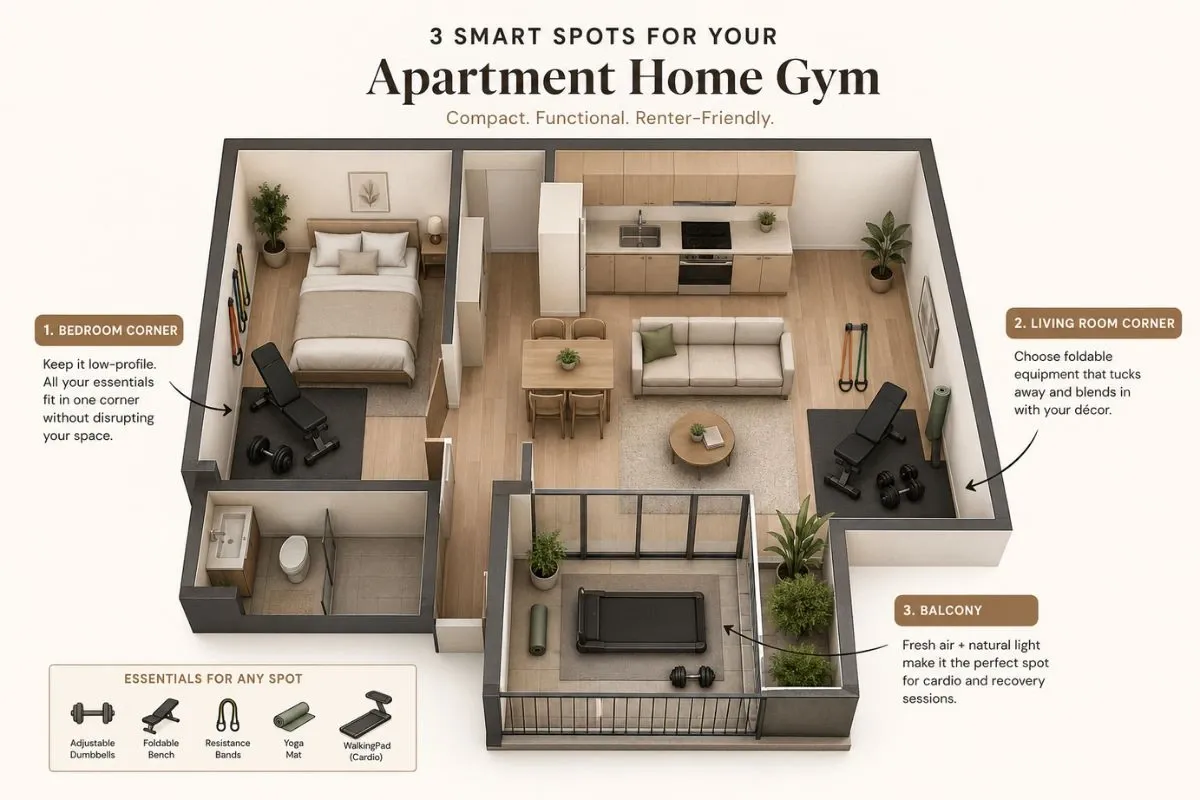
Bedroom corners, living rooms, and balconies can all become effective workout spaces with the right equipment.
The Gear That Actually Earns Its Square Footage
Adjustable Dumbbells
One pair replaces an entire rack. If you're weighing brands, our PowerBlock vs. Bowflex comparison covers the two sets I'd actually buy again.
Resistance Bands
Cheap, silent, and they roll up small enough to disappear into a drawer. Non-negotiable for apartment training.
Foldable Bench
Folds to the thickness of a yoga mat and leans behind a door when it's not in use. Unlocks bench presses, step-ups, and seated work you can't do on the floor — see my foldable weight bench picks for renters if you're still deciding.
Cardio, Without a Dedicated Room
This is the category where apartment dwellers get it wrong most often — buying cardio equipment sized for a garage. Here's what actually fits:
- WalkingPad — slides under my bed when I'm done. See my full best walking pad for apartment living roundup before you pick a model.
- Mini steppers — the smallest footprint on this list. My quiet mini steppers for renters guide breaks down which ones are actually quiet enough for thin apartment floors.
- Compact rowing machines — more floor space than a stepper, but foldable models store vertically.
- Under-desk ellipticals — the move if you work from home and want movement during calls.
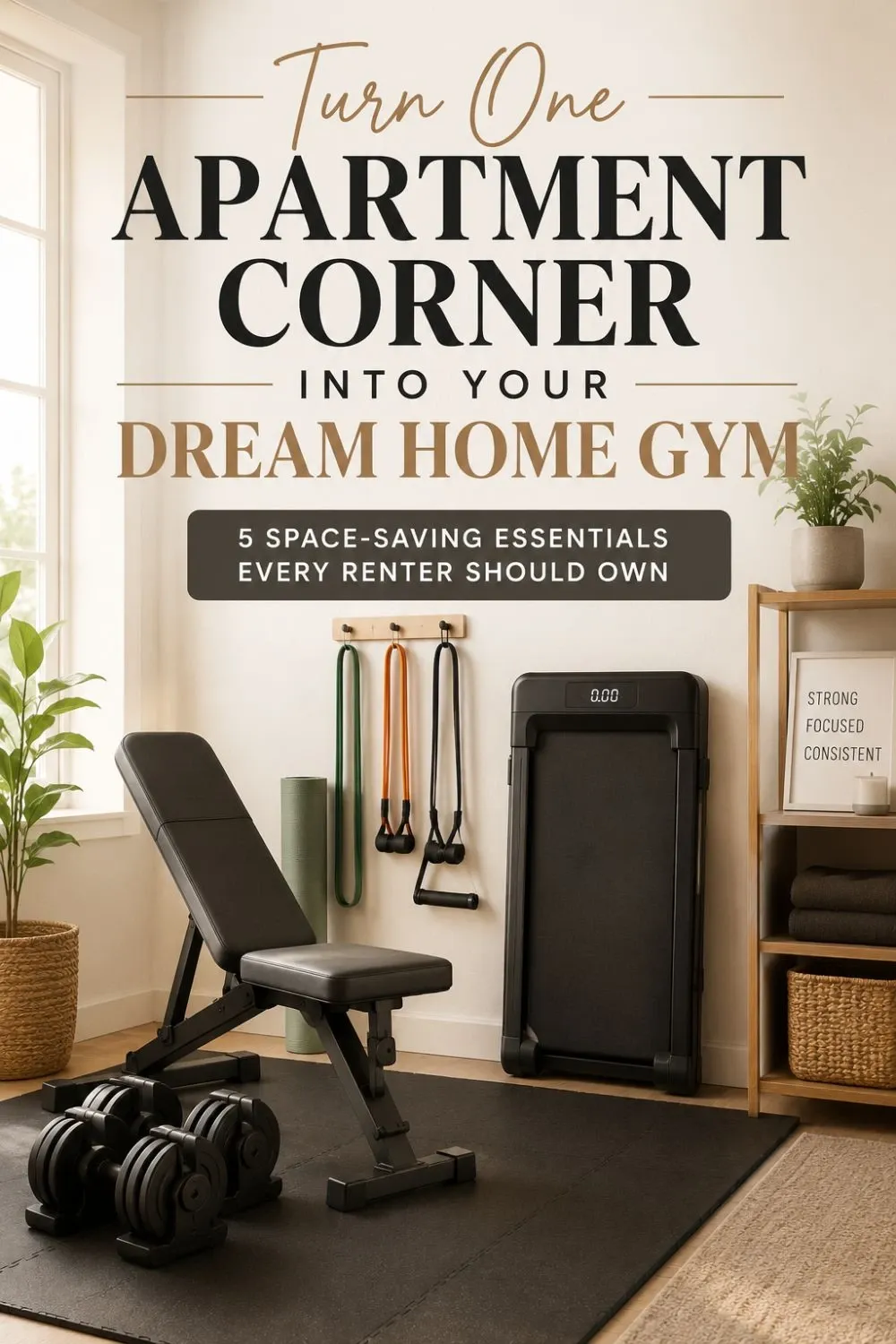
Five compact pieces of equipment can replace an entire traditional home gym.
Storage That Doesn't Require a Drill
You're not putting holes in a wall you don't own. I laid out my full setup in these no-drill wall storage ideas that protect your deposit — but here are the only three storage tools I actually trust:
- Weight-rated command hooks for bands and jump ropes
- Over-the-door racks for mats and foam rollers
- Under-bed bins for anything you use less than twice a week
→ Shop the over-door rack I use
What This Actually Costs
You can start for well under $200 with a mat, bands, and a jump rope. I broke down two full tiers — line item by line item — in my $500 vs. $1,500 apartment gym comparison, including exactly what changes between the two.
Protecting Your Floor (and Your Deposit)
Dumbbells on hardwood are how you lose part of your security deposit. Interlocking rubber tiles under your gear stop scuffs, muffle noise for the unit below you, and roll up when you move.
Staying Consistent
A small setup you actually use beats a garage gym gathering dust. The habit that worked for me: I keep the WalkingPad's app open on my phone during work calls and just walk. No separate "workout time" to schedule — the movement happens while I'm already sitting at my desk anyway.
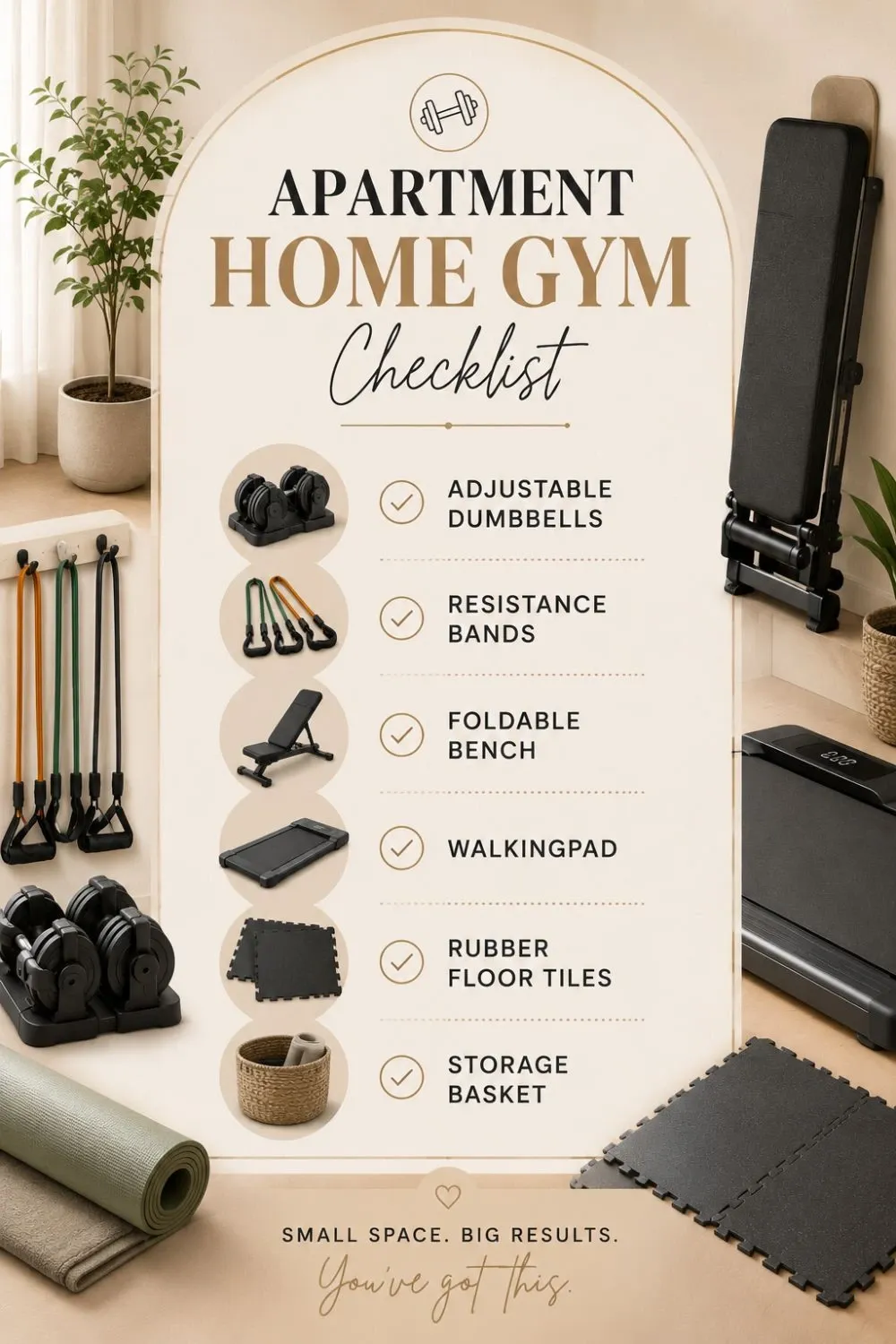
A simple checklist makes it easier to build an apartment-friendly gym without wasting space or money.
FAQ
How much space do I actually need?
Around 20–30 square feet is enough for the full setup in this guide — roughly a 5-by-5-foot corner.
Will my downstairs neighbors hear me working out?
Not if you're using floor tiles and sticking to the gear in this guide. The WalkingPad and mini steppers are both designed to run quiet — I cover measured noise levels in the individual reviews linked above.
Is a WalkingPad worth it if I already have a mini stepper?
They solve different problems. A stepper is for short, high-intensity bursts; a WalkingPad is for low-impact movement you can sustain for hours during work. I use both, but if I had to pick one for a true single-item setup, it'd be the WalkingPad.
Bottom Line
You don't need a spare room. You need about 25 square feet, gear that folds or rolls away, and a system for keeping it out of sight when you're not using it. Start with the essentials, add the $500-vs-$1,500 upgrades when you're ready, and you'll have a setup that survives every apartment you move into next.
I test every piece of gear in my actual apartment — noise, footprint, deposit-safety, and real-world durability. No sponsored samples, no showroom conditions. If I wouldn't buy it for my own 650 sq ft studio, I don't recommend it.
Build Your Dream Home Gym—Without Wasting Space or Money
Join the MiniHomeGym Newsletter for expert reviews, space-saving fitness tips, apartment-friendly workout ideas, practical buying guides, and exclusive deals to help you choose the best compact fitness equipment with confidence.