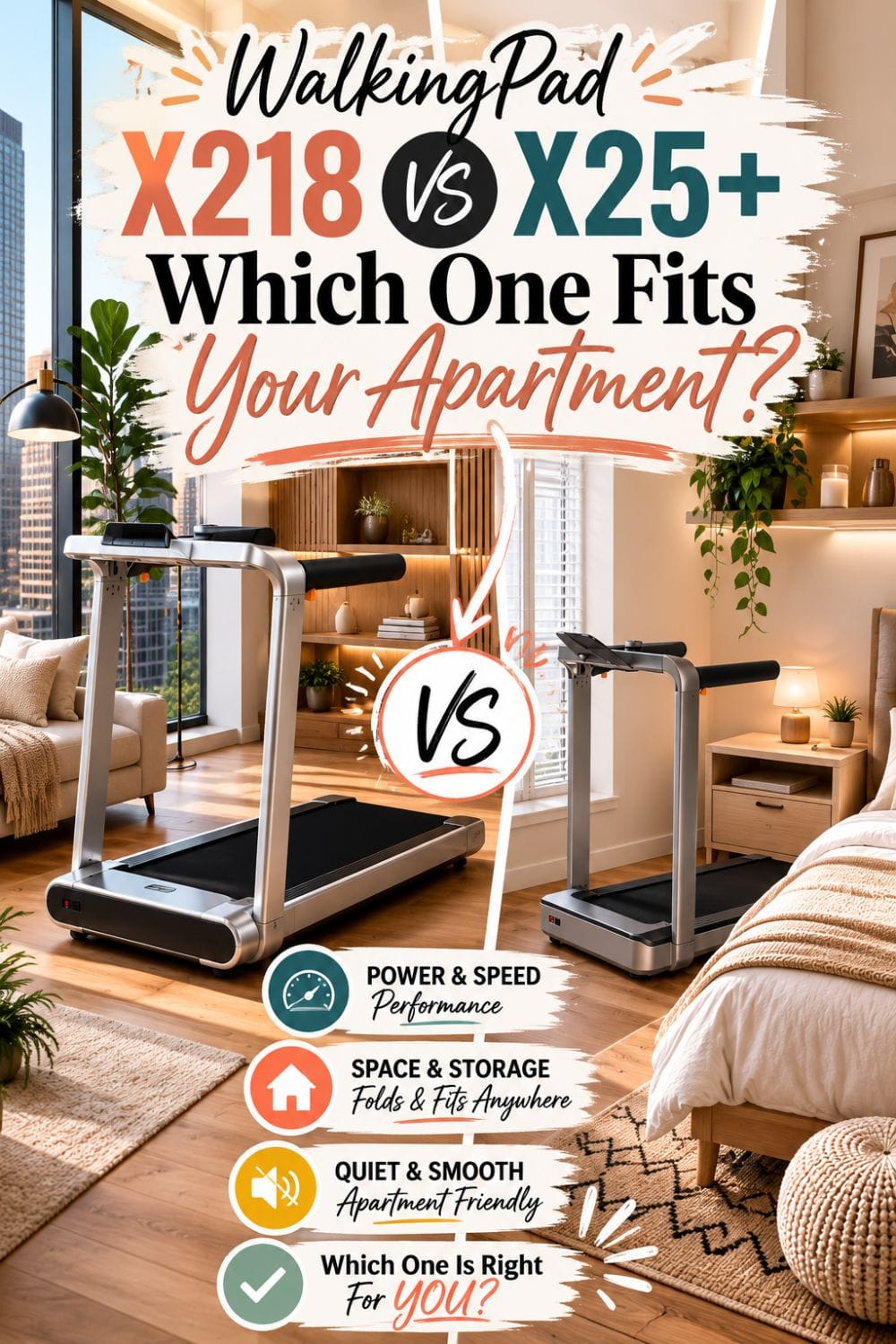
WalkingPad X218 vs X25+: Which Compact Treadmill Fits Your Apartment?

Last updated: July 2026 · Prices verified at time of writing and subject to change
Affiliate disclosure: This article contains affiliate links. If you buy through them, I may earn a commission at no extra cost to you. I only recommend products I've personally tested and would buy myself.
Short answer: the WalkingPad X218 is the better pick if you want the fastest, widest-decked foldable treadmill WalkingPad makes and you have a dedicated corner or wall for upright storage. The WalkingPad X25+ is the better pick if floor space is your #1 constraint — its double-fold design collapses to under 10 inches thick for under-bed or closet storage, at a lower price.
Two of WalkingPad's best compact treadmills, one big question: which one actually belongs in your apartment? I tested both side by side. Here's what the spec sheets alone won't tell you.
Quick Answer: Which WalkingPad Should You Buy?
If you want elite running performance, the widest deck in WalkingPad's foldable lineup, and top speed up to 11.5 MPH — get the WalkingPad X218.
If you want the most space-efficient double-fold design that still hits 10 MPH and saves $100 — get the WalkingPad X25+.
Both are compact. Both fold. Both are affiliate partners I've tested and genuinely trust. But they are not the same machine, and buying the wrong one for your space is a $1,400 mistake. Let me break it down.
A quick note on naming: WalkingPad sells both an "X25" and an "X25+," and retailers list them inconsistently. This article covers the X25+ specifically — the double-fold, 10 MPH, 300 lb-capacity version at ~$1,399. If a listing you're looking at shows different numbers, confirm it's the "+" model before buying.
Jump to:
Who Each Machine Is For
These aren't interchangeable options — they're built for two slightly different people. If you're still deciding between formats entirely, my under-desk walking pads and compact treadmills guide is a good place to start.
The WalkingPad X218 Is For You If…

- You're a serious runner who wants sprint-worthy speed (up to 11.5 MPH) at home
- You want the widest, longest deck available in a foldable WalkingPad — 55.1" x 20"
- You have a dedicated corner or wall for upright storage (it folds vertically, not flat)
- You want the SpeedDial knob plus dedicated 3/6/9 MPH shortcut keys for interval training
- You have help (or an elevator) for setup — at roughly 130 lbs, it's easiest to position with two people
- Financing matters to you — installment payments via Affirm and Shop Pay are available
The WalkingPad X25+ Is For You If…

- You live in a truly tiny apartment where every inch of floor space counts
- You need a double-fold design that collapses to 9.6" thick for closet or under-bed storage
- 10 MPH is plenty — you walk, jog, and run but aren't training for race-pace sprints
- You're budget-conscious and want to save $100 without giving up real running performance
- You want 11 KS Fit programs, NFC tap-to-start, and a whisper-quiet motor that won't wake neighbors
- Portability matters — at roughly 20 lbs lighter than the X218, it's easier to move solo
Side-by-Side Specs
Here's exactly what matters, side by side.
| Spec | WalkingPad X218 | WalkingPad X25+ |
|---|---|---|
| Price | $1,499 $1,799 | $1,399 $1,499 |
| Max Speed | 11.5 MPH | 10 MPH |
| Motor | 1.75 HP Brushless | 1.5 HP Brushless |
| Running Deck | 55.1" x 20" | ~51.9"–52" x 19.6"–20" |
| Incline | None | None |
| Fold Style | Single vertical fold, stands upright | Double fold, lies flat |
| Folded Size | 42.5" x 33" x 11.6" | 9.6" x 30.4" x 41.5" |
| Net Weight | ~129–131 lbs | ~104–116 lbs |
| Weight Capacity | 300 lbs | 300 lbs |
| Programs | 11 via KS Fit app | 11 via KS Fit app |
| Display | LED dial display + light bar | OLED + LED light strip |
| Connectivity | NFC, Bluetooth, KS Fit, Apple Watch | NFC, Bluetooth, KS Fit, Apple Watch |
| Warranty | 1 year | 1 year |
| Financing | Affirm / Shop Pay | Affirm / Shop Pay |
| Assembly | Fully assembled | Fully assembled |
Specs verified against WalkingPad's official product listings and independent testing outlets at time of publication. Always confirm current specs on the retailer page before buying, as manufacturers do revise these.
In-Depth Breakdown
Size & Storage
This is the biggest differentiator — and where your apartment layout makes the decision for you.
The X218 folds upright into a single vertical position, standing against the wall at roughly 42.5" x 33" x 11.6". It looks more like a piece of modern furniture than gym equipment. But it needs floor space to stand upright, and that footprint stays at 33" wide — it's not going under a bed.
The X25+ double-folds down to just 9.6" thick. You can slide it under a bed, tuck it flat in a closet, or store it behind a sofa — I've got a full breakdown of under-bed storage ideas that actually work in small apartments if you're figuring out where it would live. If you're in a 400-square-foot studio and storage is a genuine constraint, the X25+ wins this category outright.
Winner: X25+ for micro-apartments. X218 for anyone with a dedicated wall or corner.
Motor, Speed & Running Feel
The X218 runs a 1.75 HP brushless motor to reach 11.5 MPH, while the X25+ runs a 1.5 HP brushless motor capped at 10 MPH. That gap sounds small on paper, but it matters if you're doing genuine sprint intervals rather than steady-state jogging — the X218's extra headroom and wider deck give faster runners more margin before they feel like they're outrunning the machine.
Neither treadmill has an incline function — both are flat-only decks. If simulated hill training matters to your routine, that's a limitation on both models, not a differentiator between them.
Worth knowing before you buy: compact, lower-HP treadmill motors like these aren't designed for unlimited daily mileage the way a 3+ HP commercial treadmill is. Independent long-term testing of this motor class generally recommends capping sustained weekly mileage (rough guidance is well under 30 miles/week) to avoid premature motor wear — that applies to both machines here, and it's a reasonable trade-off given the folding design, but it's worth factoring in if you're training for a marathon rather than doing general cardio.
Winner: X218 for higher-speed training. Both are better suited to regular cardio than high-mileage marathon training.
Noise Level
Both machines use brushless motors, which run quieter than older brushed designs. Apartment-friendliness is baked into WalkingPad's DNA — this is a brand built on not waking up your downstairs neighbor. For a full rundown of how WalkingPad stacks up against the competition here, my quiet treadmills for apartments guide covers exactly that.
In practice, the X25+ is whisper-quiet even at its 10 MPH top speed — likely the quieter of the two simply because it's doing less work. The X218 is also low-noise by treadmill standards (WalkingPad's own testing puts it under 65 dB), but you'll notice more sound from the motor during sprint intervals near its 11.5 MPH ceiling. Think focused gym hum, not construction noise.
Winner: X25+ for quiet-first apartments. X218 is still apartment-friendly — just a touch louder at sprint speeds.
Ease of Use & Controls
Both treadmills arrive fully assembled. Unfold, plug in, go — no tools, no guesswork, no YouTube tutorials at 9pm.
The X218 pairs its SpeedDial control with dedicated 3, 6, and 9 MPH shortcut buttons on the console — genuinely useful mid-run when you need to spike your pace fast. The LED dial display and light bar give real-time feedback that feels motivating rather than clinical.
The X25+ also has the SpeedDial for smooth pace adjustment, NFC tap-to-start, and an LED light strip that tracks progress visually. The OLED display is compact and easy to read. Both connect to the KS Fit app for workout tracking, Apple Watch integration, and all 11 training programs — no membership fee required.
Winner: Tie on daily usability. X218 wins for in-workout speed control; X25+ wins for faster fold-and-store.
Value
At $1,499 (currently $300 off), the X218 includes a stronger motor, the widest deck in WalkingPad's foldable lineup, foldable side handrails, and Affirm financing. For a flagship-tier foldable running treadmill, that's a strong price point if running performance is your priority.
At $1,399 (currently $100 off), the X25+ delivers real 10 MPH performance, the same 300 lb capacity, double-fold storage, and the full KS Fit smart ecosystem for $100 less. For apartment renters who want a genuine running treadmill without the largest footprint, it's an excellent value.
Both come with a 1-year warranty, free US shipping, 30-day returns, and HSA/FSA eligibility. If you're building a full cardio setup on a budget, my roundup of the best compact treadmills for small spaces covers where these two sit relative to the wider market.
Winner: X218 for performance-per-dollar at the flagship level. X25+ for value-per-square-inch of storage.
Real Trade-Offs (What Neither Product Page Tells You)
A few practical things worth knowing before you check out:
- Delivery and setup: the X218 weighs roughly 130 lbs and often ships freight; it's genuinely easier with two people to unbox and position, especially if you're carrying it up stairs or through a narrow apartment hallway. The X25+ is lighter at around 104–116 lbs and more manageable solo.
- No incline on either model: if hill simulation is a training priority for you, neither of these machines offers it — that's true across WalkingPad's foldable lineup, not a gap unique to this comparison.
- Safety features: both include overload protection, automatic standby, and a child-lock function — worth knowing if you have kids or pets around the machine.
- Mileage expectations: these are compact folding treadmills, not commercial-grade machines. Both are well suited to regular cardio, walking, and moderate running, but I wouldn't push either one toward high-mileage marathon training week after week.
Serah's Verdict
I've spent enough time testing compact fitness gear to know when a product solves a real problem versus when it's just marketing a lifestyle. Both of these treadmills are the real deal. They just solve different problems.
If I were moving into an apartment with a dedicated bedroom corner or living room wall, I'd order the X218. The stronger motor, the wide 20-inch deck, and the 11.5 MPH ceiling make it feel like a real gym machine that happens to fold — not a folding machine that happens to be a treadmill. The speed shortcuts make interval training at home feel genuinely premium. This is the one I'd keep long-term.
But if I were in a studio, pulling the treadmill out and sliding it back under the bed every day, the X25+ is the smarter move. That 9.6" folded thickness is genuinely impressive. It still runs well at 10 MPH, it's $100 cheaper, and you won't resent it every time you have to put it away.
Bottom line: if storage is a daily friction point, choose the X25+. If you have a permanent spot for it and run hard, choose the X218. Neither decision is wrong — but only one is right for your apartment.
Want more context before you decide? Read my full guide to foldable treadmills that actually fit in apartments, see how WalkingPad holds up against other brands in my WalkingPad vs. competitors comparison, or check my full WalkingPad X218 review and full WalkingPad X25+ review for deeper testing notes on each. Still building out your space? The apartment gym ideas setup guide is worth a look before you commit.
FAQ
Is the WalkingPad X218 or X25+ better for apartment living?
Both are designed for apartment living, but the right pick depends on your storage situation. The X25+ double-folds to just 9.6" thick — thin enough to slide under most bed frames or stand flat in a closet — making it the better choice for micro-apartments and studios. The X218 folds upright into a compact vertical footprint and stores neatly against a wall, but it needs dedicated floor space. If you run hard and have a corner to spare, the X218 is the upgrade; if your square footage is truly limited, the X25+ is the smarter fit.
What's the actual difference between the WalkingPad X25 and X25+?
The "+" matters. Some retailers list a base "X25" alongside the "X25+," and specs can vary between listings, so always confirm you're looking at the X25+ (10 MPH, 1.5 HP brushless motor, double-fold to 9.6" thick, $1,399) before buying — the numbers in this comparison apply specifically to that model.
Will either treadmill disturb my downstairs neighbors?
Both machines use brushless motors engineered for quiet operation — WalkingPad has built its brand reputation on apartment-friendly noise levels. The X25+ is whisper-quiet even at its 10 MPH top speed. The X218 is also low-noise by treadmill standards (independently tested under 65 dB), but its stronger motor produces more audible sound during sprint sessions near its 11.5 MPH ceiling. Pairing either machine with a non-slip floor mat helps absorb vibration further. If you're in a building with noise-sensitive neighbors, walking or light jogging on either machine should pose no issue.
Does either treadmill have an incline function?
No. Neither the X218 nor the X25+ offers incline — both are flat-deck machines focused on speed and foldability rather than simulating hill training. If incline is a must-have for your routine, you'll want to look outside WalkingPad's foldable lineup.
Can I use installment payments for these treadmills?
Yes. WalkingPad supports financing through Affirm and Shop Pay, with options for up to 12 months interest-free for qualified customers, available on both the X218 and X25+ at checkout. Both treadmills are also HSA and FSA eligible if you have pre-tax health spending dollars to use.
What's the difference in deck size, and does it matter?
Yes, especially if you're tall or run with a longer stride. The X218 has the largest deck in WalkingPad's foldable lineup at 55.1" long by 20" wide, giving genuine full-stride room at higher speeds. The X25+ comes in slightly smaller at roughly 52" long by 19.6"–20" wide — still spacious for most users, but narrower than the X218. If you're over 5'8" and regularly run at 8+ MPH, the X218's extra length is noticeably more comfortable. For walkers and moderate joggers, the X25+ deck is more than sufficient.
I test every piece of gear in my actual apartment — noise, footprint, deposit-safety, and real-world durability. No sponsored samples, no showroom conditions. If I wouldn't buy it for my own 650 sq ft studio, I don't recommend it.
Build Your Dream Home Gym—Without Wasting Space or Money
Join the MiniHomeGym Newsletter for expert reviews, space-saving fitness tips, apartment-friendly workout ideas, practical buying guides, and exclusive deals to help you choose the best compact fitness equipment with confidence.