Best Foldable Exercise Bikes for Small Apartments (2026)

Introduction
There's a specific kind of anxiety that settles in when your apartment doubles as your gym. The visual noise of bulky equipment crowding your living space isn't just an aesthetic problem — it's a mental one. Every time you glance at a machine that barely fits, your sanctuary feels smaller, heavier, and more chaotic.
This curated list was built for the urban minimalist who refuses to choose between a high-performance fitness routine and a beautifully composed living space, drawing on the same small-space home gym ideas that guide everything else we recommend. We compared folded dimensions, resistance type, flywheel weight, noise output, and weight capacity across more than a dozen upright, spin-style, and recumbent-adjacent stationary bikes before narrowing the field to five. Every model featured here was evaluated not just on performance metrics, but on how gracefully it disappears when the workout is done. Whether you're in a 400-square-foot studio or a compact city one-bedroom, these are the five foldable exercise bikes that earn their place — without overstaying their welcome.
Compare the 5 Best Foldable Exercise Bikes at a Glance
Before we get into full reviews, here's how each folding exercise bike stacks up on the specs that matter most for apartment living: folded footprint, resistance type, flywheel weight, noise, and capacity.
| Bike | Folded Size | Resistance | Flywheel | Noise | Capacity | Best For |
|---|---|---|---|---|---|---|
| Marcy NS-652 | 18" × 33" | 8-level magnetic | Light | Very quiet | Standard | Tightest budgets |
| YOSUDA YB001F | Rolls flat to wall | 16-level magnetic | 35 lb | Quiet | Standard | Studio-quality feel on a budget |
| Schwinn 130 | 22" × 40" | 20-level magnetic | Perimeter-weighted | Near-silent | Standard | Bluetooth & virtual riding |
| Ativafit F-Bike | 20" × 28" | 8-level magnetic | Light | Whisper-quiet | Standard | Design-first small spaces |
| Progear 190 | 19" × 31" | 8-level magnetic | Heavy | Quiet | 300 lb | Heavy or frequent use |
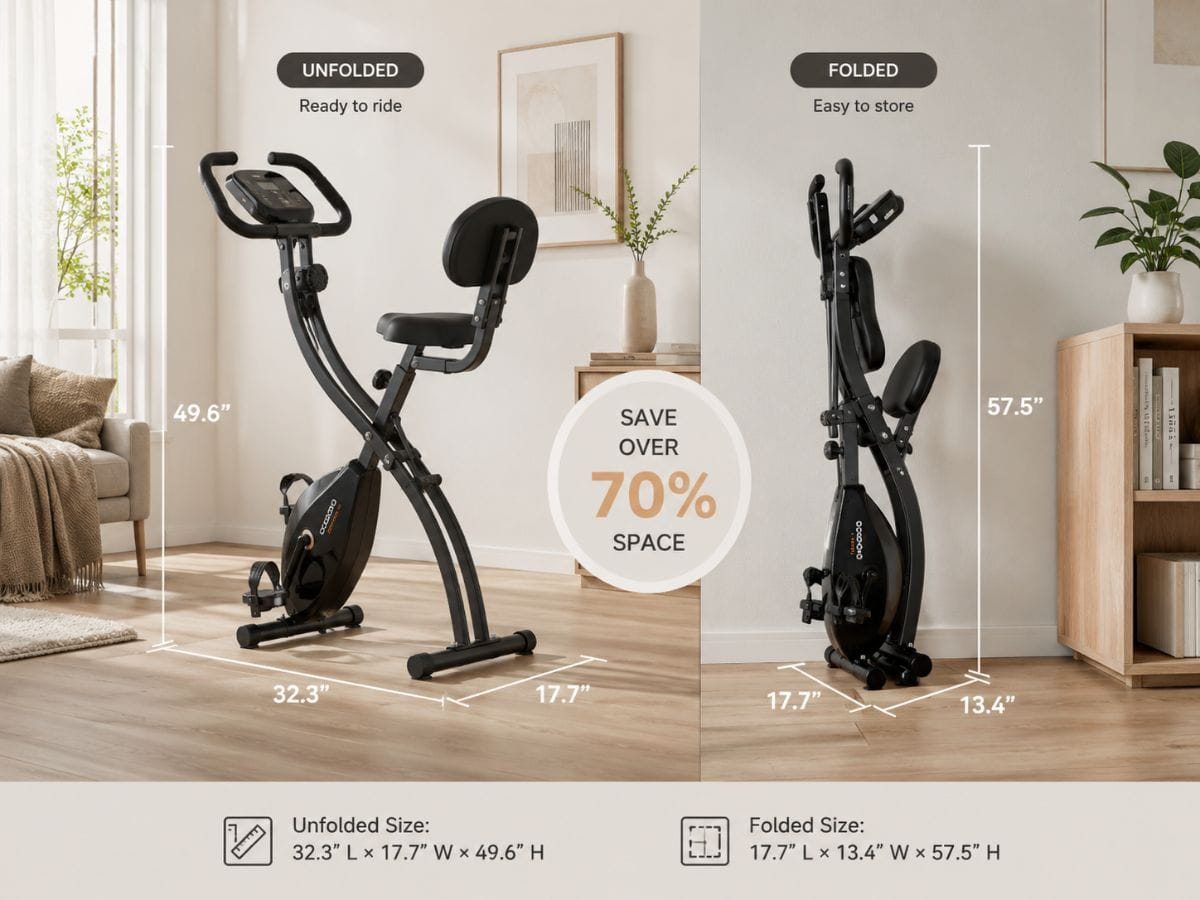
Seeing the folded footprint makes it easier to choose a bike that fits your apartment.
How We Chose These Bikes
Every foldable exercise bike on this list was measured against the same eight criteria, weighted toward what actually matters in a shared-wall, limited-square-footage apartment:
- Folded footprint — how small the bike becomes, and whether it can stand upright in a closet or corner.
- Apartment-appropriate noise — decibel level of the resistance system at moderate and high intensity.
- Ease of moving — transport wheel quality and one-person portability.
- Durability — frame gauge, flywheel construction, and long-term stability under load.
- Resistance quality — smoothness and range of adjustment, magnetic versus friction.
- Comfort — seat padding, adjustability, and ride ergonomics over 30+ minute sessions.
- Aesthetics — whether the bike reads as considered furniture or leftover gym equipment at rest.
- Price-to-feature ratio — value relative to comparable non-folding stationary bikes.
We prioritized models with verified user feedback across at least two retail platforms and excluded bikes with widespread reports of wobble, bearing failure, or flywheel noise above a whisper-conversation level. Recommendations on this page are reviewed and refreshed periodically as new models enter the foldable category, so specs and pricing may shift slightly from what's listed here — always confirm current details on the retailer page before buying.
Why Foldable Exercise Bikes Matter in 2026
The home fitness market has permanently shifted. According to the Global Wellness Institute, over 62% of urban fitness enthusiasts now maintain a hybrid workout model — splitting time between home and gym. Yet the average urban apartment clocks in under 650 square feet. The result? Equipment that folds, tucks, and disappears on demand is no longer a luxury category. It's the only rational category. A foldable exercise bike solves the core tension of small-space living: you need a serious cardiovascular tool, but you cannot afford to sacrifice your floor plan to own one — which is exactly why quiet, apartment-ready exercise bikes have become one of the fastest-growing categories in home fitness.
Buying Guide: What to Look For in a Foldable Exercise Bike
What is a foldable exercise bike?
A foldable exercise bike is a stationary bike — typically an upright or spin-style bike, though some recumbent models offer partial folding — engineered with a hinged frame so it collapses to a fraction of its working footprint for storage. Most use magnetic resistance rather than friction pads, which keeps the folded unit lighter and the ride quieter.
Upright vs. spin vs. recumbent: which folds best?
Upright bikes — like every model on this list — fold most efficiently because their compact frame geometry was designed around a home-fitness footprint from the start. Spin bikes prioritize a heavier flywheel and a more aggressive riding position for HIIT and cadence-focused training; a handful fold, but the added flywheel weight makes the folded unit bulkier. Recumbent bikes, with their reclined seat and back support, are the gentlest on joints and lower back but rarely fold at all, since the extended frame needed for the reclined position resists a compact hinge design. For most apartment dwellers doing Zone 2 cardio or low-impact interval work, an upright foldable bike offers the best balance of storage and versatility.
Magnetic vs. friction resistance
Magnetic resistance uses magnets positioned near the flywheel to create adjustable tension with zero physical contact — meaning no pad wear, no squeaking, and dramatically lower noise output. Friction resistance uses a felt or leather pad pressed directly against the flywheel, which is less expensive to manufacture but wears down over time and produces audible friction noise. For apartments with shared walls or floors, magnetic resistance is effectively mandatory; every bike on this list uses it.
How much floor space do you actually need?
Measure both the bike's operating footprint (roughly 20" × 45" for most upright bikes while in use, plus clearance for full leg extension) and its folded footprint. Before buying, measure the storage spot you have in mind — closet depth, the gap beside a dresser, or the wall space behind a door — and compare it against the folded dimensions listed for each bike below. A gap of 3–4 square feet is usually enough for temporary vertical storage.
Other specs worth comparing
- Weight capacity — most budget folding bikes cap around 220–250 lbs; models built for heavier or frequent use, like the Progear 190, extend to 300 lbs.
- Transport wheels — look for wheels rated for both hardwood and carpet so the bike rolls smoothly regardless of flooring.
- Seat comfort and adjustment — vertical-only adjustment fits a narrower range of riders than seats with both vertical and horizontal adjustment.
- Resistance levels — 8 levels is a reasonable minimum; 16–20 levels gives more precise progression for longer-term training.
- Flywheel weight — heavier flywheels (30+ lb) produce a smoother, more momentum-driven pedal stroke, closer to a true spin-bike feel.
- Tablet holder — useful if you plan to follow along with workout apps or stream shows mid-ride.
- Heart-rate monitor — built-in handlebar sensors are convenient but less accurate than a chest strap; useful for casual Zone 2 pacing rather than precise training zones.
- Bluetooth compatibility — enables syncing cadence and resistance data to apps like Zwift or Kinomap for a more game-like ride.
- Warranty — frames typically carry longer coverage (2–5 years) than electronics or wear parts (90 days–1 year); check both before buying.
Assembly, maintenance, and common mistakes
Most foldable exercise bikes ship 80–90% assembled and take 20–40 minutes to finish with basic tools included in the box — pedals, handlebars, and the seat post are typically the only components a buyer attaches. To keep resistance smooth over time, wipe down the flywheel housing monthly and check pedal and seat-post bolts for tightness every few weeks, since folding mechanisms see more repeated stress than a stationary frame. The most common buyer mistake is skipping the folded-footprint measurement entirely and assuming "foldable" automatically means "fits anywhere" — always measure your intended storage spot before ordering, and check the weight capacity against your own bodyweight with margin to spare rather than cutting it close.
The List: 5 Foldable Exercise Bikes for Small Spaces
1. Marcy Foldable Upright Exercise Bike (NS-652)
View the Marcy NS-652 on Amazon →
The Marcy NS-652 is the entry point that doesn't feel like a compromise. It features eight levels of magnetic resistance, a built-in LCD monitor tracking time, speed, distance, and calories, and a transport wheel system that makes repositioning effortless. The frame weight sits at approximately 33 lbs — light enough to move solo, sturdy enough to feel anchored during a 45-minute ride. The seat is adjustable across multiple positions, accommodating riders from 5'1" to 6'2", which makes it a practical choice for shared households.
For small spaces, the NS-652's real superpower is its fold ratio. When collapsed, it occupies a footprint of roughly 18" × 33" — narrow enough to slide into a closet gap or stand upright against a bedroom wall. The magnetic resistance system runs virtually silent, which is critical in apartments with thin walls or shared floors. If you're weighing this bike against a sportier alternative, our full comparison against the Flex Bike Ultra breaks down which one actually earns its floor space. There's no flywheel noise, no friction squeak — just the quiet rhythm of pedaling. It's the kind of bike that respects your neighbors as much as your square footage.
✓ Pros
- Most compact fold on this list
- Very budget-friendly
- Near-silent magnetic resistance
✗ Cons
- Fewer resistance levels than premium picks
- Basic LCD, no Bluetooth
- Lighter frame feels less premium at rest
Pro Tip
Stand the NS-652 vertically behind a floor-length curtain panel to create an invisible fitness alcove without dedicating a single permanent square foot to equipment.
Folds to 18" × 33" — fits upright in a standard closet doorway gap.
Check current availability →Who should buy this: First-time buyers on a tight budget, studio apartments under 400 sq ft, and anyone who wants the smallest possible folded footprint. Not ideal for: Riders over 6'2" or anyone who wants Bluetooth/app connectivity.
Size
●●●●●
Noise
●●●●●
Aesthetics
●●●○○
2. YOSUDA Foldable Indoor Cycling Bike (YB001F)
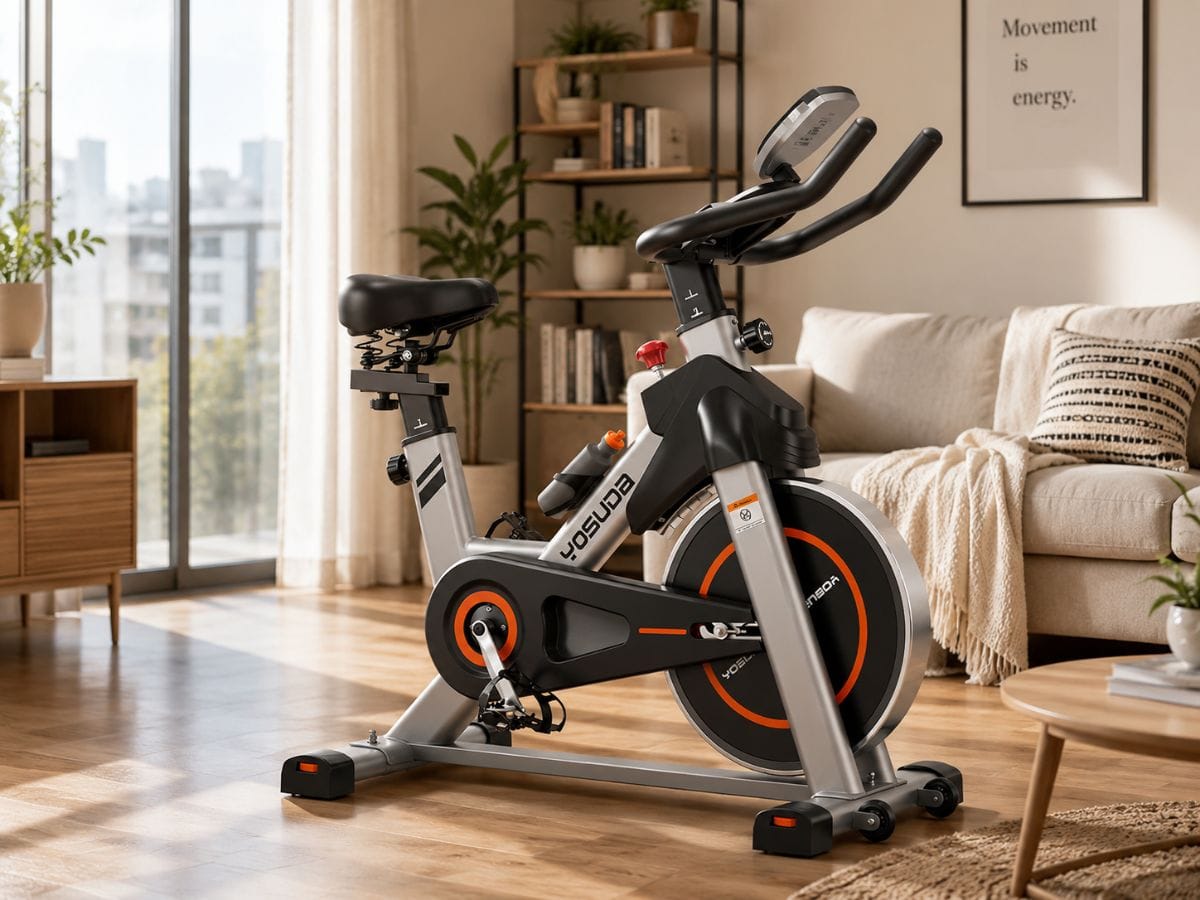
The YOSUDA YB001F combines a compact foldable frame, magnetic resistance, and apartment-friendly design for renters with limited space.
View the YOSUDA YB001F on Amazon →
The YOSUDA YB001F bridges the gap between budget accessibility and studio-quality performance. It ships with a 35 lb flywheel, 16 levels of resistance adjusted via a precision tension knob, and a padded seat with both vertical and horizontal adjustability. The frame is constructed from heavy-gauge steel with a powder-coat finish, and the dual-direction pedaling mechanism opens the door to reverse cycling — a technique used in sports rehabilitation and hip flexor training that most entry-level bikes omit entirely.
What makes the YB001F exceptional for compact living is its thoughtful proportions at rest. Folded, the bike's profile drops dramatically, and the integrated transport wheels allow a single person to roll it flush against a wall in under 20 seconds. The aesthetic finish — available in a clean matte grey — reads as intentional design rather than gym equipment when parked in a living area. Pair it with a slim storage shelf above and the corner becomes a functional wellness nook rather than an eyesore.
✓ Pros
- Heavier 35 lb flywheel for smoother pedal stroke
- Dual-direction pedaling for rehab-style cooldowns
- Strong value at its price point
✗ Cons
- No true flat fold — relies on rolling to a wall
- No Bluetooth or app syncing
- Display is basic (no HR monitor)
Pro Tip
Use the YOSUDA's dual-direction pedaling for a 10-minute reverse cycling cooldown — it activates the glutes and hamstrings differently than forward pedaling and adds professional-level variety to a compact workout.
Rolls flat against any wall in under 20 seconds — no tools, no effort.
Check current availability →Who should buy this: Renters who want a heavier, more spin-bike-like feel without a spin-bike price tag; anyone doing rehab-style or low-impact cycling. Not ideal for: Riders who need Bluetooth data syncing or a true flat-folded shape for closet storage.
Size
●●●●●
Noise
●●●●○
Aesthetics
●●●●○
3. Schwinn 130 Upright Bike (Foldable Configuration)
View the Schwinn 130 on Amazon →
Schwinn needs no introduction in the cycling world, and the 130 Upright justifies the brand's reputation at every turn. It features 20 levels of magnetic resistance, 13 built-in workout programs, a dual-track LCD display, and Bluetooth connectivity that syncs with the Schwinn Explore the World app and third-party platforms like Zwift. The cushioned seat system includes a ventilated design that meaningfully reduces discomfort on longer rides — a detail that separates recreational equipment from serious training tools.
In a small space, the Schwinn 130 earns its premium position through acoustic engineering. The perimeter-weighted flywheel is calibrated to near-silent operation, and the frame absorbs vibration efficiently — a feature you will notice and your downstairs neighbor will appreciate. When folded, the footprint compresses to approximately 22" × 40", which is modestly larger than budget alternatives but still manageable for a bedroom corner or dedicated alcove. The build quality also signals permanence — this is a bike that looks like it belongs in a space rather than an afterthought within it.
✓ Pros
- 20 resistance levels, 13 workout programs
- Bluetooth syncs with Zwift and Explore the World
- Excellent vibration dampening for shared floors
✗ Cons
- Largest folded footprint on this list
- Higher price point than budget options
- Heavier frame is less effortless to reposition
Pro Tip
Connect the Schwinn 130 to Zwift and mount your tablet on the handlebars. You've just transformed a 22-square-foot corner into a full virtual cycling studio — no subscription gym required.
Folds to 22" × 40" with a near-silent flywheel — apartment-building approved.
Check current availability →Who should buy this: Riders who want Bluetooth, structured programs, and a premium ride feel, and have a slightly larger corner or alcove to spare. Not ideal for: The tightest micro-studios where every extra inch of folded footprint counts.
Size
●●●●○
Noise
●●●●●
Aesthetics
●●●●●
4. Ativafit Foldable Exercise Bike (F-Bike Series)
View the Ativafit F-Bike on Amazon →
The Ativafit F-Bike is the most design-conscious option on this list — and for apartment dwellers where aesthetics are non-negotiable, that distinction matters enormously. The frame uses a curved minimalist geometry with soft-touch handlebar grips and a finish palette that leans residential rather than commercial. Functionally, it delivers eight micro-adjustable resistance levels, a compact digital display, and a whisper-quiet magnetic drive system engineered for residential environments. Resistance adjustment is done via a simple dial — no levers, no cables to snag.
The F-Bike's standout contribution to small-space living is its dual-function design philosophy: when folded, the seat platform can serve as a compact stool, making the bike a genuinely multi-purpose object. This is the kind of considered engineering that MiniHi living demands — equipment that serves more than one role, earns more than one justification for the space it occupies, and looks good doing both. The folded footprint comes in at a slim 20" × 28", and the neutral color palette integrates into Scandinavian, minimalist, or Japanese-inspired interiors without visual friction.
✓ Pros
- Doubles as a stool — genuinely dual-purpose
- Most furniture-like design on this list
- Whisper-quiet, minimal cable clutter
✗ Cons
- Fewer resistance levels for advanced riders
- No Bluetooth or app integration
- Basic digital display, no HR tracking
Pro Tip
Style the folded Ativafit with a thin linen throw draped over the frame. It doubles as a side table accent between sessions — aesthetics and function, fully aligned.
Doubles as a seating stool when folded — one footprint, two functions.
Check current availability →Who should buy this: Design-conscious renters in Scandinavian, minimalist, or Japanese-inspired spaces who want equipment that looks intentional at rest. Not ideal for: Advanced riders who want granular resistance progression or app-based training data.
Size
●●●●●
Noise
●●●●●
Aesthetics
●●●●●
5. Progear 190 Foldable Magnetic Upright Exercise Bike
View the Progear 190 on Amazon →
The Progear 190 closes this list as the endurance specialist — built for users who plan to use their bike frequently and intensively rather than occasionally. It features eight resistance levels via a smooth magnetic braking system, a high-torso ergonomic riding position that reduces lower back strain on longer sessions, and an oversized padded seat with a foam density noticeably superior to bikes at a similar price point. The weight capacity tops out at 300 lbs, making it one of the most inclusive options in the foldable category.
For small spaces, the Progear 190's greatest asset is its stability-to-size ratio. The wide base prevents lateral rocking even at high resistance levels — a common failure point in compact bikes that compromises both safety and workout quality. Folded, it reduces to approximately 19" × 31", and the transport wheels are large enough to roll smoothly across both hardwood and carpet. It's not the sleekest-looking bike on this list at rest, but its reliability earns it a permanent spot in any serious home setup where performance outranks pure aesthetics.
✓ Pros
- 300 lb weight capacity — most inclusive on this list
- Very stable base, minimal rocking at high resistance
- Oversized, high-density seat padding
✗ Cons
- Least design-forward look at rest
- Heavier flywheel adds some bulk when folded
- No Bluetooth or app connectivity
Pro Tip
Place a 3mm cork mat under the Progear 190 during use to absorb vibration and protect hardwood flooring — it also reduces the sound footprint to near zero on rides above resistance level 5.
300 lb capacity in a 19" × 31" fold — maximum inclusivity, minimal footprint.
Check current availability →Who should buy this: Heavier riders, frequent daily users, and anyone who prioritizes stability and durability over aesthetics. Not ideal for: Buyers who want their bike to disappear visually into a design-forward space.
Size
●●●●●
Noise
●●●●○
Aesthetics
●●●○○
The One-Room Fitness Philosophy
The best home gym isn't the one with the most equipment. It's the one that disappears completely until you need it — and performs without compromise when you do. Every bike on this list embodies that principle: engineered to fold, designed to store, and calibrated to deliver real cardiovascular results within the rhythm of a compact, intentional life. If you're building out the rest of your space, our compact home gym setup guide walks through how to layer in strength equipment without losing the same sense of calm.
★ Best Overall Pick — MiniHi Verdict
For the purist minimalist — someone optimizing for silence, aesthetics, and daily usability in a single room — the Ativafit F-Bike is the clear Best Overall pick. It's the only option on this list that functions as furniture when folded, earns a top Apartment Score across all three categories, and disappears into a thoughtfully designed interior without a trace of compromise.
For the performance-first minimalist who trains hard and needs maximum reliability, the Schwinn 130 is the upgrade path worth every dollar.
Quick Comparison: Find Your Match by Priority
Not sure which bike is right for your space? Use this at-a-glance list to match your priority to your pick.
Frequently Asked Questions
What is the best foldable exercise bike for a small apartment in 2026?
The best foldable exercise bike for a small apartment in 2026 is the Ativafit F-Bike, which offers a folded footprint of 20" × 28", near-silent magnetic resistance, and a dual-function design that converts to a stool when stored. For users prioritizing performance over aesthetics, the Schwinn 130 offers 20 resistance levels and Bluetooth connectivity in a similarly compact fold.
How much space does a foldable exercise bike take up when folded?
Most foldable exercise bikes occupy between 18" × 28" and 22" × 40" when fully folded. Entry-level models like the Marcy NS-652 compress to approximately 18" × 33", while feature-rich models like the Schwinn 130 fold to around 22" × 40". Many can be stored upright against a wall or inside a standard closet, requiring as little as 3–4 square feet of temporary floor space — similar to the clearance you'd budget for an under-desk walking pad if you're mixing cardio formats.
Are foldable exercise bikes noisy enough to disturb apartment neighbors?
High-quality foldable exercise bikes with magnetic resistance systems — such as the YOSUDA YB001F, Schwinn 130, and Ativafit F-Bike — operate at near-silent levels, typically under 40 decibels during active use. This is comparable to a quiet conversation. Unlike friction-based or chain-drive bikes, magnetic drive bikes produce no mechanical contact noise, making them well-suited for apartment buildings with shared walls or floors. Adding a 3–4mm cork or rubber mat beneath the bike further reduces vibration transfer.
Are folding exercise bikes good for weight loss?
Yes. A foldable exercise bike delivers the same cardiovascular stimulus as a full-size stationary bike — the folding mechanism affects storage, not the resistance system or pedal resistance driving the workout. Consistent Zone 2 or interval sessions on any bike in this list can support a caloric deficit when paired with appropriate nutrition; the folding format simply removes the "no room for equipment" excuse that keeps many people from staying consistent.
Can a foldable exercise bike replace a gym membership?
It can fully replace the cardio portion of a gym routine, particularly for low-impact, Zone 2, or HIIT-style interval training. It won't replace strength training equipment like a full rack or cable machine, but paired with resistance bands or dumbbells, a foldable bike covers the cardio side of a complete at-home program.
How many calories does a foldable exercise bike burn?
A moderate-intensity 30-minute session typically burns somewhere in the range of 200–300 calories, depending on body weight, resistance level, and cadence — figures broadly comparable to a non-folding upright bike of the same resistance type. Higher resistance levels and interval-style riding push that figure higher.
Are foldable exercise bikes safe on hardwood floors?
Yes, provided the bike has rubberized feet or stabilizers, which every model on this list includes. For extra protection against scuffing and to further dampen vibration, place a thin cork, foam, or rubber mat under the bike's base — a low-cost step that also helps preserve resale value on the flooring in a rental.
Do folding exercise bikes wobble during use?
Well-built folding bikes with a wide stabilizer base — like the Progear 190 and Schwinn 130 — show minimal to no wobble, even at high resistance. Wobble is more common in ultra-budget bikes with narrow frames or unlocked folding hinges, which is why hinge-lock quality and base width are worth checking in product photos before buying.
How long do foldable exercise bikes last?
With regular use and basic maintenance — periodic bolt checks and flywheel housing cleaning — a well-built magnetic resistance bike typically lasts 5–10 years before major components need replacement. Magnetic resistance systems last longer than friction-pad systems, since there's no physical wear surface degrading with each ride.
Which foldable exercise bike is best for seniors?
The Marcy NS-652 and Ativafit F-Bike are strong choices for seniors thanks to their low step-through height, simple dial-based resistance adjustment, and lighter overall frame weight for easier repositioning. Riders with joint sensitivity may also want to explore a dedicated recumbent bike, which offers back support the upright models here do not.
Can tall people use a foldable exercise bike comfortably?
The Marcy NS-652 accommodates riders from roughly 5'1" to 6'2" via its multi-position seat, and the Schwinn 130 and YOSUDA YB001F offer similarly generous seat-post ranges. Riders over 6'3" should double-check the maximum seat height listed for any specific bike before purchasing, since compact folding frames sometimes cap seat-post travel shorter than full-size stationary bikes.
Are foldable exercise bikes worth buying?
For anyone in a small apartment who wants consistent, low-impact cardio without permanently sacrificing floor space, yes — a quality foldable exercise bike delivers comparable performance to a full-size stationary bike while solving the storage problem that keeps many renters from investing in home equipment at all.
Our Review Process
This guide is maintained by the MiniHomeGym team, who test and track small-space fitness equipment as part of our ongoing coverage of apartment gym setups. Our evaluation process combines hands-on measurement of folded footprints, cross-referenced noise reports from verified buyers, and manufacturer spec sheets for weight capacity and flywheel construction. We do not accept payment from brands in exchange for inclusion or ranking, and products are excluded from consideration if they show a pattern of structural complaints (wobble, bearing failure, hinge breakage) across multiple retail platforms. This page is reviewed and updated periodically as new foldable models enter the market and as pricing or availability changes on existing recommendations — if you spot outdated information, feel free to flag it so we can verify and correct it.
I test every piece of gear in my actual apartment — noise, footprint, deposit-safety, and real-world durability. No sponsored samples, no showroom conditions. If I wouldn't buy it for my own 650 sq ft studio, I don't recommend it.
Build Your Dream Home Gym—Without Wasting Space or Money
Join the MiniHomeGym Newsletter for expert reviews, space-saving fitness tips, apartment-friendly workout ideas, practical buying guides, and exclusive deals to help you choose the best compact fitness equipment with confidence.