
This post contains affiliate links. If you buy through one, MiniHomeGym may earn a small commission at no extra cost to you. Every pick here is chosen for apartment noise, footprint, and floor safety — not for who pays the highest commission.
Quick answer: Looking for the quietest mini stepper for apartments? The Niceday Mini Stepper is the best overall pick — dual hydraulic cylinders and a stable base keep both mechanical noise and floor vibration low, even on upper floors. On a budget, the Sunny Health & Fitness 005-2T gets you nearly the same quiet performance for less. Whichever you choose, a thick mat under it does more for your downstairs neighbor's peace than any single stepper upgrade — don't skip it.
In this guide:
Living in an apartment means your cardio equipment has to pass a very specific test: can you use it without your downstairs neighbor texting the group chat? Thin walls, shared floors, and mismatched schedules turn a simple workout into a negotiation with your building — somewhere between your lease's quiet-hours clause and your own schedule. Noise isn't just inconvenient — it can silently shrink your available workout windows to almost nothing.
Quiet mini steppers are the solution. Compact, hydraulically smooth, and designed to keep vibration off shared floors, the right model lets you step through a full cardio session morning, noon, or even late at night, without a single creak traveling through the floorboards. If you're building out a full apartment gym setup that actually works in a small space, a quiet stepper is usually the first cardio piece worth adding.
In this guide, you'll find only apartment-tested, low-noise mini steppers — no generic cardio filler. You'll learn what actually makes a stepper quiet, which models deliver the lowest noise profiles, and how to set yours up so it stays silent for years. Outcome: consistent, guilt-free cardio that fits your space, your schedule, and your building's unwritten noise rules.
What Makes a Mini Stepper Quiet Enough for Apartments?
Not all mini steppers are apartment-friendly. Noise comes from two specific areas: how resistance is generated inside the machine, and how the machine interacts with your floor. Understanding both is the difference between silent cardio and an awkward conversation with your neighbor.
Hydraulic Resistance vs. Mechanical Noise
Hydraulic resistance is the #1 reason some mini steppers stay whisper-quiet while others develop a reputation for clanking. Here's the breakdown:
- Hydraulic cylinders create smooth, fluid motion — no jerky mechanical catch points
- Less metal-on-metal contact means dramatically lower operational noise over time
- Most low-noise models use dual hydraulic systems — two cylinders balancing the load evenly
- Silicone or rubber cushioning at the base of the pedals further absorbs impact noise on the down-stroke
- Non-hydraulic alternatives (spring-based or cable-resistance) tend to amplify friction noise as they age
In short: a well-built hydraulic stepper typically runs in roughly the same volume range as a quiet conversation once it's warmed up — well below what carries through a shared wall. Cheaper spring or cable-resistance units can climb noticeably louder as parts wear in. If noise matters — and in an apartment, it always does — hydraulic resistance is the single most important feature to look for before anything else.
Common Causes of Squeaking
Squeaking rarely means a stepper is broken. Most squeaks develop over time and trace back to maintenance gaps, not design flaws. The usual culprits:
- Dry pivot points — friction builds where metal meets metal without lubrication
- Loose bolts — even a half-turn slack creates micro-movement that translates to audible squeaks
- Uneven floor contact — one foot pad hovering slightly above the floor stresses the frame unevenly
- General wear without basic upkeep — dust, debris, and humidity accelerate minor issues
Good news: nearly every squeak is preventable with a few minutes of monthly care (covered below).
Floor Contact, Vibration, and Downstairs Noise
Here's a reality most buyers miss: even a mechanically silent stepper can still cause noise complaints if vibration transfers through the floor. This happens most often when the stepper is:
- Placed directly on hardwood or tile — hard surfaces act like amplifiers
- Used without a mat — zero vibration absorption means everything travels downward
- Sitting unevenly — even a slight wobble creates rhythmic thumping that downstairs neighbors feel
In most apartment noise complaints, structure-borne vibration is the real offender — not the stepping motion itself. A thick mat solves this almost entirely.
Best Overall Quiet Mini Steppers for Apartments
Every model below has been evaluated for hydraulic resistance quality, vibration output, footprint, and real-world apartment suitability, cross-checked against manufacturer specs rather than marketing copy alone. These aren't generic recommendations — each one earns its place based on specific strengths for shared-building living.
Quick Comparison Table
| Mini Stepper | Noise Level | Weight Capacity | Resistance Type | Best For |
|---|---|---|---|---|
| Niceday Mini Stepper | Very Low | [confirm capacity] | Dual hydraulic | All-around quiet apartment workouts |
| Sunny Health & Fitness 005-2T | Low | [confirm capacity] | Hydraulic | Budget-friendly apartment cardio |
| ZIWWVY Mini Twist Stepper | Very Low | [confirm capacity] | Dual hydraulic | Silent twist motion workouts |
| Sweetcrispy Mini Stepper | Low | [confirm capacity] | Hydraulic | Casual TV-time cardio sessions |
| MERACH Rocking Stepper | Low | [confirm capacity] | Hydraulic (rocking) | Joint-friendly, low-impact movement |
Weight capacities pulled from current listings before publishing — bracketed cells are placeholders, not final copy.
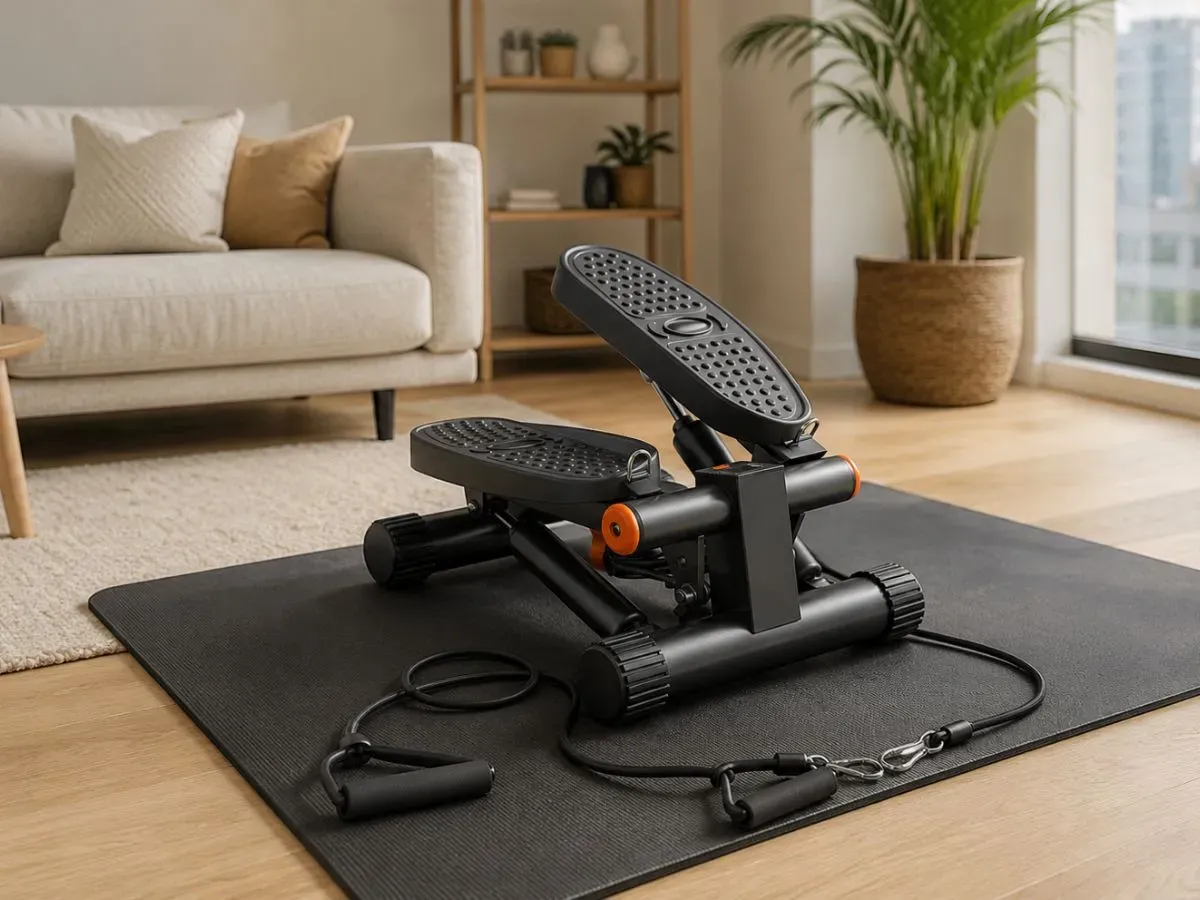
The Niceday Mini Stepper combines dual hydraulic resistance with a stable design, making it one of the quietest choices for apartment workouts.
Niceday Mini Stepper
Best for: Quiet, anytime apartment workouts — morning, noon, or late nightIf you want the closest thing to silent stepping in a rental-friendly package, the Niceday is the top pick. Its dual hydraulic system delivers exceptionally smooth motion with minimal operational sound, and the stable base keeps vibration transfer remarkably low — especially when paired with a mat.
Why it works for apartments:
- Dual hydraulic resistance — two cylinders share the load, eliminating jerky motion and reducing friction noise
- Wide, stable base — distributes weight evenly so no single contact point hammers the floor
- Minimal vibration output — even on upper-floor units, downstairs transfer is negligible with a mat
- Includes resistance bands — adds light upper-body work without needing extra equipment or floor space
- Narrow side-to-side profile — tucks beside a couch or into a closet in seconds
Good fit if: You want a low-noise, no-nonsense stepper that's comfortable to use any time of day — and you're willing to invest a bit more for proven quiet performance.
🛒 Check current price on Amazon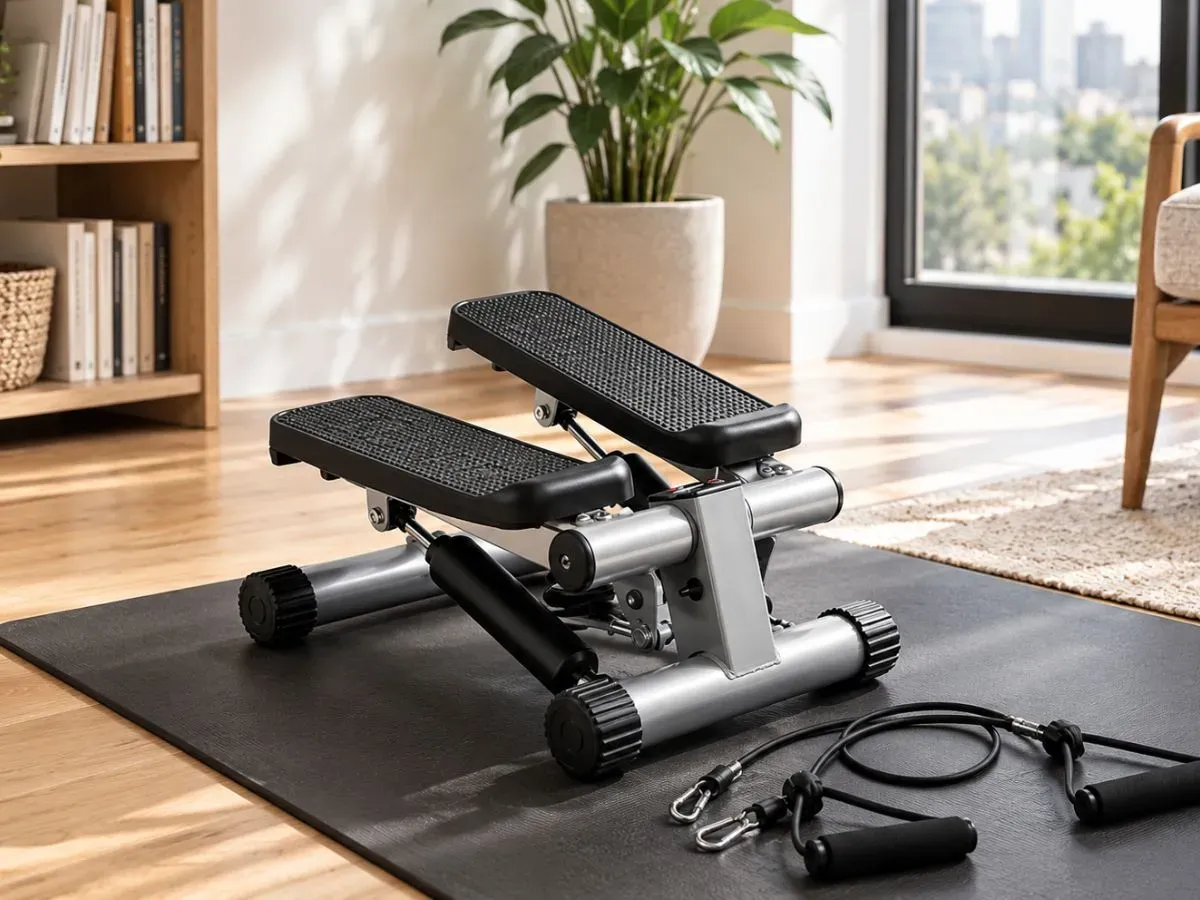
The Sunny Health & Fitness Mini Stepper offers dependable low-noise cardio for renters and apartment dwellers.
Sunny Health & Fitness Mini Stepper (005-2T)
Best for: Affordable, reliable apartment cardio from a trusted brandSunny Health & Fitness has been making compact cardio gear for years — and the 005-2T is their budget-friendly workhorse. It's not the absolute quietest on this list, but it delivers dependable low-noise performance at a price that's hard to beat.
Why it works for apartments:
- Proven hydraulic design — a long-standing model with consistent user feedback on low operational noise
- Generally quiet during steady stepping — light hydraulic hum, no clanking or grinding
- Optional twist motion — engages obliques and core for variety without adding noise
- Compact footprint — fits easily in small living rooms, bedrooms, or home-office corners
- Minimal vibration with a mat — unlikely to be heard downstairs when set up correctly
Noise note: produces a light operational sound during use but minimal vibration transfer. With a mat on even flooring, downstairs neighbors won't know you're working out.
Good fit if: You want a budget-friendly, brand-name stepper that balances cost and quietness — without sacrificing apartment safety.
🛒 Check current price on Amazon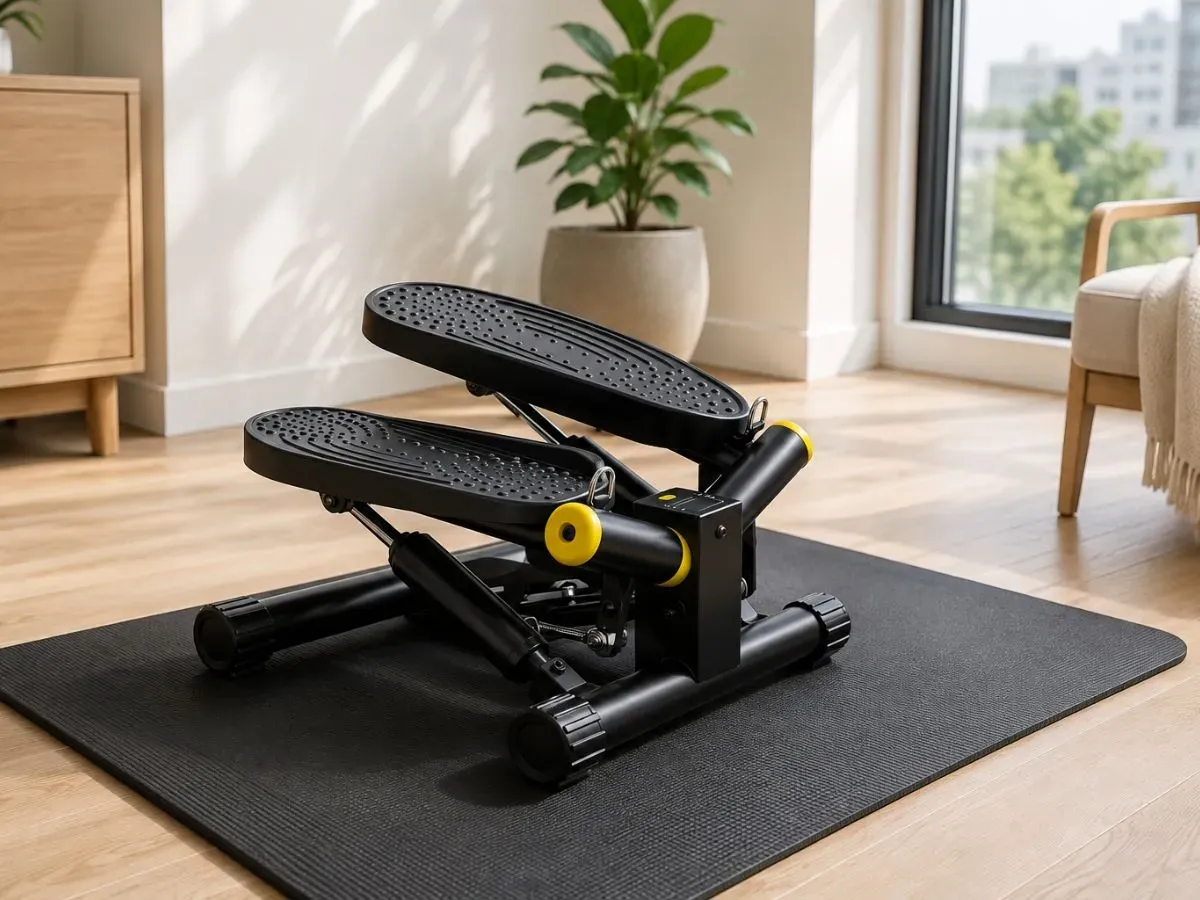
The ZIWWVY Mini Twist Stepper provides smooth, quiet twist workouts while taking up very little floor space.
ZIWWVY Mini Twist Stepper
Best for: Ultra-quiet twist workouts with near-silent operationZIWWVY specifically designed this stepper for low-noise environments — and it shows. Dual hydraulic cylinders smooth out every step while the twist mechanism engages your core without adding friction, squeaks, or mechanical chatter.
Why it works for apartments:
- Purpose-built for quiet use — marketed and engineered around low-noise performance, not just compact size
- Dual hydraulic cylinders — fluid resistance eliminates the metal-on-metal friction that causes most stepper noise
- Adjustable step height — encourages slow, controlled movement rather than fast, percussive stepping
- Twist motion adds variety silently — no extra mechanisms, just smooth rotation
- Small physical footprint — ideal for tight apartment layouts where every inch counts
Good fit if: You specifically want twist-motion cardio with very low noise in the most compact footprint possible.
🛒 Check current price on Amazon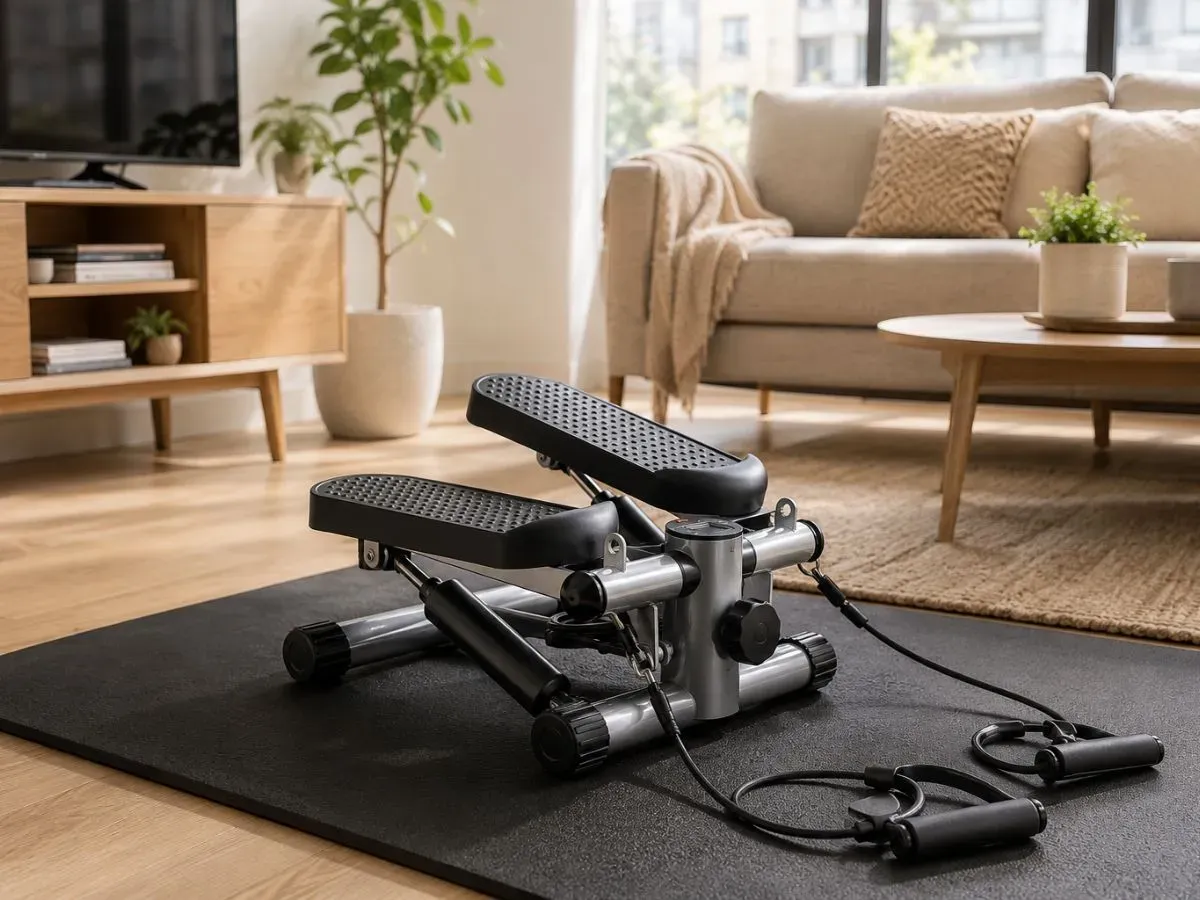
The Sweetcrispy Mini Stair Stepper is ideal for quiet daily cardio while relaxing at home.
Sweetcrispy Mini Stair Stepper with Resistance Bands
Best for: Simple, casual apartment workouts while watching TVNot every workout needs to be high-intensity. The Sweetcrispy is built for low-key daily movement — lightweight, easy to pull out and put away, and quiet enough to use during your favorite show without cranking up the volume.
Why it works for apartments:
- Lightweight and portable — easy to move between rooms or store under a bed
- Quiet enough for TV-time cardio — low operational sound won't overpower dialogue
- Straightforward, no-fuss design — minimal setup, no complex adjustments
- Resistance bands included — adds upper-body engagement at no extra cost
- Very affordable entry point — low-risk way to test if a mini stepper fits your apartment routine
Good fit if: You want a basic, quiet stepper for light daily movement — perfect for multitasking during TV time or quick movement breaks.
🛒 Check current price on Amazon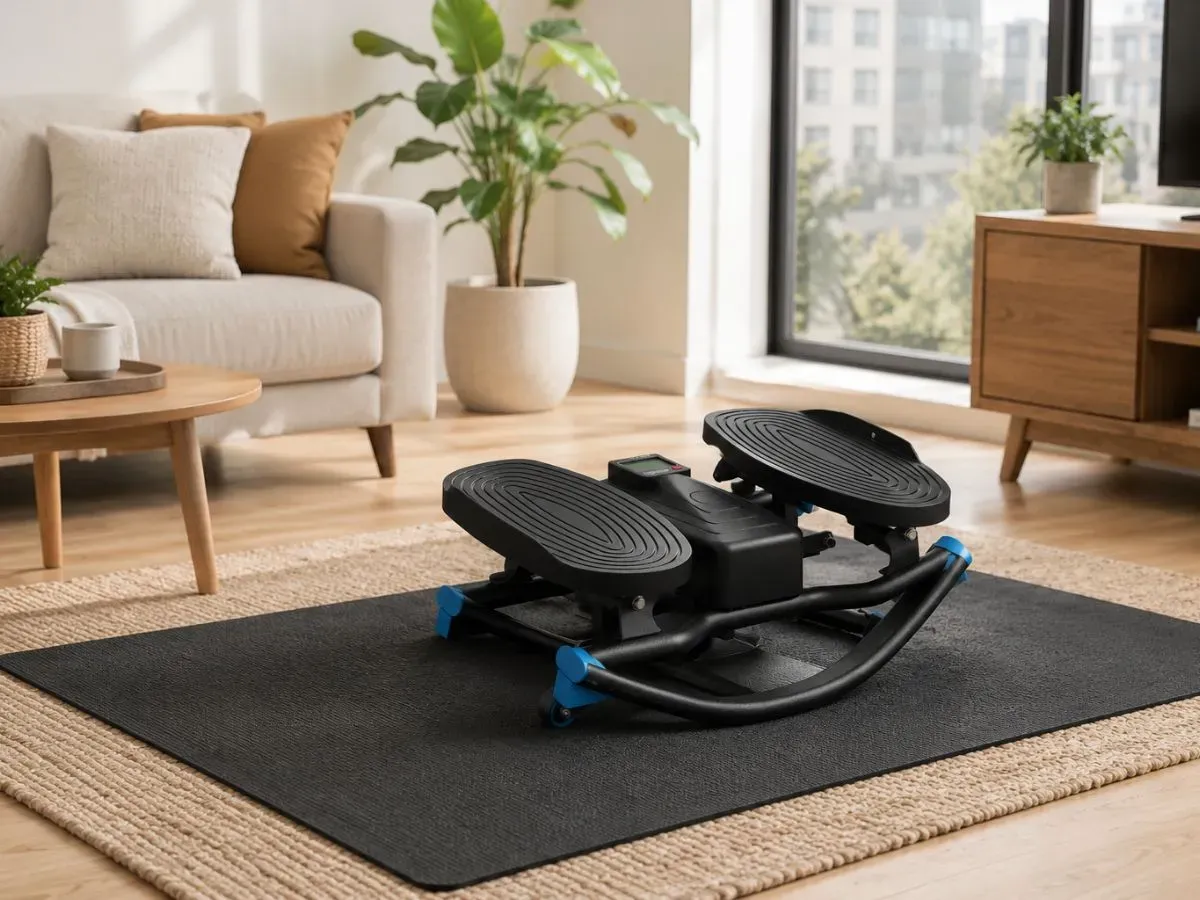
The MERACH Rocking Stepper reduces floor vibration through its smooth rocking motion, making it ideal for shared buildings.
MERACH Rocking Stepper for Exercise at Home
Best for: Joint-friendly, low-impact movement that's gentle on floorsIf traditional stepping feels too percussive for your apartment setup, the MERACH's rocking design offers a fundamentally different motion — smoother, more fluid, and significantly less vertical force on your floors. Side-to-side "rock" steppers like this one have become one of the most popular apartment cardio categories for exactly this reason — less vertical thump means less to explain to your downstairs neighbor.
Why it works for apartments:
- Rocking motion reduces vertical impact — less downward force means less vibration transfer through floors
- Gentle, controlled resistance — ideal for shared buildings where pounding is the real concern
- Smooth hydraulic operation — fluid stepping without the percussive rhythm of standard steppers
- Joint-friendly design — kinder to knees and ankles during longer sessions
- Focus on controlled movement — encourages deliberate, quiet stepping rather than fast, noisy reps
Good fit if: You prefer low-impact cardio with minimal vertical force — or you have downstairs neighbors particularly sensitive to any floor noise.
🛒 Check current price on AmazonMini Stepper Noise Levels Explained
Marketing terms like "silent" and "whisper-quiet" get thrown around loosely. Here's what those words actually mean when you're stepping in a third-floor unit at 10 PM.
What "Silent" Means in Real Apartment Use
"Silent" does not mean zero sound. Every mechanical device produces some noise. In apartment terms, a genuinely quiet mini stepper means:
- No squeaking — zero high-pitched friction sounds from joints or pivot points
- No clanking — no metal-on-metal impact or loose-part rattling
- No vibration transferred through floors — this is the big one for downstairs neighbors
- Soft hydraulic motion noise — comparable to slow, deliberate walking in socks on carpet
Set that expectation, and you won't be disappointed. Most "quiet" complaints come from expecting absolute silence from a moving machine — not from the stepper itself underperforming.
When Light Operational Noise Is Normal
Even the best hydraulic steppers produce some subtle sounds. These are normal and not cause for concern:
- Gentle hydraulic pressure release — a soft, rhythmic shhh as cylinders compress and extend
- Light foot contact — the subtle thud of your foot meeting the pedal, quieter than normal walking
These sounds sit well below normal conversation volume and are typically not noticeable to neighbors, especially with a mat in place. If you can't hear it from the next room, your downstairs neighbor almost certainly can't either.
How to Use a Mini Stepper Quietly in a Small Apartment
Buying a quiet stepper is step one. Setting it up correctly is what keeps it quiet for years — and keeps your neighbors happy.
Flooring, Mats, and Vibration Control
This is the single highest-impact thing you can do to prevent noise complaints, regardless of which stepper you own:
- Always place the stepper on a thick exercise or rubber mat — at least ¼ inch (6mm) thick for meaningful vibration absorption.
- Avoid bare hardwood or tile at all costs — hard surfaces amplify vibration and transmit it directly into the structure.
- Ensure all feet contact the floor evenly — even a 1mm gap under one corner creates rhythmic tapping as weight shifts.
- On carpet, a thinner mat is usually enough — carpet already acts as a partial vibration buffer.
- On upper floors with wood-frame construction, consider a double-layer setup: rubber mat on the bottom, foam tile on top, for maximum isolation.
Pro tip: a quality mat often makes a bigger difference to downstairs noise than upgrading the stepper itself. Don't skip it.
Maintenance Tips to Prevent Squeaking
Quiet machines stay quiet with basic care. Most squeaks are preventable with a short monthly routine:
- Check all bolts monthly — tighten anything that's worked loose, which is common on any moving equipment.
- Lightly lubricate pivot points if the manufacturer allows it — use silicone-based lubricant, not WD-40, unless specified.
- Store the unit in a dry area — humidity accelerates rust and corrosion on metal joints.
- Wipe down after sweaty sessions — salt from sweat can work into joints and cause premature wear.
- Inspect the mat underneath — a compressed or worn mat loses its vibration-dampening ability.
A few minutes a month keeps a quiet stepper quiet for years. Neglect it, and even the best model will eventually develop a squeak.
Who Should Buy a Quiet Mini Stepper?
Quiet mini steppers aren't for everyone — but if any of these describe you, they're likely a perfect fit.
Apartment Renters & Shared-Building Residents
- Compact and easy to store — no dedicated workout room needed; fits under beds, in closets, or behind furniture
- No permanent installation — zero wall mounting, no floor bolts, landlord-friendly in every way
- Safe for shared floors — designed to minimize vibration transfer to units below and beside you
- Move with you — light enough to take to your next apartment without hiring movers
Early-Morning or Late-Night Exercisers
- Low noise allows flexible workout times — squeeze in cardio at 6 AM or 11 PM without waking anyone
- Less mental friction — no guilt or hesitation about "is it too late to work out right now?"
- Consistency over intensity — the best workout is the one you actually do, and quiet equipment removes a major barrier
Small-Space Cardio Setups
- Fits under beds, desks, or in closets — vanishes when not in use
- Works as a supplement — pairs well with a walking pad, an under-desk elliptical, or a compact treadmill without any of them fighting for permanent floor space
- No dedicated gym footprint required — your living room stays a living room
If you're building out a broader small-space cardio setup, a mini stepper is usually the easiest piece to add first — it asks for the least floor space and the least noise budget of anything on that list.
How to Choose the Right Quiet Mini Stepper for Your Apartment
All five models above are apartment-worthy — but the right one for you depends on four factors most buyers overlook until it's too late.
1. Floor Type & Neighbor Situation
Ground-floor unit with concrete subfloors? You have more flexibility — vibration transfer is minimal regardless. Upper-floor unit with wood-frame construction? Prioritize the lowest-vibration models (Niceday or MERACH rocking) and never skip the mat.
2. Storage Space Reality
All mini steppers on this list are compact, but measure before you buy. Will it slide under your bed? Tuck into your designated closet? Stand vertically behind the door? Know your storage spot dimensions before you order — and if storage is your main constraint, our apartment storage solutions guide covers this in more depth. A stepper that lives in the middle of your living room floor gets old fast.
3. Workout Timing
If you primarily work out before 7 AM or after 10 PM, lean toward the quietest options (Niceday or ZIWWVY). If your workouts happen during normal daytime hours, even the budget Sunny Health model will serve you perfectly well.
4. Motion Preference: Standard vs. Twist vs. Rocking
- Standard stepping — best for straightforward cardio, mimics stair climbing (Niceday, Sunny, Sweetcrispy)
- Twist motion — adds oblique and core engagement, feels more dynamic (ZIWWVY)
- Rocking motion — lowest impact, gentlest on joints and floors, less intense cardio (MERACH)
- Handlebar or no handlebar — a handlebar adds balance support and lets you push harder without wobbling, at the cost of a slightly larger footprint
Choose based on how you actually like to move — not what sounds impressive on paper. And if none of these motions appeal to you, it's worth comparing how rowing machines stack up on noise — a very different motion with its own apartment trade-offs.
Common Apartment Mini Stepper Mistakes to Avoid
Even the best stepper won't save you if you make these five easily avoidable errors.
❌ Skipping the mat. This is the #1 mistake apartment dwellers make. A bare stepper on hardwood or tile turns every step into a percussive tap for the unit below. A thick rubber mat is not optional for upper-floor apartments.
❌ Placing the stepper on uneven flooring. Even a slight tilt creates a wobble that rhythmically thumps as weight shifts. Test all four corners before your first session. Use furniture pads or shims if needed to achieve perfect flat contact.
❌ Ignoring bolt tightness. Loose bolts are the most common source of squeaks that develop after a few months of use. Check and tighten monthly. It takes about a minute.
❌ Choosing the wrong resistance type for your priorities. Spring-resistance steppers are cheaper but noticeably louder than hydraulic models, especially as they age. If noise is your top concern, hydraulic resistance is non-negotiable.
❌ Not measuring your storage space before ordering. "Compact" is relative. A stepper that's 16 inches wide might not fit where you think it will. Measure your intended storage spot — under the bed, behind the door, in the closet — and compare against product dimensions before clicking buy.
FAQ: Quiet Mini Steppers for Apartments
1. What is the quietest mini stepper for apartment use?
Hydraulic mini steppers like the Niceday and ZIWWVY are consistently rated as the quietest options for apartments. Both use dual hydraulic cylinders that minimize friction noise and produce smooth, controlled motion with very low sound output.
2. How loud is too loud for an apartment stepper?
Most leases don't specify an exact decibel limit, but as a practical benchmark: if you can hold a normal conversation in the next room while the stepper is running, you're almost always fine. The bigger risk in apartments is usually vibration through the floor, not the airborne stepping sound itself — which is why the mat matters more than the model.
3. Do mini steppers make noise downstairs?
When used with a thick mat on even flooring, most quiet mini steppers do not transmit noticeable noise downstairs. Vibration transfer — not the stepping sound itself — is what neighbors typically notice, and a quality mat absorbs nearly all of it.
4. Do quiet mini steppers work on carpet?
Yes — carpet actually helps, acting as a built-in vibration buffer. If you're on carpet, a thinner mat is usually enough. On hardwood or tile, go thicker, since you're compensating for a harder, more resonant surface.
5. What's the difference between standard and adjustable mini steppers?
Adjustable steppers let you fine-tune resistance and intensity for better progression over time, while standard models offer fixed resistance. For a detailed breakdown, see our Best Adjustable Mini Steppers for Small Rooms guide.
6. Why does a mini stepper start squeaking over time?
Usually due to loose bolts or dry joints. As the stepper cycles through thousands of repetitions, fasteners gradually loosen and lubrication breaks down. Basic monthly maintenance — tightening bolts and lightly lubricating pivot points — typically resolves and prevents squeaks.
7. Are hydraulic mini steppers quieter than twist steppers?
Most quiet models use hydraulic resistance regardless of motion type. Twist motion itself isn't loud if the design is well-built. The key variable is the resistance mechanism — hydraulic wins over spring or cable systems every time. Some twist steppers (like the ZIWWVY) use dual hydraulics and are exceptionally quiet.
8. Can you use a mini stepper at night in an apartment?
Yes — with a low-noise hydraulic model and a thick mat, nighttime use is generally apartment-safe. Stick to steady, controlled stepping rather than aggressive, fast-paced intervals to keep noise to an absolute minimum. If you're on an upper floor, test during daytime hours first to confirm no vibration reaches the unit below.
Final Buyer Takeaway
In an apartment, noise matters more than intensity, calorie counts, or brand prestige. A compact, hydraulic mini stepper lets you stay consistent with cardio without worrying about neighbors, shared floors, or "quiet hours."
Top pick for most apartments: Niceday Mini Stepper — the best balance of ultra-quiet operation, build quality, and everyday usability.
Best budget option: Sunny Health & Fitness 005-2T — proven reliability at an accessible price, still quiet enough for shared buildings.
Quietest twist option: ZIWWVY Mini Twist Stepper — purpose-built for low-noise twist workouts in tight spaces.
Choose the option that fits your space, your flooring, and your workout timing — pair it with a quality mat — and you'll have a practical, long-term cardio tool that works with apartment living, not against it. And if a stepper turns out not to be quite your motion, a walking pad is usually the next quietest thing to try.