Home Gym Setup Under $500 vs $1,500: What's Actually Worth It for Renters in 2026?

Updated August 21, 2026 — pricing and product links checked against current retailer listings.
Picture two corners of the same 650 sq ft studio. In one: a rolled mat, adjustable dumbbells stacked against the baseboard, a door-frame pull-up bar above the closet — $500 total, invisible when guests come over. In the other: a WalkingPad folded under the bed frame, a bench flat against the wall, dumbbells up to 50 lbs on a wood tray — $1,500, and it looks designed, not assembled. Save this before you buy anything.
Home gym setup $500 vs $1,500 for renters:
The $500 setup covers the essentials — resistance training, cardio, and core — in a 6×6 ft corner. The $1,500 setup adds a walking pad or adjustable dumbbells with a higher weight ceiling, a foldable bench, and storage. For most renters, the $500 setup handles 80% of fitness goals. Upgrade to $1,500 when you've outgrown the basics or need daily cardio equipment.
The Real Question Renters Are Asking
The real question isn't which home gym setup wins on a spec sheet — it's how much of your studio you're willing to give up, and whether the gear survives your next move. Renters aren't building a gym. They're carving a functional corner out of a space that already holds a couch, a desk, and a downstairs neighbor who notices footsteps at 7am. Every purchase runs through constraints a product page never mentions: no permanent fixtures, because a security deposit isn't a line item you get to negotiate later; a noise ceiling, because impact sound moves through hardwood in ways a foam mat only partly absorbs (carpet is more forgiving, but the storage and deposit rules below still apply either way); storage limits, because equipment that sits out all week in 650 square feet stops feeling like a gym and starts feeling like clutter; and portability, because whatever you buy has to survive a move-out in one trip. I started with $400 and a resistance band set I used exactly twice before it ended up in a drawer. Here's what I'd tell myself to buy instead — starting with how I'd approach putting together a small-space gym setup from scratch today.
Either budget also beats the math of an ongoing membership. A basic setup in this range typically pays for itself in 4–8 months against an average $40–80 monthly membership fee, and over five years the savings usually land between $2,000 and $4,400 — plus the equipment keeps resale value a membership never does. I break down that full math in the home gym cost-vs-membership guide if you want the numbers for your own situation.
The $500 Apartment Gym — Full Build
At $500, you're not building a full gym — you're building consistency in a corner that disappears when you're done with it. This setup covers four real training days: push, pull, bodyweight-loaded legs, and core, plus daily low-impact cardio you can do without leaving your apartment. What it enables: resistance training up to roughly 30 lbs per hand, vertical pulling work most small-space setups skip entirely, and enough floor-based conditioning to build a genuine cardio habit. What it doesn't enable: heavy leg loading, sustained daily cardio on a dedicated machine, or upper-body work past the point where 25 lb dumbbells stop feeling hard. That's the honest trade at this budget, and it's a fair one for most renters just starting out — this is basically the exact gear list I use at $500, itemized below.
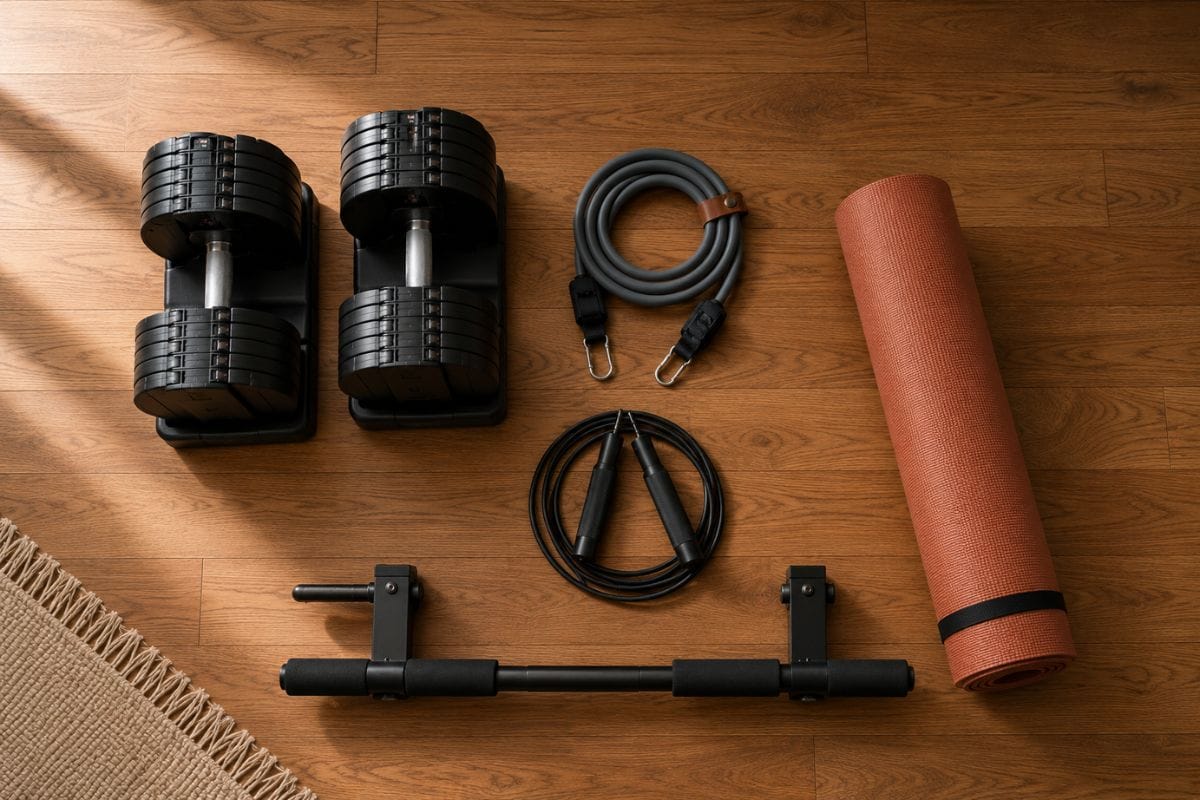
The entire $500 setup. One shelf, zero clutter.
Cardio
Mini stepper or under-desk elliptical (~$42) — Quiet, takes up 1 sq ft, and covers your low-impact daily cardio without a walking pad budget. Mine lives under my desk and I barely notice it's there.
Strength
Adjustable dumbbells, entry-level, up to 25–30 lbs (~$70) — Replaces a full rack of fixed weights in about 2 sq ft of floor space. Non-negotiable at this budget — buy these before anything else on this list. If you want more options at this price point, here's 18 adjustable dumbbells under $200 I've tested.
Resistance bands set (~$30) — Covers pulling movements dumbbells alone can't load properly, especially rows and face pulls.
Foldable yoga/exercise mat (~$45) — Floor work, stretching, and floor protection — one product doing three jobs in a small footprint.
Accessories
Resistance loop bands (~$9) — The cheapest way to add glute and hip work without adding a single piece of visible equipment.
Jump rope, quiet and weighted (~$30) — A genuinely apartment-safe cardio option once you've got the timing down. No impact noise, no neighbor texts.
Door-frame pull-up bar (~$27) — The highest-ROI piece at this budget. Adds vertical pulling, dips, and hanging core work you can't replicate with dumbbells or bands. Check the listed weight rating before you hang your full bodyweight from any door-frame bar — most quality bars are rated well over 250 lbs, but confirm it on the product page first.
Total: about $253 all-in at current retailer prices — less than a single month of a gym membership plus a rideshare to get there. Even lighter: dumbbells and a mat alone run under $115 if you want to start smaller and build from there.
What you can train at this budget:
- Push (dumbbells + bands): chest, shoulders, triceps ✓
- Pull (pull-up bar + bands): back, biceps ✓
- Legs (bands + bodyweight): quads, glutes, hamstrings ✓ (limited loading)
- Cardio (stepper or jump rope): daily low-impact ✓
- Core (mat + bands): full coverage ✓
"What this setup can't do: heavy leg loading above 30 lbs, daily cardio on a machine, upper body work above roughly 25 lb dumbbells. If you lift seriously or want daily steps without leaving your apartment, this budget runs out before you get there."
The $1,500 Apartment Gym — Full Build
The extra $1,000 doesn't just add gear — it changes what your body can actually do in the same corner. A weight ceiling that jumps from 30 lbs to 50+ lbs per hand means push and pull days stop feeling capped by week six. A bench turns chest press, incline row, and step-ups from theoretical into real training options. And a walking pad changes your daily step count from "whatever happened between the couch and the kitchen" into a deliberate, trackable habit — the single biggest behavioral shift of the upgrade. This isn't a better version of the $500 setup. It trains differently.
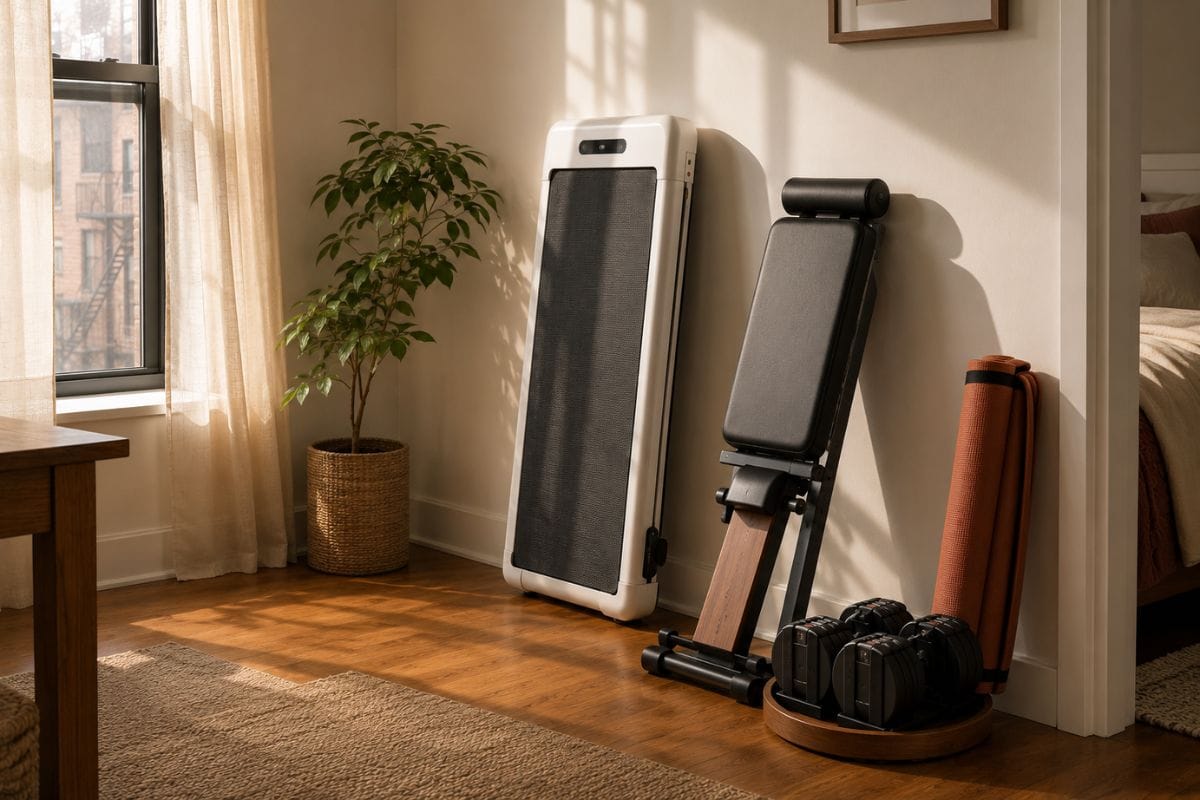
This is what the extra $1,000 actually buys.
Cardio (choose one)
WalkingPad C2 (~$399) — The anchor piece of the $1,500 build. Quiet enough to use during a work call and folds flat, adding 6,000+ daily steps without a commute to a gym. I wrote up my full review of this exact model after four months of daily use.
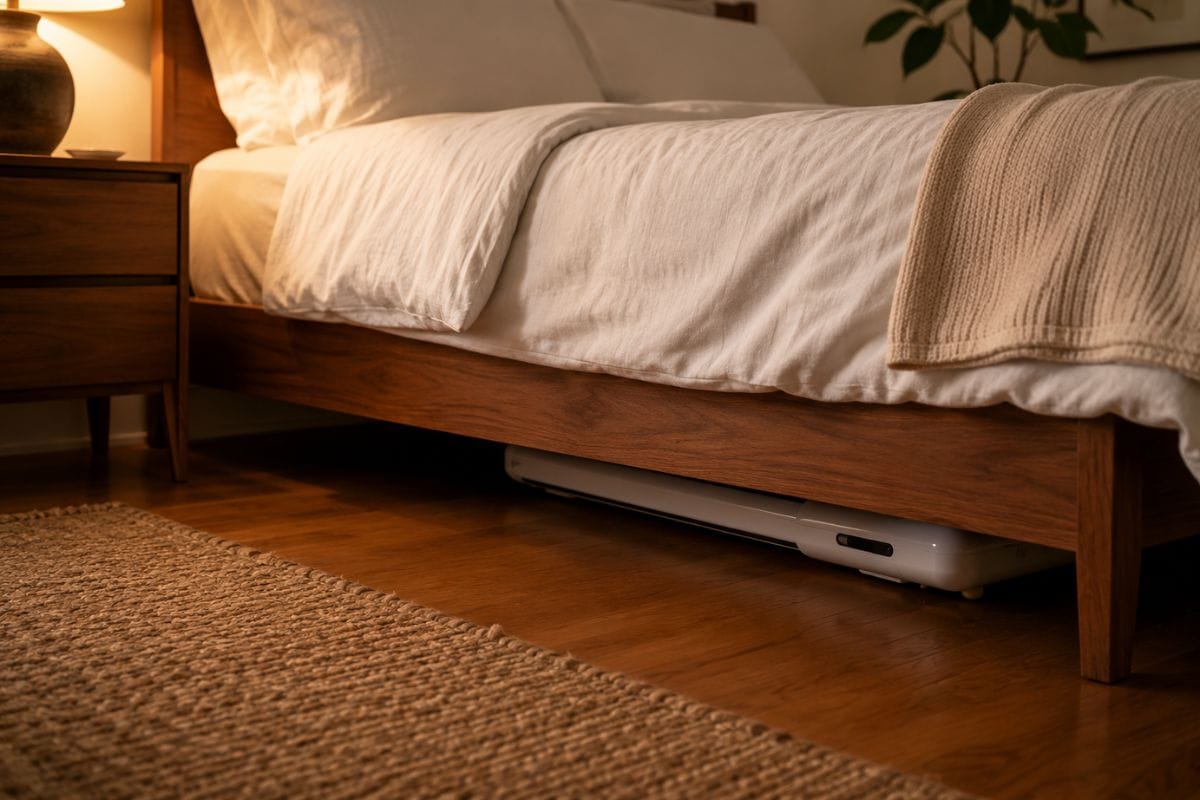
Cardio that disappears by bedtime.
or WalkingPad A1 Pro (~$499) — Worth the upgrade if you're over 5'7" or planning 60+ minute daily sessions. The longer deck makes a real difference at that height and duration.
Strength
Adjustable dumbbells, mid-range, up to 50–52.5 lbs (~$399) — PowerBlock or Bowflex SelectTech style, this is where the $1,500 budget opens up real strength training instead of maintenance work. If you're torn between the two, here's how PowerBlock stacks up against Bowflex SelectTech for small spaces specifically.
Foldable weight bench (~$129) — Changes every dumbbell pressing movement you own. The $500 setup can't do a proper chest press or incline row without this. Look for a stated user weight capacity on the listing, especially if you're pairing it with the heavier dumbbell range above.
Resistance bands set (~$30) — Same bands, more load behind them now that the dumbbells and bench can carry heavier work.
Foldable exercise mat (~$45) — Still doing the same three jobs: floor work, stretching, and protecting the floor underneath, hardwood or otherwise.
Storage
Dumbbell storage tray or small rack (~$96) — Keeps 50 lb dumbbells off the floor where they scuff hardwood and become a tripping hazard in a small space.
Anti-fatigue/walking mat for the walking pad (~$65) — Protects the floor under the WalkingPad and quiets the motor hum another notch. Worth it for a downstairs neighbor, and doubles as extra cushioning if you're on a harder concrete subfloor.
Total: roughly $1,163–$1,263 at current retailer prices, depending on which WalkingPad you choose.
What you can train at this budget:
- Push: heavy dumbbell pressing on a bench ✓✓
- Pull: heavier rows with more range of motion ✓✓
- Legs: up to 50 lb dumbbell loading ✓✓
- Cardio: daily walking pad sessions, 6,000–10,000 steps ✓✓
- Core: full mat and band coverage ✓✓
"What this setup still can't do: barbell work, squat rack movements, running. If those are your actual goals, you need a different setup entirely — or a different apartment."
$500 vs $1,500 — Head to Head
| $500 Setup | $1,500 Setup | |
|---|---|---|
| Total cost | ~$253 | ~$1,163–$1,263 |
| Cardio equipment | Mini stepper or jump rope | WalkingPad C2 or A1 Pro |
| Max dumbbell weight | 25–30 lbs | 50–52.5 lbs |
| Bench included | No | Yes |
| Walking pad included | No | Yes |
| Storage solution | Closet shelf | Dumbbell tray + under-bed WalkingPad |
| Floor space (in use) | ~6×6 ft | ~8×5 ft |
| Floor space (stored) | Closet shelf | Under bed + wall lean |
| Renter portability | One car trip, easy | One trip, WalkingPad is the awkward piece |
| Noise ceiling | Near-silent | Quiet, slight motor hum on WalkingPad |
| Best for | Building the habit, first home gym | Proven habit, ready for daily cardio + heavier lifts |
| Serah's rating for renters* | 4.5 / 5 | 4.7 / 5 |
*Rated on four things: noise ceiling, storage footprint, weight ceiling, and cost per training day covered. The $1,500 build edges ahead mainly on weight ceiling and daily cardio — not on how well either one respects your apartment, since both score well there.
The Upgrade Decision — When to Move from $500 to $1,500
There isn't a fixed timeline for moving from $500 to $1,500 — there are honest triggers, and most renters know them when they hit. Upgrade when your dumbbells top out: if you're consistently pressing or rowing at the max weight and it still feels easy, the $500 setup has done its job and it's time to add load. Upgrade when your step count tells on you: if you're already hitting 10,000 steps outside daily, a walking pad won't add much, but if you're not hitting them at all because you won't leave the apartment, that's a different signal entirely — and it points straight at a WalkingPad. Upgrade once you've been consistent for 90 days; spending $1,500 on gear before you know you'll use it just moves the problem to a more expensive shelf. Build the habit at $500 first, then decide if it's worth funding. Don't upgrade if you haven't used what you already have. A $1,500 setup with a low usage rate isn't a better gym — it's a more expensive version of the same unused corner. The upgrade only pays off when the $500 setup is the thing standing in your way, not the thing you're avoiding.
The Renter-Specific Buying Rules That Apply at Both Budgets
Two budgets, same four rules. Noise comes first — every piece of gear gets a noise check before it gets a performance check. At $500 or $1,500, if it's loud, it's a problem, full stop, regardless of how good the reviews are. Storage comes second: ask whether every piece of a setup can disappear when you have people over. At $500, the whole build should fit on a closet shelf. At $1,500, the WalkingPad lives under the bed or next to a standing desk and walking pad combo, and everything else stacks or hangs — nothing sits out permanently. Deposit safety comes third: no wall anchors, no adhesive strips, no floor damage of any kind. That means a rubber mat under the WalkingPad, silicone feet on the bench legs, and if you want the pull-up bar or hooks mounted at all, stick to no-drill storage tricks that protect your deposit. Portability comes fourth: can you move all of it in one car trip on your last day in the unit? At $500, yes, easily — I moved once with this exact setup and it fit in a hatchback with room to spare. At $1,500, still yes, but the WalkingPad is the awkward piece. Fold it flat, plan for it to take up the whole trunk, and don't leave it for last.
One more option if either number still feels steep: secondhand marketplaces (Facebook Marketplace, OfferUp, local gym liquidations) regularly turn up adjustable dumbbells and benches at 30–50% off retail. It won't get you a warranty, but it's a legitimate way to stretch either budget further, especially on the strength pieces.
How to Make Either Budget Look Intentional
Neither budget should look like a pile of Amazon boxes in the corner of your bedroom — here's how to make both look designed instead of assembled in a panic, and honestly, most of the whole aesthetic apartment gym look comes down to restraint, not spending more. If you want a version of this built specifically around what tends to work in a smaller footprint, my compact home gym guide for women goes deeper on the styling side.
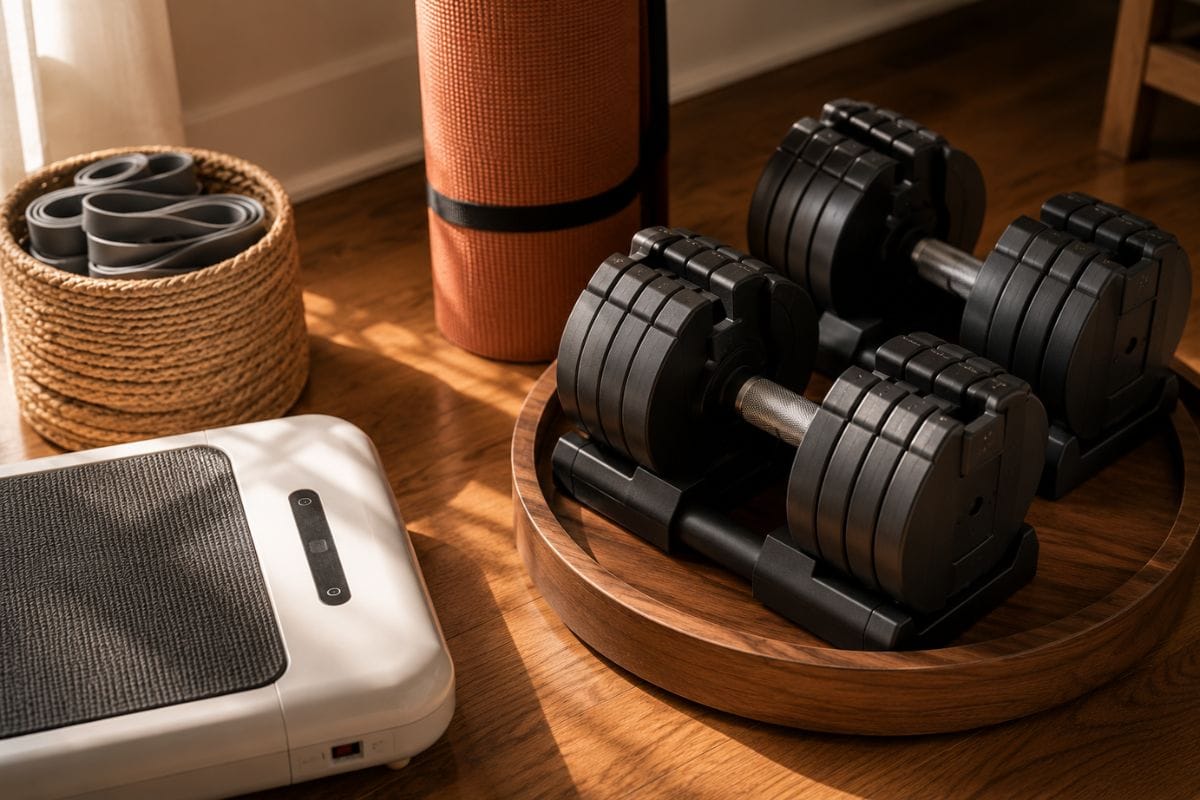
Save this palette before you buy anything.
Stick to a warm neutral palette: natural rubber or cork mats, wood-tone dumbbell trays, and matte black or sand-colored accessories instead of anything neon or logo-heavy. The trick that instantly upgrades a budget setup is vertical storage — hang the resistance bands on a hook, lean the mat rolled against the wall, and stack the loop bands in a small woven basket instead of leaving them loose on the floor. Pick one accent color for every small piece of gear so it reads as curated instead of collected over time. A blush or terracotta mat, a walnut-finish dumbbell tray, and a cream WalkingPad base photograph beautifully together and actually match your existing decor. Save this layout before you buy a single thing — it's the difference between a gym corner and a cluttered one.
FAQ
What is the best home gym setup for a small apartment under $500?
The best $500 apartment setup pairs entry-level adjustable dumbbells (up to 25–30 lbs) with resistance bands, a foldable mat, and a door-frame pull-up bar. Add a mini stepper for daily cardio. Together these cover push, pull, legs, cardio, and core in roughly a 6×6 ft corner without any permanent installation.
Is a $500 home gym setup enough for real results?
Yes, for most renters. A $500 setup handles about 80% of common fitness goals — building strength, staying consistent with cardio, and maintaining mobility. It falls short only on heavy leg loading, daily machine cardio, and upper-body work past roughly 25 lb dumbbells. Most people outgrow it in months, not weeks.
What does a $1,500 apartment gym include?
A $1,500 apartment gym typically adds a WalkingPad for daily cardio, mid-range adjustable dumbbells up to 50–52.5 lbs, a foldable weight bench, and dedicated storage for both. It keeps the same renter-safe footprint as the $500 build but raises the weight ceiling and adds a real daily-cardio solution.
Is a walking pad worth adding to a home gym setup?
It's worth it if your daily step count is inconsistent or weather-dependent. A WalkingPad adds 6,000–10,000 steps without leaving your apartment and folds flat for storage. It's the single upgrade that changes daily behavior, not just workout capacity, which is why it anchors the $1,500 build.
How do I build a home gym in a studio apartment?
Start with a defined footprint — a 6×6 ft corner works for most budgets. Prioritize adjustable dumbbells first, since they cover the most training ground per square foot. Choose gear that folds, stacks, or stores vertically, and always test noise and floor impact before committing to anything permanent.
What gym equipment do renters actually need?
Renters need equipment that's quiet, storable, and deposit-safe above almost anything else. Adjustable dumbbells, resistance bands, a foldable mat, and a door-frame pull-up bar cover most training needs without wall anchors or permanent fixtures. Everything beyond that — benches, walking pads — is an upgrade, not a requirement.
How long does a home gym take to pay for itself compared to a gym membership?
A basic $200–400 setup typically pays for itself in 4–8 months compared to an average $40–80/month membership. Over five years, total savings usually land between $2,000 and $4,400, and the equipment still has resale value a membership never does.
What if I can't afford $500 for a home gym right now?
Start with just adjustable dumbbells and a mat, which covers most of the $500 build's training value for well under $200. Add the pull-up bar, bands, and cardio piece as budget allows — the $500 list is a target, not a minimum entry point.
Serah's Honest Call — Final Verdict
If you're renting, still building the habit, or not sure fitness is going to stick as a daily practice, start at $500 — or even below it, with just the dumbbells and a mat. It covers more than people expect and it's cheap enough to walk away from if your life changes in six months. If you've already built the habit, you're maxing out your current weights, or you can't reliably hit your step count without a machine in your apartment, the $1,500 build is worth it — the difference isn't cosmetic, it's behavioral. If you're working with more than $1,500, the next real upgrade is usually a squat rack or heavier plates rather than anything on this list — that's a different apartment gym article entirely. Regardless of budget, buy adjustable dumbbells first. Everything else on this list is optional; dumbbells aren't. And if you're deciding what separates the two tiers most meaningfully, it's the walking pad — it changes your daily behavior, not just your workout capacity.
Start here: WalkingPad C2 — the anchor piece of the $1,500 build, or the entry-level adjustable dumbbells — start here regardless of budget.
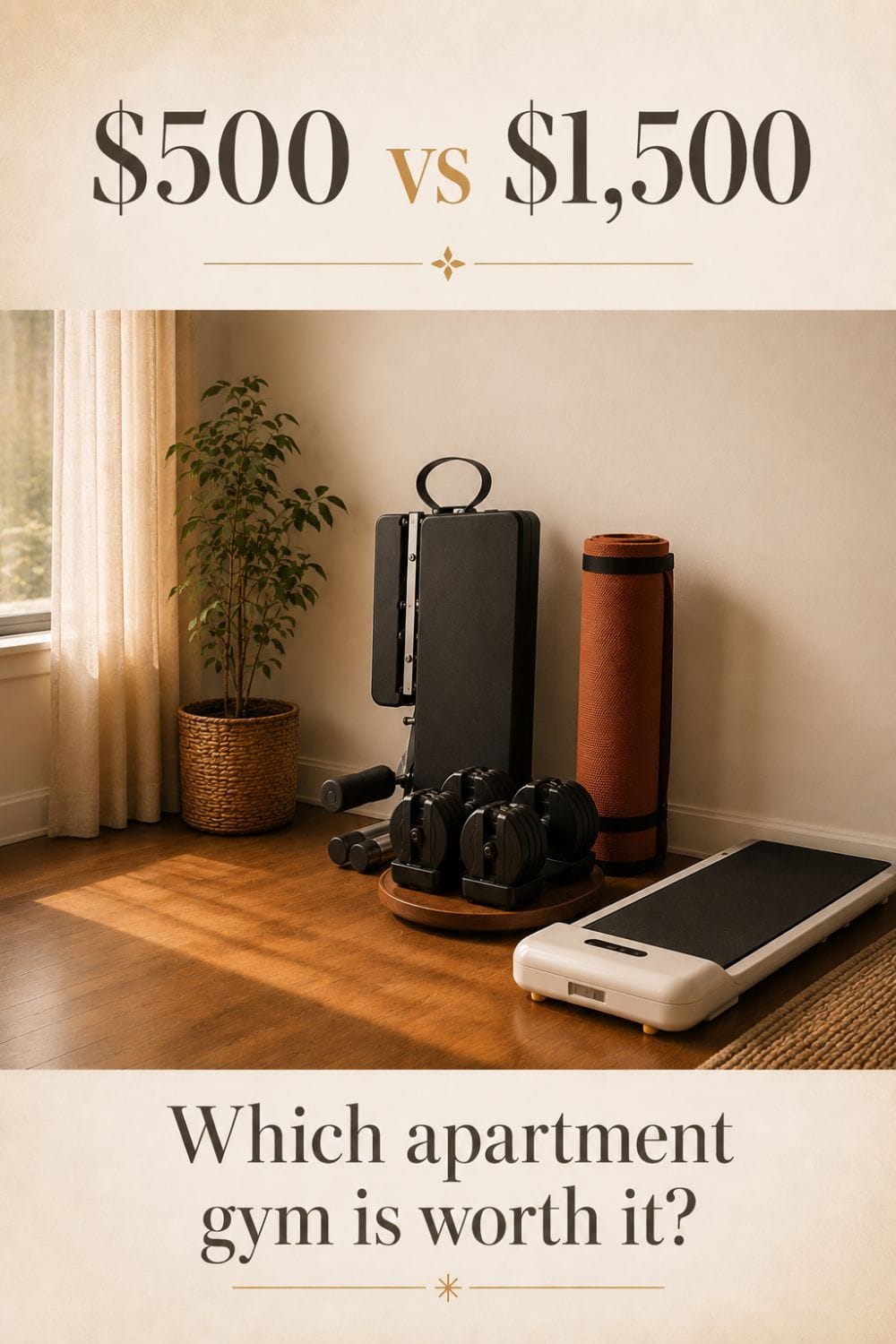
Pin this for your next apartment gym haul 📌
I test every piece of gear in my actual apartment — noise, footprint, deposit-safety, and real-world durability. No sponsored samples, no showroom conditions. If I wouldn't buy it for my own 650 sq ft studio, I don't recommend it.
Build Your Dream Home Gym—Without Wasting Space or Money
Join the MiniHomeGym Newsletter for expert reviews, space-saving fitness tips, apartment-friendly workout ideas, practical buying guides, and exclusive deals to help you choose the best compact fitness equipment with confidence.