WalkingPad X21 Review: Honest Results After 90 Days of Daily Use

Quick Verdict
Overall rating: 8/10
Best for: WFH walkers and renters who need a real treadmill that disappears into a closet when company comes over.
Not for: Anyone who wants incline, needs to run longer distances, or weighs over 220 lbs and plans to use this hard daily.
Price: $799
Check current price → WalkingPad X21I already own the WalkingPad C2. I've walked on it basically every morning for three months in a 650 sq ft apartment with original hardwood floors and a neighbor directly below me. So when WalkingPad sent me the X21 to test, I wasn't coming in blind or impressed by marketing copy. I was coming in as someone who already knows what this category of machine can and cannot do — and I had specific questions I needed answered before I could recommend it at $799.
This review is everything I found out. No padding, no softening the negatives.
Specs at a Glance
First Impressions — Unboxing to First Walk
The box arrived in two pieces. Setup took me exactly 5 minutes — attach the display rail, click the phone holder into place, plug it in. That's it. WalkingPad is not lying when they say it's ready to use out of the box. There's a refreshing absence of assembly chaos.
Moving it solo is manageable but not comfortable. At 84 lbs, it's not light. The two transport wheels help, but tipping it onto those wheels and navigating a narrow apartment hallway took a little maneuvering. It's a one-person job if you're reasonably strong. If you're petite and live above the ground floor, plan how you'll get it inside before it arrives.
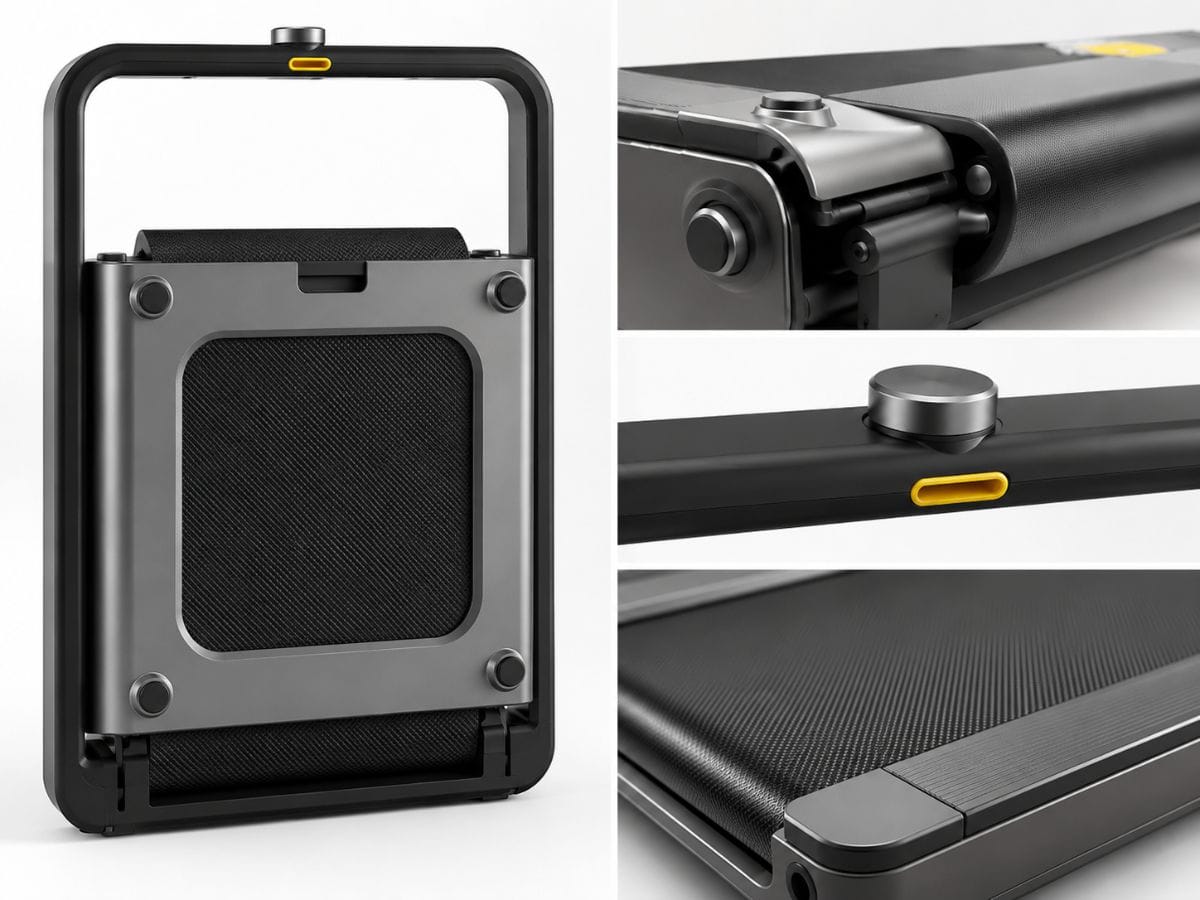
The first thing that surprised me on my first walk was the belt feel. It's firmer than the C2 — noticeably so — and the deck is closer to the ground (about 3.8 inches). That low step-up is great for apartments. What I didn't expect was the fold seam. There's a slight ridge running across the middle of the belt where the deck hinges, and at 3 mph with thin-soled shoes, I could feel it underfoot on every pass. It faded into the background once I put on proper training shoes, but it's worth knowing about up front.
The speed dial — a physical knob on the display rail — is genuinely satisfying to use. No app required, no double-tapping a screen mid-walk. Twist right to go faster, twist left to slow down. That's the whole interface, and it works exactly as advertised.
The Apartment Tests
a. The Noise Test
My partner takes client calls from the desk about 10 feet away from where I walk. The first week with the X21, I kept the speed at 2.5 mph during his calls and he said he couldn't hear it over his noise-canceling headphones. Without headphones, he described it as quieter than my dishwasher on eco mode — which was exactly my experience with the C2. At 3.5 mph the motor hum becomes more present, still low-frequency, nothing that reads as disruptive. At 6+ mph it gets louder, but I wasn't using this for runs. Walking speed? It's genuinely apartment-appropriate.
The downstairs neighbor concern is more about impact than motor noise. At walking speeds with a mat underneath, I've had zero complaints in 90 days. Jogging without a mat is a different story — that's not what this machine was built for in a shared building. If noise is your top concern when choosing a quiet treadmill for apartment use, it's worth reading through what actually separates the quieter models from the rest.
b. The Floor Test
My apartment has original hardwood floors — the kind of floors that make landlords flinch. I put down a 3mm rubber mat (standard gym mat, about $25 on Amazon) before the X21 ever touched the floor. After 90 days of daily use, I pulled the mat back to check. No marks, no indentations, no issues. The rubber feet on the machine are grippy and well-placed — the treadmill stayed put even at higher walking speeds.
One note: when unfolding the deck, it drops onto the floor with a clank that sounds worse than it is. It startled me the first three times. Nothing breaks, nothing dents — the sound is just mechanical. But if you're doing a 5 AM walk, your neighbors will know about it at the moment of unfolding.
c. The Storage Test
The listing says it fits under a bed. I measured mine: 9.5 inches of clearance. The X21 folded flat is 8.8 inches tall. It fits — but barely, and sliding it in requires removing the phone holder and making sure the display rail is fully collapsed. Mine goes under the bed with about half an inch to spare. I measure that as a win, but I'd strongly recommend measuring your bed frame clearance before buying, not after.
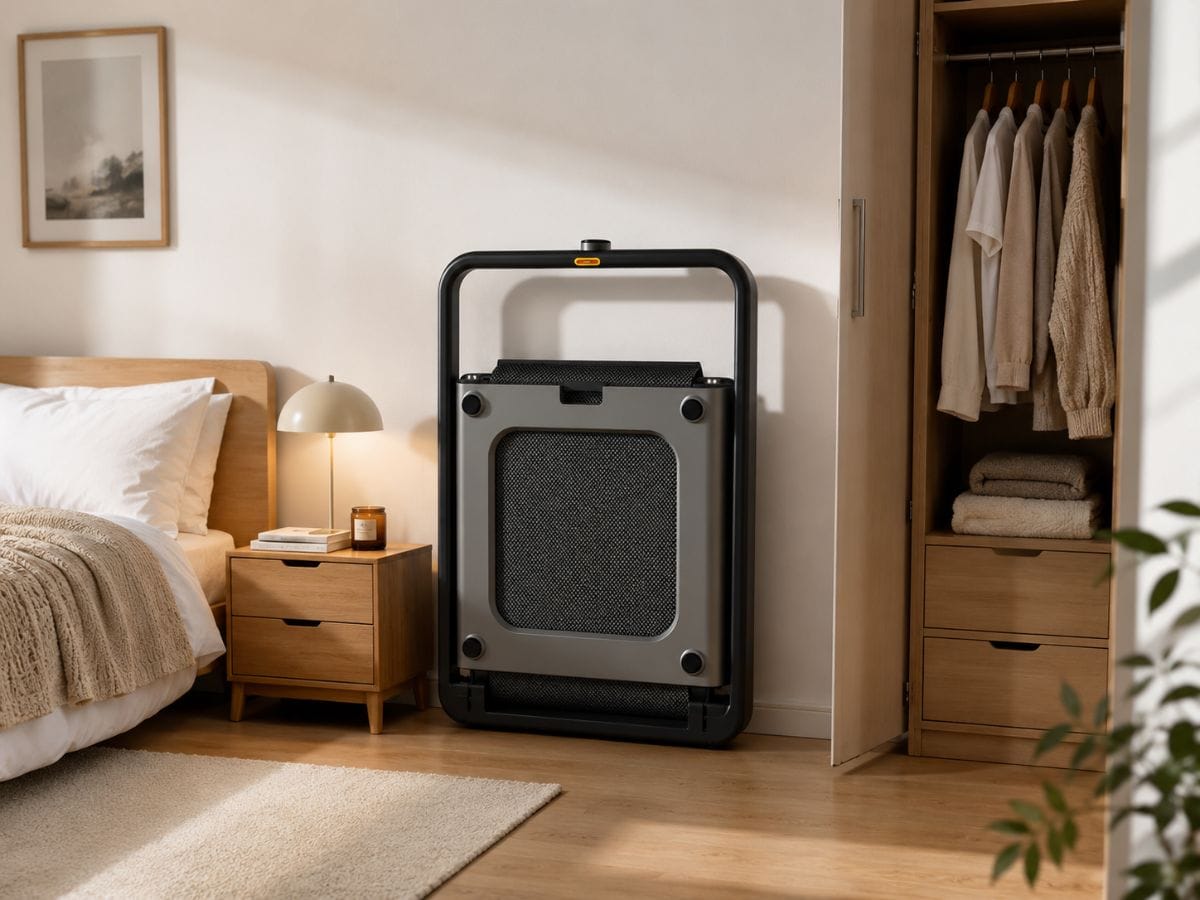
The vertical storage option (standing it against a wall) is actually easier day-to-day. It's stable, it takes up about 2.5 square feet of floor space, and rolling it out is quicker than extracting it from under a bed. I switched to wall storage after week two and haven't looked back.
d. The Daily Use Test
I used the X21 five to six times a week for twelve weeks — mostly 30-to-45-minute walks at 2.5 to 3.5 mph while working. What held up: the frame (rock solid, no wobble creep), the belt (no slipping, no unusual wear), and the speed dial (still smooth and responsive). What didn't hold up perfectly: the phone holder. It's fine for walking but vibrates loose at 4+ mph, so if you're keeping a tablet up there while jogging, expect it to shift. I eventually started just propping my phone against a book stack on my desk instead.
The more meaningful thing I noticed around week four: I stopped skipping morning movement. Not because I suddenly became a morning person, but because the machine was right there, rolled out in 20 seconds, requiring nothing. That's the real case for this price point. The friction is gone.
Also relevant if you're comparing options: see my full roundup of the best walking pads for apartment living and my breakdown of walking pad vs. foldable treadmill for small spaces.
What I Liked
The double-fold is the feature that earns the price. Other folding treadmills fold once and still require a 6-foot floor footprint when stored. The X21 folds twice and stands upright in a corner taking up less square footage than a dining chair. After twelve weeks, this is still what I point to when people ask what makes the X21 worth $200 more than cheaper alternatives. You actually use what you can actually store without resenting it.
The speed dial is a genuine quality-of-life win. I cannot overstate how annoying it is to tap an app screen while walking at 3 mph trying to adjust your speed. The X21's physical knob means one hand, one motion, done. No screen lag, no connectivity hiccup, no looking down. It's the kind of interaction design decision that makes you wonder why more treadmills don't do this.
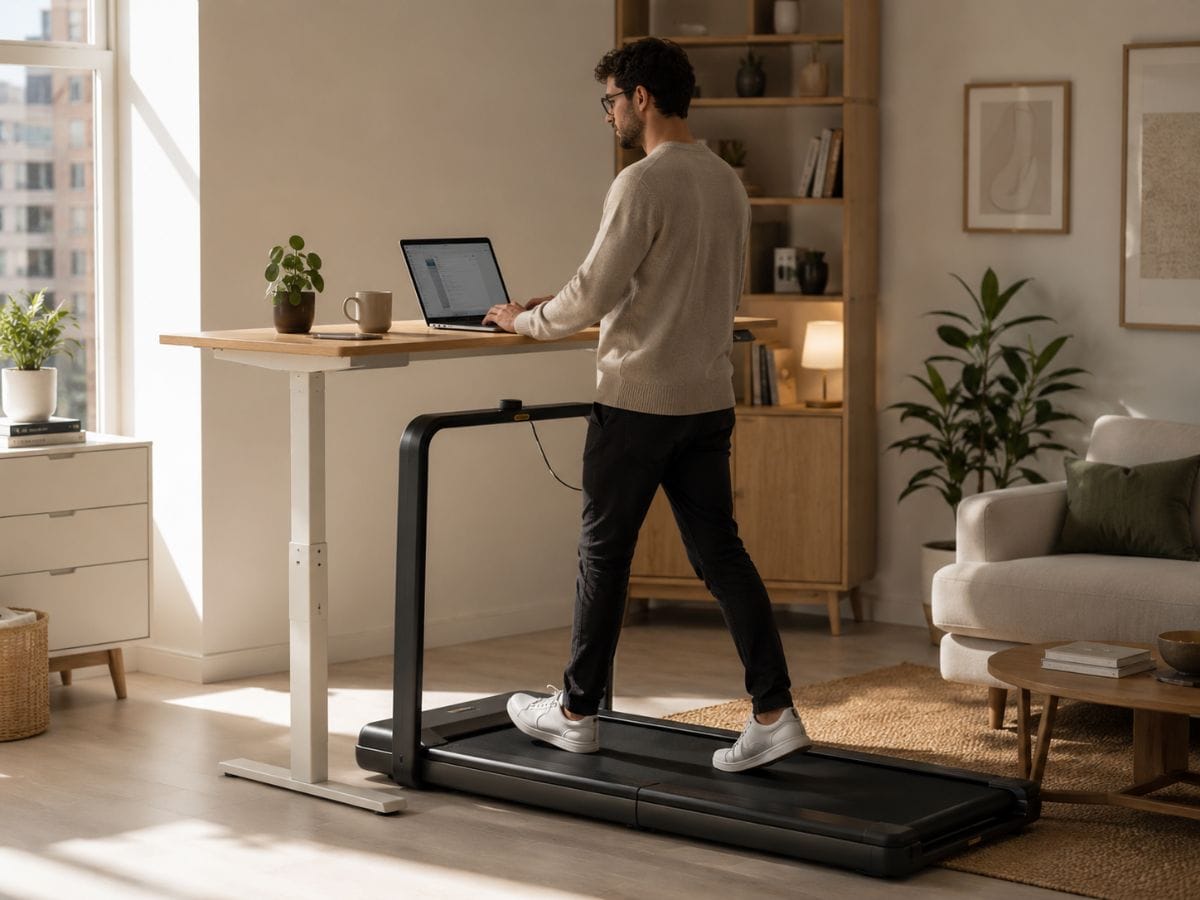
The brushless motor holds up at the speeds this machine is built for. At 2.5 to 3.5 mph — the real WFH walking sweet spot — the motor is smooth, consistent, and quiet enough that I've forgotten it was on during meetings. No belt stutter, no speed inconsistency, nothing that would flag it as underpowered at walking pace. It only starts to show its limits above 5 mph, which is a jogging speed most walking-pad buyers won't live at. Pairing this with a standing desk makes the setup even more effective — I wrote a full guide on building a standing desk and walking pad combo for WFH routines if you want to see exactly how I set mine up.
What Annoyed Me
The fold seam in the deck is a real issue for some users. It runs across the middle of the belt exactly where your feet fall at a normal stride, and at walking speed it creates a subtle but persistent ridge sensation with every step. I adapted to it by wearing cushioned shoes exclusively. But if you planned on walking in house shoes or socks, you'll feel it on every session, every time. It's not painful. It is consistently annoying in a way that doesn't go away.
The transport wheels are too small for the machine's weight. Rolling it across my hardwood floor in a straight line was fine. Getting it over a small rug threshold or pivoting it to change direction? That required lifting one end, which at 84 lbs is not nothing. For a machine that sells partly on its portability, the wheels feel like a cost-cutting decision that they got away with on paper but not in practice.
The KS Fit app is mediocre. It connects, it tracks steps and calories, and it logs your sessions. It also has a UI that looks like a 2019 fitness app that never got updated, and on two occasions it lost a session's data mid-walk for no apparent reason. If you're someone who tracks workouts obsessively, the app will frustrate you. If you just want a rough calorie count at the end of a walk, it's fine. Either way, don't make "great app" a reason you buy this machine — it isn't one.
Who Should Buy the WalkingPad X21
The WFH walker
You work from home and your step count on a normal day is somewhere between embarrassing and concerning. You want to walk during calls, during emails, during anything that doesn't require you to type fast. The X21 was built for exactly this scenario. The dial speed control means you can adjust without breaking focus, the noise level won't interrupt your calls, and the low deck height means getting on and off doesn't require a production. This is the use case where the X21 is genuinely excellent.
The step-goal chaser
Your 10,000-step goal started optimistically and currently lives in your fitness app as a red streak of missed days. The weather outside is inconsistent, the gym feels like a commitment, and you just want to walk at home while watching something. The X21 is reliable enough, quiet enough, and compact enough to become a permanent fixture of your living room routine without taking over the room. The KS Fit app is underwhelming, but your Apple Watch or Fitbit will track steps just fine regardless.
The renter who ruled out every other treadmill
You've looked at full-size folding treadmills and every single one has a folded footprint that still takes up your entire guest closet or a visible corner of your living room. You live in under 700 square feet and you need something that actually disappears. The X21's double-fold vertical storage is genuinely the best storage solution in this category. If storage was the reason you kept saying "next year" to home cardio equipment, the X21 removes that excuse. For a broader look at how renters are building practical setups around machines like this, the compact home gym setups built around real apartment constraints are worth browsing.
Who Should Skip It
The X21 caps at 7.5 mph, the belt is 18 inches wide, and the deck cushioning is minimal. If running is the goal — real running, not a 5-minute jog at the end of a walk — this machine will feel inadequate quickly. The stride length is constrained, the belt firmness transmits impact to your joints at running speeds, and the fold seam becomes a genuine nuisance when your foot is striking hard.
Users close to or over 220 lbs who want to use this intensively every day should look elsewhere. The 240 lb weight limit exists on paper, but the motor and frame are sized for walking, not for daily sustained jogging at heavier body weights. You'll likely get away with it for a while, but you're working against the machine's design intent.
There's no incline on the X21. If incline walking is part of your training — for weight loss, for glute activation, for anything — this machine has a flat deck and that's all it will ever have. No workaround exists for this one.
FAQ
Is the WalkingPad X21 worth buying in 2026?
Yes, for walking-focused users in small spaces. The double-fold storage, brushless motor, and intuitive dial control hold up at $799 — particularly compared to cheaper options with worse build quality. The fold-seam deck and mediocre app are genuine drawbacks, but neither makes the machine a bad buy. If under-desk walking or daily step goals are the use case, the X21 delivers.
Can the WalkingPad X21 be used for running, or is it only for walking?
Technically yes — it reaches 7.5 mph. Practically, it depends on your stride length and tolerance for a firm, narrow belt. Shorter runners with a high cadence can jog on it. Taller runners or anyone used to a full-size treadmill will feel cramped. For occasional jogging intervals mixed into walks, it's fine. As a running-primary machine, it isn't the right tool.
How quiet is the WalkingPad X21 for apartment living?
At walking speeds (2.5 to 3.5 mph), the motor hum is low-frequency and genuinely unobtrusive — quieter than a dishwasher on eco mode in my experience. The brand spec is 75 dB at max speed under no-load conditions. Real-world at max speed with body weight is louder, but at walking speeds with a rubber mat under the machine, it's the quietest treadmill category available. The louder moment is the deck drop when unfolding — plan for that.
Does the WalkingPad X21 fit under a standing desk?
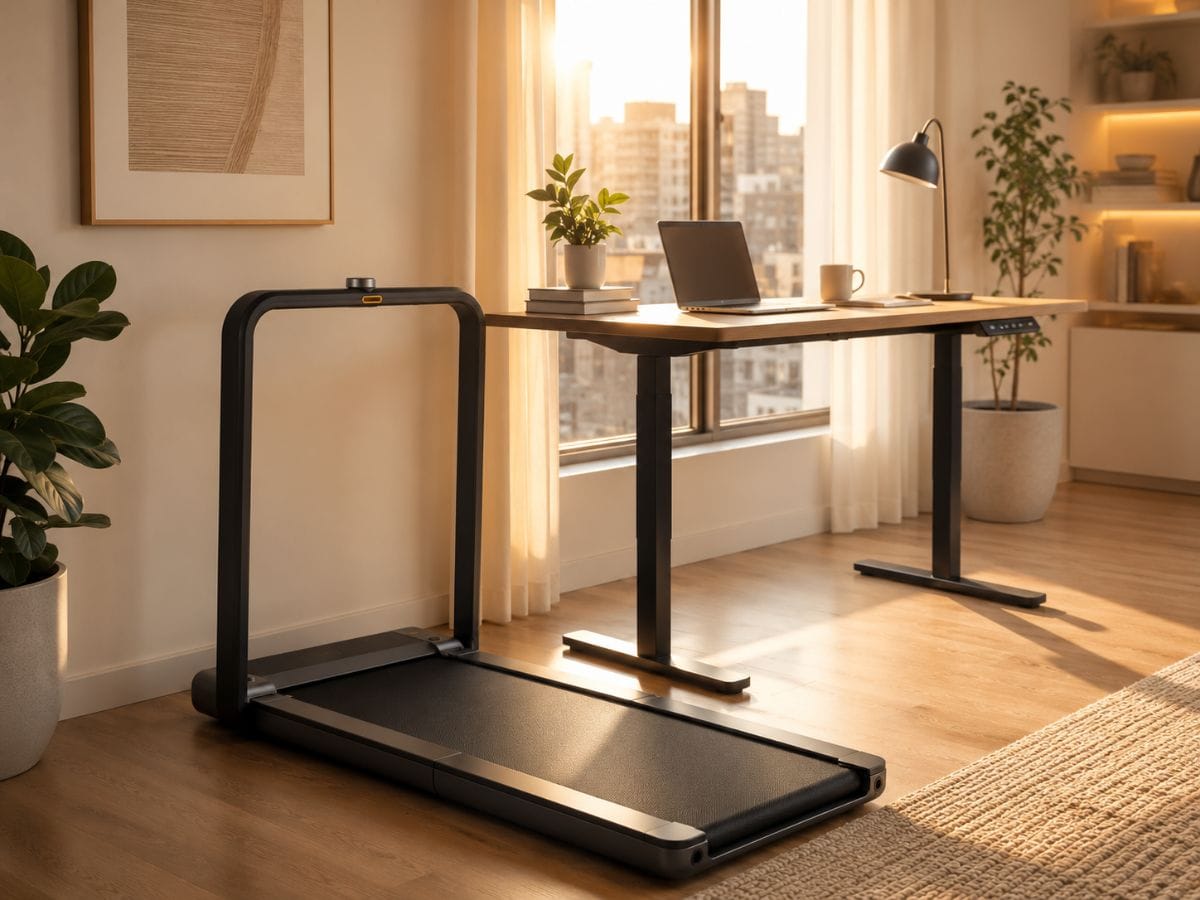
Yes. The deck height when in use is about 3.8 inches, which works under virtually any standing desk set to a standard height. Make sure your desk is adjustable enough to accommodate your walking posture — most electric standing desks go high enough. The display rail sits at hip height and doesn't interfere with desk use. This is one of the cleaner under-desk setups in this price range.
What are the biggest drawbacks of the WalkingPad X21?
Three things worth knowing before you buy: the fold seam in the deck is noticeable at walking speeds with thin-soled shoes; the transport wheels are undersized for the machine's weight, making tight pivots harder than they should be; and the KS Fit app is functional but unremarkable, with occasional data sync issues. None of these are dealbreakers for the target use case, but they're real, and you should know about them.
Final Verdict
The WalkingPad X21 is a well-made machine solving a specific problem: how do you get real daily movement in a small apartment without giving up your floor plan? The double-fold design genuinely works, the motor is quiet enough for the people around you, and the physical dial makes daily walking frictionless in a way that adds up over months. The fold-seam underfoot bothered me more than I expected, the app is forgettable, and the transport wheels could be better. But none of that changes the fundamental reality: after 90 days, I'm still using it. That's the verdict that matters.
See it on WalkingPad.com → WalkingPad X21 Double-Fold Treadmill
I test every piece of gear in my actual apartment — noise, footprint, deposit-safety, and real-world durability. No sponsored samples, no showroom conditions. If I wouldn't buy it for my own 650 sq ft studio, I don't recommend it.
Build Your Dream Home Gym—Without Wasting Space or Money
Join the MiniHomeGym Newsletter for expert reviews, space-saving fitness tips, apartment-friendly workout ideas, practical buying guides, and exclusive deals to help you choose the best compact fitness equipment with confidence.