MERACH S19 Recumbent Bike Review — What 45 Days Actually Taught Me (2026 Honest Verdict)

I bought the MERACH S19 because my knees were done negotiating with my walking pad's incline sessions. This MERACH S19 review is what actually happened over 45 days — the good, the wobbly, and the one thing I wish someone had told me before I clicked "buy."
MERACH S19 Recumbent Bike — Serah's Verdict
Rating: 8.1/10
Best for: renters who need quiet, low-impact cardio that doesn't punish knees or disturb downstairs neighbors
Not for: anyone wanting a running or high-intensity machine — this is a walking/cycling-pace cardio tool
Price: ~$340
Check current priceSpecs at a Glance
SpecDetails
Price~$339.99 (list price runs closer to $449.99, so watch for the sale price)
ResistanceMagnetic, 8 levels, lever/knob adjustment
Weight capacity330 lb
DisplayBasic LCD — time, distance, speed, calories, heart rate. Built-in tablet holder, no backlight
App connectivityMERACH app via Bluetooth, plus Zwift and Kinomap support
Heart rate monitoringGrip-style pulse sensors on the handlebars
Seat adjustmentSlides to fit inseam 17.72–35.43 in, padded seat, adjustable mesh backrest
Footprint48.03"L x 23.62"W x 46.46"H — does not fold, so this is the permanent footprint
Machine weight~85 lb, front transport wheels for repositioning
RecognitionNamed a Best Budget pick in SELF magazine's recumbent bike roundup
Warranty1-year manufacturer's warranty
Why a Recumbent Bike Makes Sense in an Apartment
Recumbent geometry puts your back against a supported seat and your legs out in front of you instead of stacked underneath your hips, which is exactly why it loads the knees so differently than an upright bike or a treadmill incline. There's no impact, and the joint angle stays open instead of compressing on every stride. Noise-wise, magnetic resistance means there's nothing scraping or clicking as you change intensity — the loudest thing in the room is your own breathing. And because the S19 doesn't fold, it also doesn't need a storage plan; it just lives somewhere and stays there, which in a 650 sq ft apartment is its own kind of relief, especially compared to some of the other quiet, apartment-friendly exercise bikes I've tested that need to be tucked away between sessions. I bought the S19 because my knees were starting to complain about the walking pad's incline sessions. Here's what 45 days actually changed.
First Impressions — Delivery to First Session
The S19 arrives about 80% pre-assembled, and my build — seat, pedals, handlebars, console — took 34 minutes solo, most of which was spent squinting at which bolt went where. It's doable alone, but the frame is awkward to hold steady one-handed while you're threading screws with the other, so if you've got a second set of hands for ten minutes, use them. Once built, the bike weighs close to 85 lb, and while the front wheels make it rollable, getting it into its final position on my hardwood floor took some real shoving. First session, minute one: the seat felt firm but fine. By minute thirty, I noticed it — more on that in the comfort test below. The LCD display is readable in normal apartment light, but there's no backlight, so early mornings before I've turned a lamp on, I'm squinting at it. App pairing took under a minute over Bluetooth, and I'd call it optional — the console alone gives you everything you need for a straightforward ride.
Want to see the assembly? Watch it start to finish:
The Apartment Tests
The Noise Test
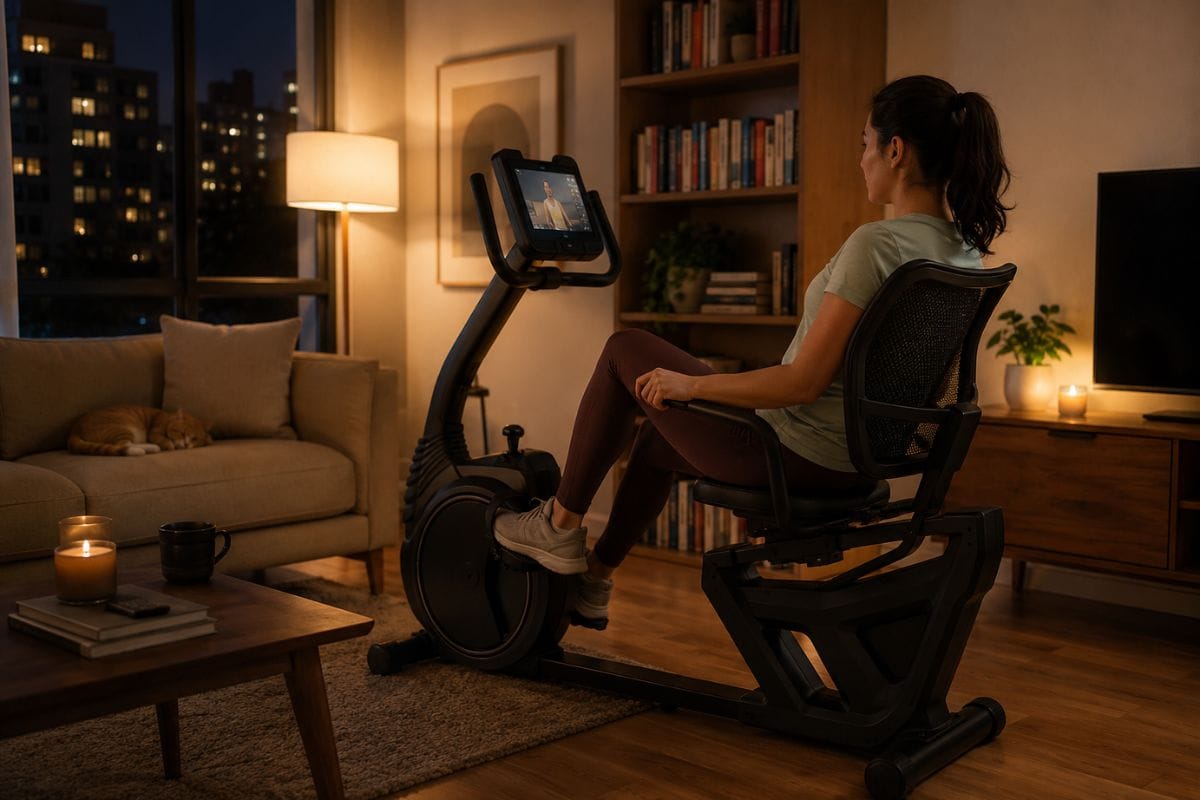
Magnetic resistance keeps rides exceptionally quiet, making evening workouts apartment-friendly.
Magnetic resistance, level 6 of 8, 9pm, hardwood floors, downstairs neighbor. I could hear the faint whir of the flywheel if I was listening for it, but nothing traveled to the next room, and there was zero vibration transmitted through the floor — no thumping, no rattle. That's a meaningfully quieter experience than my walking pad noise benchmark, where belt noise and foot-strike vibration are both part of the equation. On a recumbent bike, there's no foot strike to transmit through the floor at all — that's the biggest structural difference.
The Knee Test — the Real Reason Most People Buy This
I have a history of runner's knee from treadmill sessions, and it's the entire reason the S19 ended up in my apartment. Across 45 days, 20–30 minute rides at resistance levels 3–5 produced zero post-session soreness — nothing, not even the mild ache I'd get after a 20-minute walking pad session at incline. Where I did feel something was pushing resistance level 7–8 for 40+ minutes; not pain, but a low fatigue behind the kneecap that told me I'd found my ceiling for that day. The seated, open-hip-angle position is doing real work here — there's simply no jarring, and CDC guidance on moderate aerobic activity doesn't require impact to count, which is worth remembering if you've been avoiding cardio because your joints veto everything else.
The Comfort Test
Sessions at 20 minutes and sessions at 45 minutes felt like two different bikes. At 20 minutes, the padded seat is genuinely comfortable — no complaints. Past the 30-minute mark, I started feeling the padding compress right under the sit bones, and by 45 minutes I was shifting position every few songs. The mesh backrest holds up fine the whole way through; it's the seat cushion, not the back support, that's the limiting factor for longer rides. The handlebar grip distance worked fine for my frame, but I'm 5'6" — taller riders may want to check the inseam range before assuming the same.
The Space Test
In my 650 sq ft apartment, the S19 lives against the wall opposite my desk, angled so I can see the TV. It doesn't fold, so what you see in the box is what you live with — roughly 4 feet by 2 feet of permanent floor claim. I don't move it between sessions; it just stays put and visually reads as "furniture" more than "gym equipment," which matters more than I expected in a studio-style layout. If your space is tighter than mine, it's worth browsing other space-saving exercise bike picks before committing to a non-folding footprint like this one.
45 Days — the Honest Progression
Week 1, I rode at resistance level 3, 20 minutes at a time, and my knees felt fine post-session every single day. Week 2 through 3, I bumped up to level 5 and started pairing the app for basic stat tracking, mostly out of curiosity rather than need. By week 4 and 5, I'd settled into a rhythm — three sessions a week, 25–30 minutes, resistance level 5 to 6 — and motivation held up fine without any class format, largely because I was watching TV while riding rather than following a program. Week 6 onward, the physical changes were subtle but real: better sleep on ride days, noticeably less knee stiffness in the mornings, and a baseline fitness bump I could feel on stairs. What the S19 still can't do: it won't replace HIIT or strength training, and it never pretended to. I still use the walking pad more because it fits into my WFH day passively — I can walk while I answer emails. The S19 requires me to sit down and actually ride. That's not a criticism — it's just the reality of two different use cases.
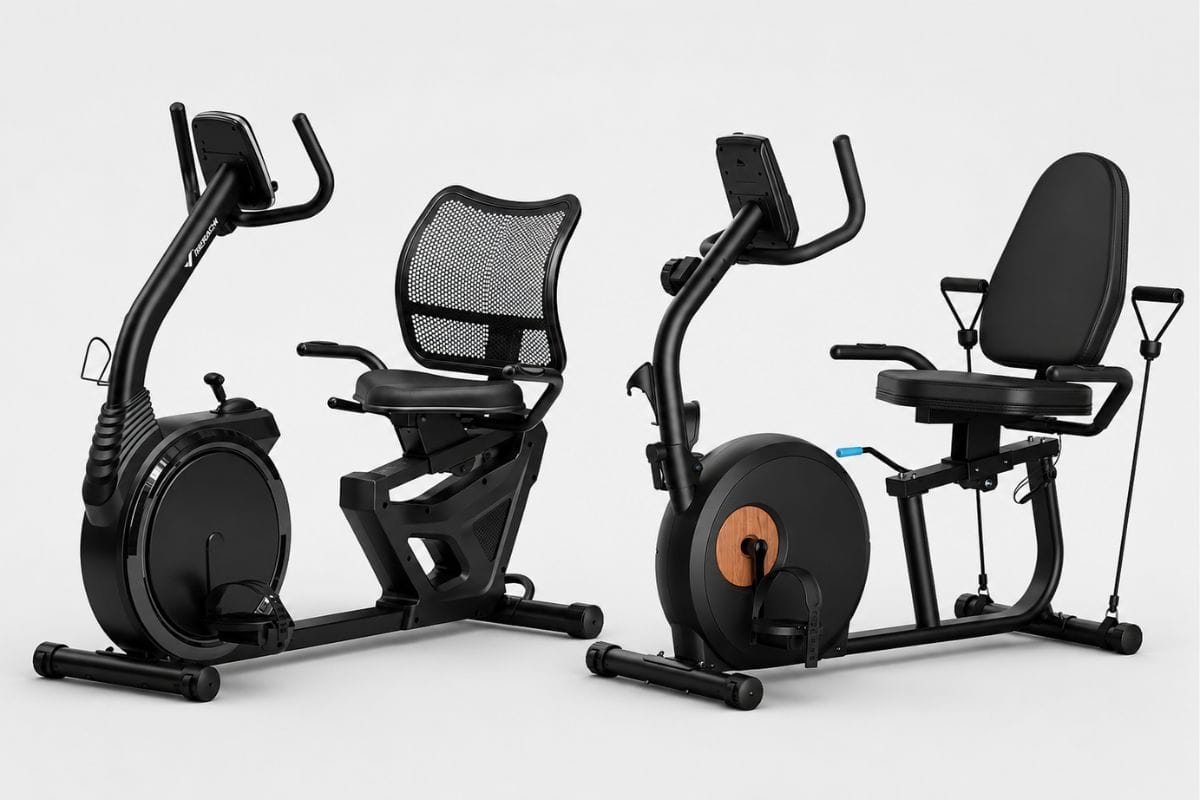
The S19 prioritizes back support, while the S23 adds resistance bands for upper-body training at a lower price.
MERACH S19 vs S23 — the Upgrade Question
Here's where I have to correct the assumption a lot of buying guides make: the S23 is not a pricier upgrade over the S19 — it's actually the cheaper model, running around $239 versus the S19's ~$340. What you're trading is the S19's ergonomic backrest and back-support-first design for the S23's integrated resistance bands, which let you work your arms while you pedal. MERACH's own comparison notes that for back support and comfort on longer sessions, the S19 is the better pick; the S23 is the move if upper-body engagement matters more to you than backrest comfort.
My verdict: if your priority is knee-friendly, back-supported cardio you can sit in for 30 minutes without shifting — the S19 wins. If you want to sneak in some arm work while you ride and don't need the deeper backrest, the S23 saves you $100 and adds a feature the S19 doesn't have. If you're weighing this against a smart bike instead, my CAROL Bike review for small apartments breaks down that higher-end comparison.
See the S23What I Liked
The near-silent magnetic resistance. At 9pm on hardwood with a neighbor below me, I couldn't get this bike to make a sound that traveled. That alone makes it usable at hours a treadmill or a belt-driven machine simply isn't.
Seat comfort for 20–30 minute sessions. Genuinely comfortable in that window — the padding and mesh backrest do their job. My honest caveat: past 30 minutes, the seat starts to make itself known.
The price point against what it replaces. At ~$340, this is a fraction of a gym membership over a year, and it covers a use case — quiet, joint-friendly cardio — that a lot of pricier smart bikes overbuild for.
What Annoyed Me
The tablet holder. It's functional, but it reads as budget — there's a visible wobble whenever I tap my phone screen mid-ride, enough that a video call would show it shaking slightly on camera.
No backlight on the LCD. Basic display, and in low apartment morning light before I've turned on a lamp, I've caught myself leaning in to read my own stats.
Seat comfort past 30 minutes. For my body type, longer rides mean shifting position more than I'd like — worth knowing if your sessions run 45 minutes-plus.
Who Should Buy the MERACH S19
The knee-pain renter who's bounced off treadmills and upright bikes and needs a machine that puts genuinely zero load through the joint — this is built for exactly that scenario, and the seated position does the work an upright bike can't.
The senior or injury-recovery buyer who needs real back support rather than just a saddle — the mesh backrest and reclined position give a level of lumbar support that upright bikes don't attempt to offer.
The budget-first cardio buyer who wants a proven, awarded machine under $400 rather than a $1,000+ smart bike — the S19 covers the fundamentals without the subscription-app upsell some competitors lean on, though it's worth a quick look at a lower-cost foldable bike comparison to see how it stacks up against other budget picks.
FAQ
Is the MERACH S19 good for bad knees?
Yes — the recumbent seated position keeps the knee joint open and avoids the impact of walking or running. In 45 days of testing at moderate resistance levels, sessions produced no post-ride soreness, though pushing high resistance for 40+ minutes did introduce mild fatigue.
How loud is the MERACH S19 recumbent bike?
Very quiet. Magnetic resistance means no belt clicking or friction noise, and at resistance level 6, the bike wasn't audible from the next room and produced no floor vibration on hardwood.
Does the MERACH S19 work with Zwift?
Yes, the S19 connects via Bluetooth to Zwift and Kinomap in addition to the native MERACH app, so you can use it for interactive rides if you want structured training beyond the built-in console.
What is the weight capacity of the MERACH S19?
330 lb, supported by a heavy-duty steel frame — one of the more generous capacities in this price range.
MERACH S19 vs S23 — which should I buy?
The S19 has the better backrest and back support and costs more (around $340); the S23 is cheaper (around $239) and adds resistance bands for upper-body work but with less back support. Choose based on whether backrest comfort or arm engagement matters more to you.
Final Verdict
Forty-five days in, the MERACH S19 does exactly what it promises: quiet, knee-friendly cardio that doesn't ask anything of your downstairs neighbor. It's not going to replace a HIIT class or a strength day, and the seat starts talking back after 30 minutes, but for what it costs and the joint problem it solves, it's earned its permanent spot against my wall. If your knees have been vetoing every other cardio option, this is the one I'd actually point you toward.
See it on MERACH Or upgrade to the S23
Related reading: apartment gym setup guide.
I test every piece of gear in my actual apartment — noise, footprint, deposit-safety, and real-world durability. No sponsored samples, no showroom conditions. If I wouldn't buy it for my own 650 sq ft studio, I don't recommend it.
Build Your Dream Home Gym—Without Wasting Space or Money
Join the MiniHomeGym Newsletter for expert reviews, space-saving fitness tips, apartment-friendly workout ideas, practical buying guides, and exclusive deals to help you choose the best compact fitness equipment with confidence.