Best Walking Pad for Under Bed Storage: How to Measure, What Fits, and What to Buy

I've measured my own bed clearance more times than I'd like to admit. I've also tested six different walking pads over about six weeks, wheeled every one of them under my IKEA MALM frame, and returned two that the box promised would "fit under most furniture" and absolutely did not. So before you add anything to cart, let's talk numbers — not marketing language.
Quick Answer: For most apartments, the WalkingPad C2 is the best walking pad for under-bed storage — it folds to 5.4 inches tall, which clears most standard bed frames (7–12 inches of clearance). Platform beds with only 4–6 inches underneath will need a slimmer model like the Sperax Walking Pad or Urevo P1. Always measure your own clearance before buying — box copy lies more than you'd think.
Measure Your Bed Before You Read Another Word
Grab a tape measure and get down on the floor. Measure straight up from the floor to the bottom of the bed frame — at the center of the bed, not at the legs, since that's where the frame usually sags lowest and where a walking pad actually has to slide through. Legs will always give you a taller, more flattering number that doesn't reflect reality.
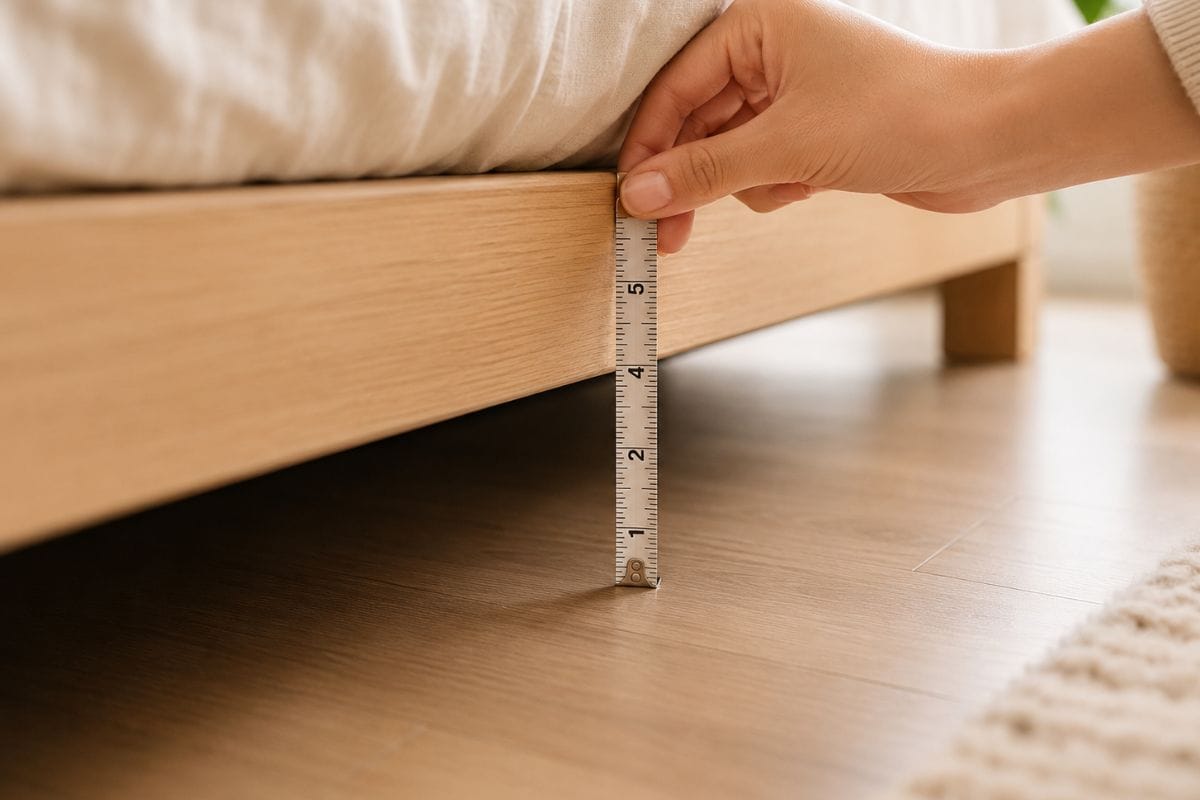
Here's how that number typically breaks down for under-bed walking pad storage:
- Platform bed: 4–6 inches (tight — most walking pads won't clear this)
- Standard bed frame: 7–12 inches (most walking pads fit comfortably)
- High-frame or storage bed: 12–18 inches (basically anything fits)
I have a standard IKEA MALM frame, and my clearance measures 9 inches at the center. That's given me room to test a handful of pads without issue — but it also means I've had close calls with anything advertised loosely as "slim" without a real number attached.
The Difference Between "Folds" and "Folds Flat"
This is the part that trips people up, and it's the reason so many under-bed treadmill searches end in a return. A traditional folding treadmill folds its deck upright — the running belt swings up and locks vertically against the motor column, so the whole unit still stands four feet tall or more when "folded." That's great for a closet. It does nothing for you under a bed.
A walking pad folds horizontally — the deck hinges in the middle and lies flat, typically landing somewhere between 2 and 5.5 inches tall once folded, depending on the model. Think of it like the difference between a dining table that folds its legs up to stand in a corner, versus one that folds in half at a center hinge and lies flat under a bed. Same word, "folds," completely different result.
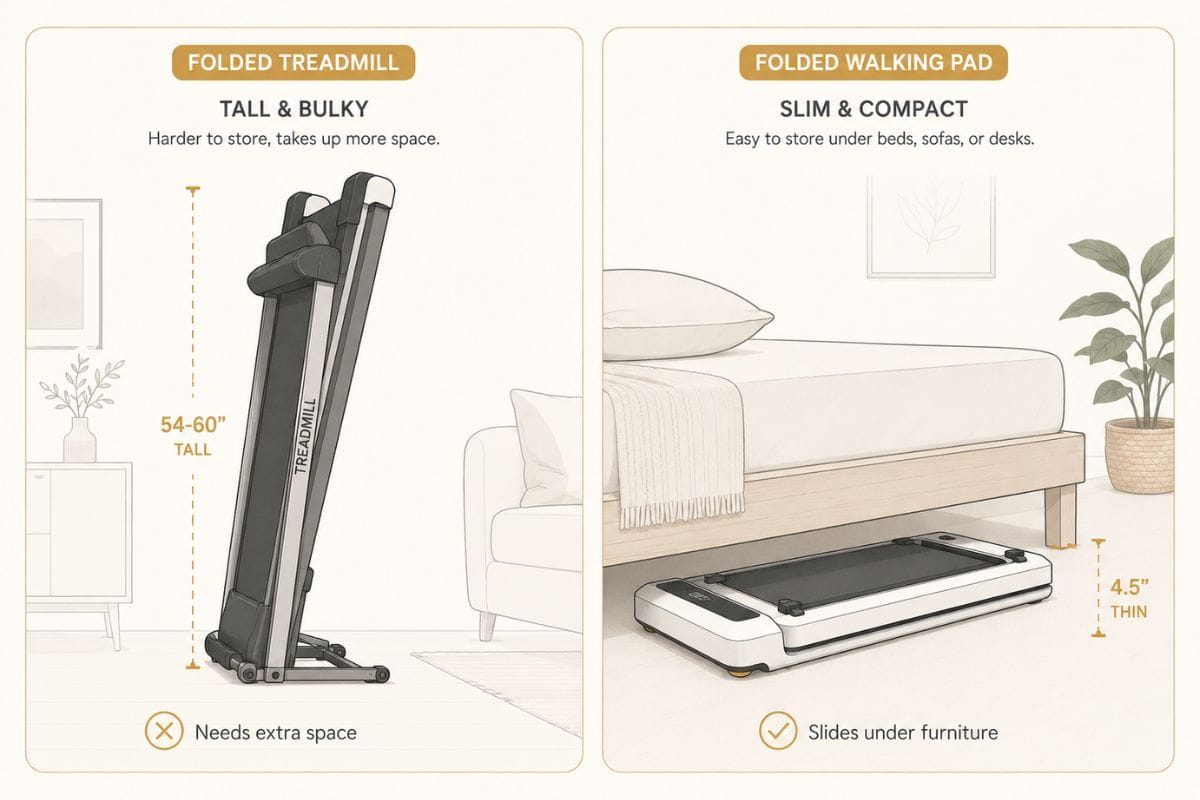
If a product page shows the treadmill standing upright in its "folded" photo, that's your sign to keep scrolling. You want a listing that shows the unit lying flat, ideally with someone sliding it under furniture.
The Walking Pads That Actually Fit Under a Bed (Reviewed)
WalkingPad C2 — Lead Pick
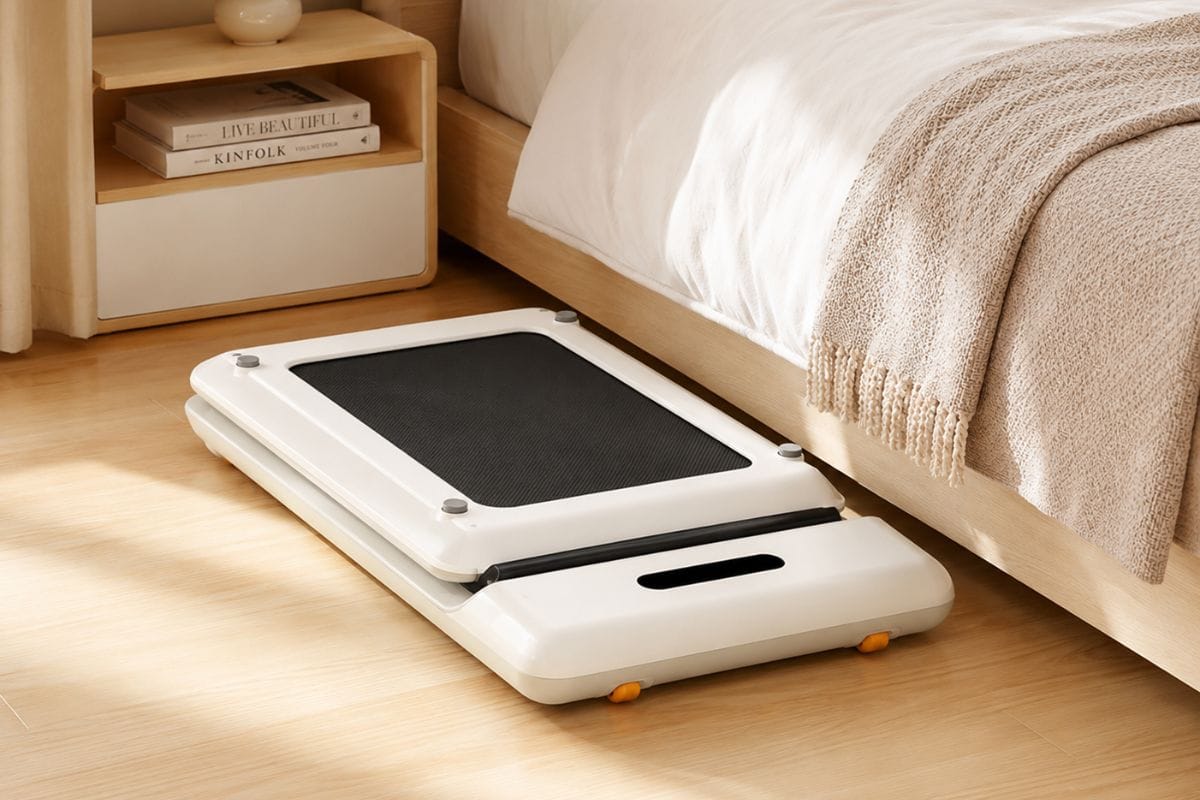
Folded height: 5.4" | Top speed: ~3.7 mph | Noise: Quiet enough for video calls at walking pace | App: Yes, WalkingPad companion app | Price: $$
Folded length × width: 32.5" × 20.4"
Wheels: Yes, two front transport wheels
Weight capacity: 220 lbs
Solo pull-out: Manageable. It weighs around 55–62 lbs depending on the retailer's spec sheet, but the wheels mean you're rolling it, not lifting it.
This is the one I actually recommend most, and it's the one I use as my own baseline. At 5.4 inches, it clears my 9-inch MALM clearance with room to spare, and it should clear most standard frames in the 7–12 inch range. If your clearance is under 6 inches, though, measure the length too — at 32.5 inches folded, it needs a bed with slats or a frame lip it can slide past, not just a tall enough gap. Read my full WalkingPad C2 review here. Check current price →
WalkingPad A1 Pro
Folded height: 5.0" | Top speed: ~3.7 mph | Noise: Comparable to the C2, slightly quieter at low speeds | App: Yes, WalkingPad companion app | Price: $$$
Folded length × width: 32.5" × 21.5"
Wheels: Yes
Weight capacity: 300 lbs
Solo pull-out: A little heavier at roughly 62 lbs, but still wheel-friendly.
This is the one I'd point you to if you weigh more than 220 lbs — it's rated up to 300 lbs, versus the C2's 220-lb cap, and the folded footprint is nearly identical. The trade-off is price; you're paying more for that higher weight capacity, not for a slimmer profile. If under-bed clearance is your only concern and you're under 220 lbs, save the money and get the C2 instead. If you want more speed for light jogging instead of pure walking, it's worth comparing this against my R3 Hybrid Plus vs. X21 comparison before you decide. Check current price →
Sperax Walking Pad — Budget Pick Under $200
Folded height: ~4.4" (mfr. spec) | Top speed: ~3.8 mph | Noise: ~48–58 dB depending on speed | App: No app — remote control only | Price: $
Folded length × width: roughly 44" × 21"
Wheels: Yes
Weight capacity: Sperax lists 320 lbs, though independent testing suggests treating that as an upper bound rather than a guarantee given the lightweight build
Solo pull-out: Easiest of the three — around 45 lbs.
If you're testing whether a walking-pad habit is even going to stick before spending WalkingPad-level money, the Sperax Walking Pad gets the under-bed job done at a lower price point and a lighter body weight, which matters if you're pulling it out solo every day. It's also the quietest of the three at low speeds. The trade-off is motor power and long-term durability — fine for light daily walking, less fine if you're logging serious mileage. As an Amazon Associate, I earn from qualifying purchases at no extra cost to you. Check current price →
One I dismissed: GoPlus 2-in-1 Under Desk Treadmill. This is the model with the fold-down handlebar console that's marketed as "slim and foldable." The deck itself folded flat, but the handlebar assembly stayed upright even in its lowest position, pushing the total folded height to just over 8 inches. It never came close to clearing my 9-inch clearance with any margin, and on a tighter frame it simply wouldn't have gone under at all. This is one of the two I returned. Lesson: if a walking pad has a handlebar or console arm, check whether that hardware folds down too — not just the deck.
Want the absolute thinnest option regardless of price? The Urevo P1 folds to about 2.25 inches — thin enough for platform beds most walking pads can't touch — but it trades away some of the weight capacity and durability track record of the WalkingPad line. I haven't tested it personally, so I'm not including it in my head-to-head picks above, but it's worth knowing about if your clearance is under 4 inches.
Comparison at a Glance
WalkingPad C2 — Folded height: 5.4" | Weight capacity: 220 lbs | Top speed: ~3.7 mph | App: Yes | Price: $$ | Fits standard bed: Yes
WalkingPad A1 Pro — Folded height: 5.0" | Weight capacity: 300 lbs | Top speed: ~3.7 mph | App: Yes | Price: $$$ | Fits standard bed: Yes
Sperax Walking Pad — Folded height: ~4.4" | Weight capacity: 320 lbs (mfr.) | Top speed: ~3.8 mph | App: No | Price: $ | Fits standard bed: Yes
Urevo P1 (not tested) — Folded height: ~2.25" | Weight capacity: Not verified | Top speed: Not verified | App: Unknown | Price: $$ | Fits standard bed: Yes
GoPlus 2-in-1 (dismissed) — Folded height: 8"+ | Weight capacity: Not verified | Top speed: Not verified | App: No | Price: $$ | Fits standard bed: No
What to Consider Beyond Just Height
Folded length. A pad can clear your clearance height and still stick out from under the bed if the frame is short front-to-back. Measure both the visible gap under your bed and how far back it runs before hitting a wall or headboard — you need the folded length to disappear fully, not just fit height-wise at the front edge.
Weight. You're pulling this out and sliding it back daily, not once a month. Anything under 40–50 lbs is easy. Past that, it stops being a quick daily habit and starts being a chore you skip on tired days — which defeats the point of buying it.
Wheels. Non-negotiable for daily under-bed storage. Without them, you're dragging dead weight across your floor twice a day, and that gets old within a week.
Noise. If you're in an apartment, this matters as much as clearance. Every walking pad hums to some degree — it's the motor, not the belt, that you'll hear most. In my testing, the difference between models was noticeable at higher speeds but minor at a normal walking pace, so if noise is your top concern over storage, check my full quiet treadmills for apartments guide before you buy on clearance alone.
App or no app. The WalkingPad models connect to a companion app for tracking steps, distance, and workout history. The Sperax pad doesn't — you're working off the onboard LED display and remote only. Not a dealbreaker, but worth knowing before you're mid-workout looking for a stats screen that isn't there.
The mat. Most walking pads still need a protective mat underneath for noise and floor protection, especially on hardwood. The good news: a folded mat is thin enough to store under the bed right alongside the pad itself, so it doesn't add to your storage problem. For more ways to keep the space under your bed organized, my under-bed storage ideas guide covers this beyond just the walking pad.
Returns. Both of my returns went back within the retailer's standard window — one for the handlebar clearance issue above, one because a "slim" listing didn't disclose folded length and it stuck out nearly a foot past my bed frame. Check the seller's return window before you buy, not after, and keep the original packaging until you've actually tested the fit under your own bed, not just measured on paper.
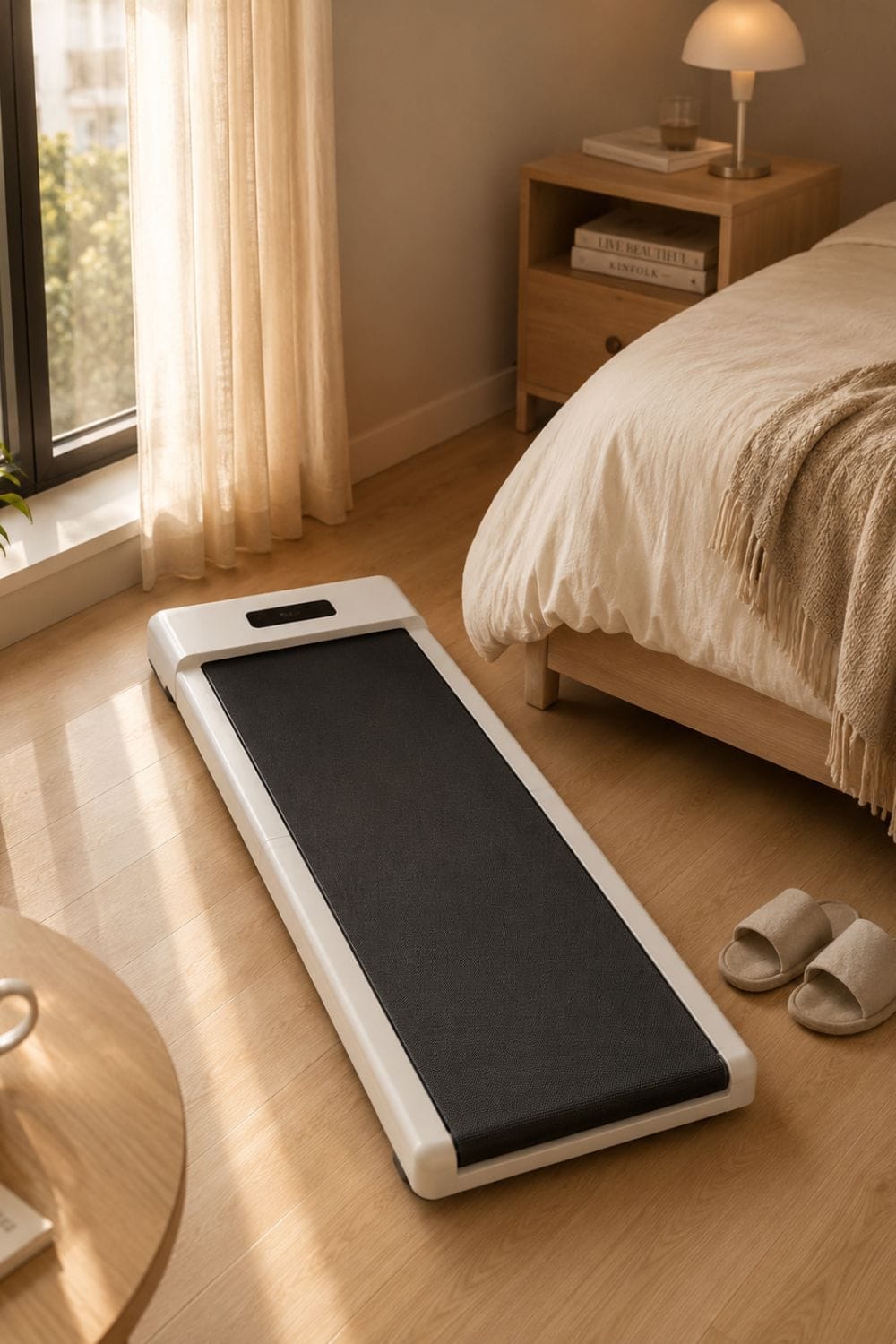
Still deciding between a walking pad and something with more room to grow? My compact home gym setup guide covers other apartment-friendly equipment beyond walking pads if you want to compare your options.
FAQ
What is the thinnest walking pad for under-bed storage?
The Urevo P1 is currently the thinnest at around 2.25 inches folded — thin enough for tight platform beds that most walking pads can't clear. Among models with a stronger durability and weight-capacity track record, the WalkingPad C2 (5.4") and Sperax Walking Pad (~4.4") are the more tested options, and either will clear a standard 7–12 inch bed frame with room to spare.
Does the WalkingPad C2 fit under a bed?
Yes, for most standard bed frames. At 5.4 inches folded, it clears the typical 7–12 inch clearance range under standard bed frames like an IKEA MALM. It will not fit under low platform beds with less than 6 inches of clearance, so measure first.
How do I know if a walking pad will fit under my bed?
Measure from the floor to the bottom of the frame at the center of the bed, not at the legs. Compare that number to the walking pad's folded height listed in its spec sheet — and check the folded length too, since a unit can clear the height but still stick out if your bed is shallow front-to-back.
Can I store a walking pad under a platform bed?
It depends entirely on your clearance. Most platform beds sit at 4–6 inches, which is tight for most walking pads. A slim model in the 4–4.5 inch range, like the Sperax Walking Pad, may work, but measure first — some platform beds sit even lower than 4 inches, which rules out under-bed storage entirely, and you're better off looking at closet or wall storage instead.
Are walking pads quiet enough for apartments?
Generally yes at a normal walking pace — the motor hum is noticeable but low enough for a video call in most cases, and it's quieter than a full treadmill by a wide margin. Noise increases with speed, so if you're above a first-floor neighbor or share thin walls, a slower, budget-oriented model like the Sperax at low speeds will be your quietest option.
Still narrowing down your options? Start with my full apartment walking pad roundup for a complete side-by-side of every model I've tested.
I test every piece of gear in my actual apartment — noise, footprint, deposit-safety, and real-world durability. No sponsored samples, no showroom conditions. If I wouldn't buy it for my own 650 sq ft studio, I don't recommend it.
Build Your Dream Home Gym—Without Wasting Space or Money
Join the MiniHomeGym Newsletter for expert reviews, space-saving fitness tips, apartment-friendly workout ideas, practical buying guides, and exclusive deals to help you choose the best compact fitness equipment with confidence.