WalkingPad Z1R Review: Is the Removable Handrail Worth the Extra $100?

Last updated August 2026 · Independently tested, not sponsored
Affiliate disclosure: Some links on this page are affiliate links. If you purchase through them, MiniHomeGym may earn a commission at no extra cost to you. This does not affect our editorial judgment or product recommendations.
Quick answer: the WalkingPad Z1R is worth the extra $100 over the standard Z1 if you walk 4–5 mph for 45+ minutes at a time or want a handrail to hold during longer sessions. If you're a slow-speed desk walker who'll never touch the rail, save the money and get the Z1 instead.
I've now tested both WalkingPad Z1 siblings, and this WalkingPad Z1R review is the one I went into skeptical. A removable handrail for $100 more felt like a solution to a problem I didn't have — until I put it through a 50-minute session at 4 mph in my 650 sq ft apartment. Here's the honest verdict on the WalkingPad Z1R walking pad treadmill, from the brand behind the original WalkingPad, KingSmith.
WalkingPad Z1R Review: Quick Verdict
Serah's Verdict
Rating: 8/10
Best for: renters who want under-bed storage AND a handrail for confidence during longer sessions
Not for: strict minimalists who won't use the handrail — the Z1 saves $100
Price: $499 at time of testing — WalkingPad runs frequent sales, so check the current price before you buy
Check current priceWalkingPad Z1R Specs at a Glance
| Price | $499 (check current price — fluctuates with sales) |
|---|---|
| Motor | 0.75 HP brushless |
| Speed range | 1–5 mph |
| Walking area | 47.6 × 15.7 in |
| Folded size | 49.2 × 23.2 × 5.5 in |
| Machine weight | 57.7 lb |
| Weight capacity | 242 lb |
| App | KS Fit (Bluetooth) |
| Removable handrail | Yes — attaches/detaches, no tools |
| FootSense | Not included |
| Display | LED |
| Transport wheels | Yes |
| Assembly | None required — attach handrail and step on |
| Cushioning | SoftStep™ shock-absorbing deck |
| Warranty | 1 year |
| Color | Silver Gray |
One spec worth flagging before you keep reading: the Z1R's folded length is 49.2 inches — noticeably longer than the Z1's 31.8 inches. That's the handrail attachment mechanism, and it's the real trade-off for under-bed storage. More on that in the storage test below.
The WalkingPad Z1R Handrail: What It Actually Does
I didn't think I'd use the handrail. Then I tried a 50-minute session at 4 mph. Here's what happened: around minute 30, my arms started swinging looser and my balance got a little sloppier — nothing dangerous, just the kind of fatigue that shows up on longer walks at higher speeds. I reached for the rail without really deciding to, and it was there.
That's the honest use case. The WalkingPad Z1R handrail genuinely earns its keep for a specific group: people with balance concerns who want something solid to hold, walkers pushing 4–5 mph who want a point of contact, and anyone doing 45–60 minute sessions where arm fatigue starts to matter. It's not about needing to hold on the whole time — it's about the option existing when your session gets long enough that you want it.
Who doesn't need it: if you're a WFH desk walker doing 1–2 mph while you take calls, you will likely never reach for this handrail. At that speed, your hands are on a keyboard or a mouse, not the rail. Be honest with yourself about which walker you are before you pay the extra $100.
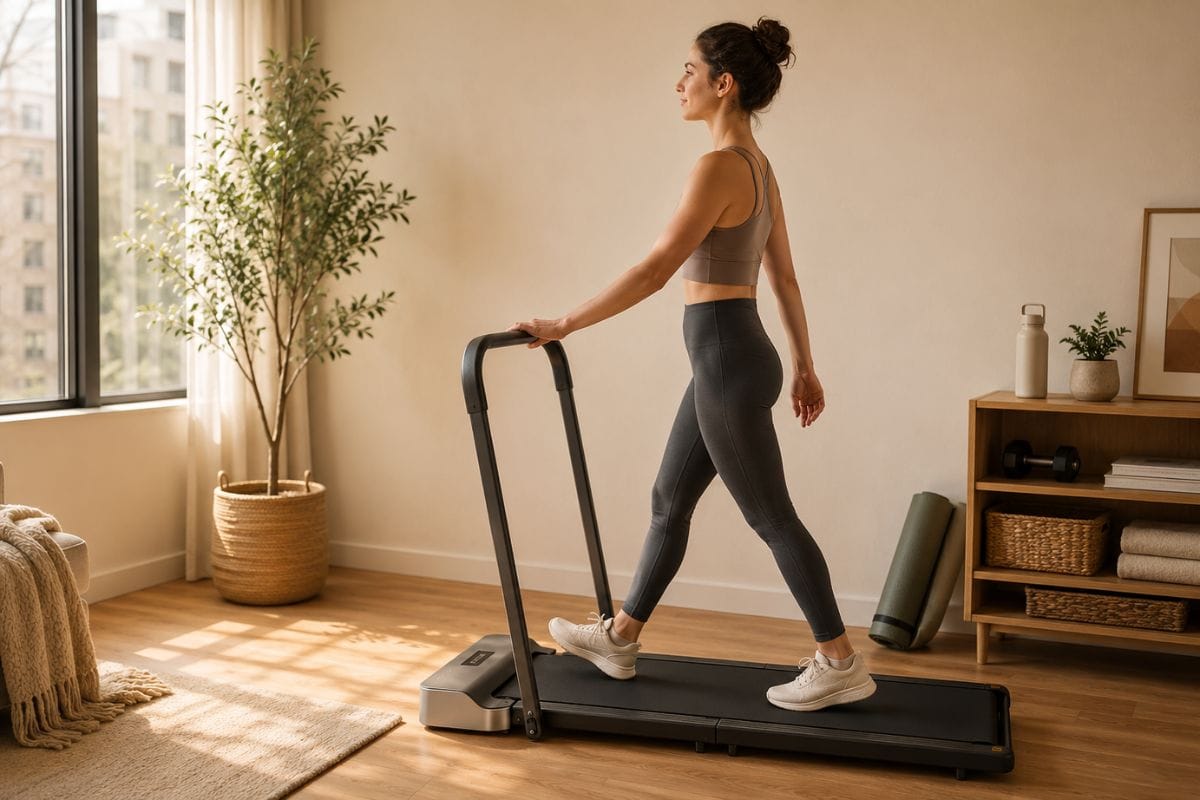
The removable handrail becomes genuinely useful during longer or faster walking sessions when extra stability is appreciated.
First Impressions: Setup to First Walk
Handrail attachment took me under a minute, no tools — it clicks into two mounting points on the deck and locks with a twist. Removing it is just as fast, which matters if you're switching between handrail and no-handrail sessions like I did for this review.
At 57.7 lb, the Z1R is 6.7 lb heavier than the Z1's 51 lb. Is that noticeable when you're the one pulling it out from under the bed every morning? Slightly — it's the difference between "light" and "manageable but not weightless." Not a dealbreaker, but if you're petite or dealing with any wrist or shoulder issues, it's worth knowing before you buy.
My first walk with the handrail up felt noticeably more stable than any handrail-free pad I've tested — there's a real sense of "something to catch me" that's absent on the Z1. The height sits at a natural forearm position for me at 5'5", though it's fixed, not adjustable, so taller or shorter walkers should check the reach before assuming it'll feel right.
The Apartment Tests
The Noise Test
0.75 HP brushless at 3 mph, 9pm, hardwood floors, downstairs neighbor I actually like — the Z1R sounded identical to the Z1 in belt hum and motor pitch. I didn't have a decibel meter on hand for this session, but by ear it's in the same ballpark other testers have logged for the Z1's motor — comfortably below normal conversation level. Nothing about the handrail itself added rattle or vibration when it was securely locked in. I did notice a faint click if the rail wasn't fully seated on one of my test sessions, which is a good reminder to double-check the lock before you start walking. Once it's properly attached, it's silent.
The Storage Test — The Critical One
Folded size: 49.2 × 23.2 × 5.5 in. My bed clearance is 9 inches, so the 5.5-inch folded height clears with room to spare — that part's not the issue. The issue is the 49.2-inch length, which is significantly longer than the Z1's 31.8 inches. Under my full-size bed frame, the Z1 tucked completely out of sight. The Z1R's extra 17.4 inches meant it stuck out slightly past the frame edge on one side. It didn't become a trip hazard in my layout since it sat flush against the wall, but if your bed frame is shorter, sits in the middle of a room, or you have a narrower gap to work with, measure twice — this is the real storage trade-off you're paying $100 for, not just the handrail.
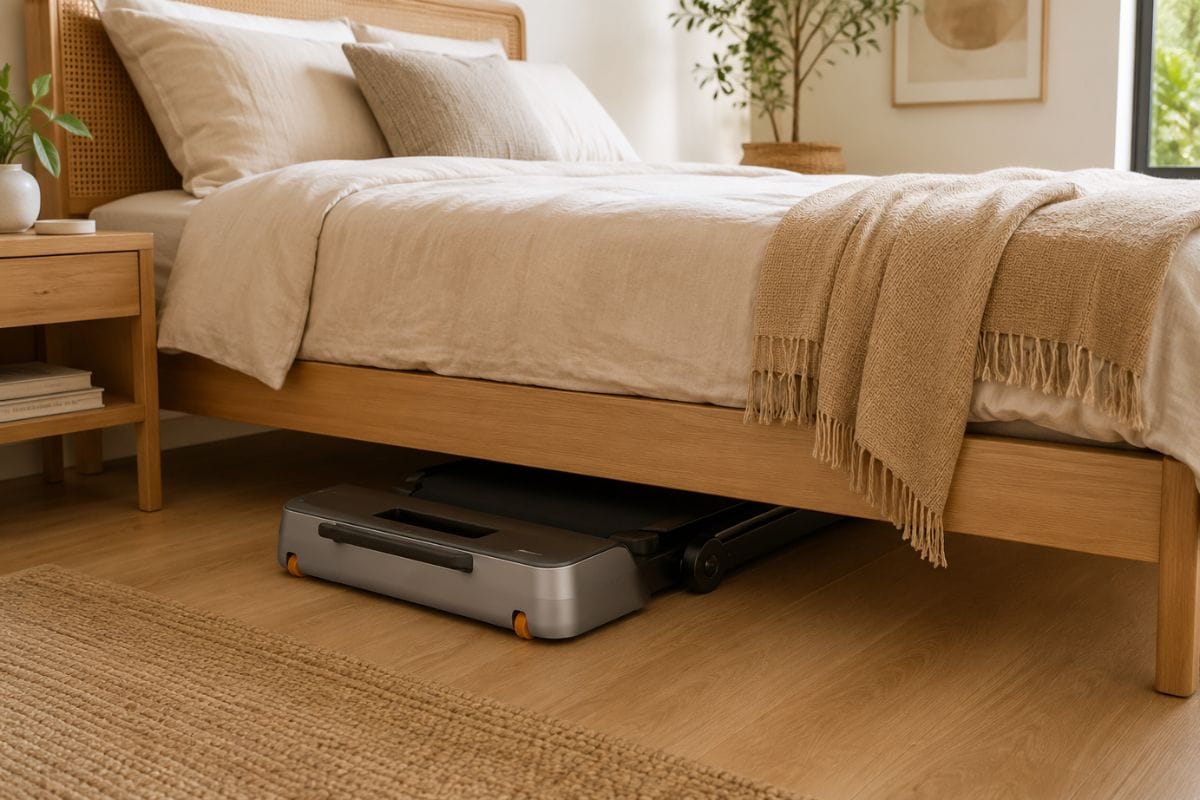
Although the Z1R fits under most beds thanks to its 5.5-inch height, its longer folded length is the main storage trade-off.
The Handrail in Daily Use
I used the Z1R with the handrail up for a week, then with it removed for a week. With the rail on, my posture stayed slightly more upright during longer sessions, and I felt comfortable pushing to 5 mph without the mental hesitation I get on rail-free pads at top speed. During short 30-minute sessions at 2–3 mph, though, I genuinely never touched it — it was just there, unused. It's during the 60-minute, higher-speed sessions that I actually reached for it, which lines up exactly with what the handrail is designed for. Since the Z1R shares its motor and deck mechanics with the Z1, it's also worth keeping an eye on belt tracking over months of daily use — a common long-term note on the Z1 from other owners, and one that likely carries over here.
The WFH Desk Test
With the handrail removed, the Z1R works as a standard under-desk treadmill at 1–2 mph, and honestly? At that point it functions almost identically to the Z1 — same motor, same walking area, same quiet hum under a desk during calls. If your only use case is WFH walking, removing the handrail doesn't unlock any downside; it just means you paid $100 for a feature you're storing in a closet, not using.
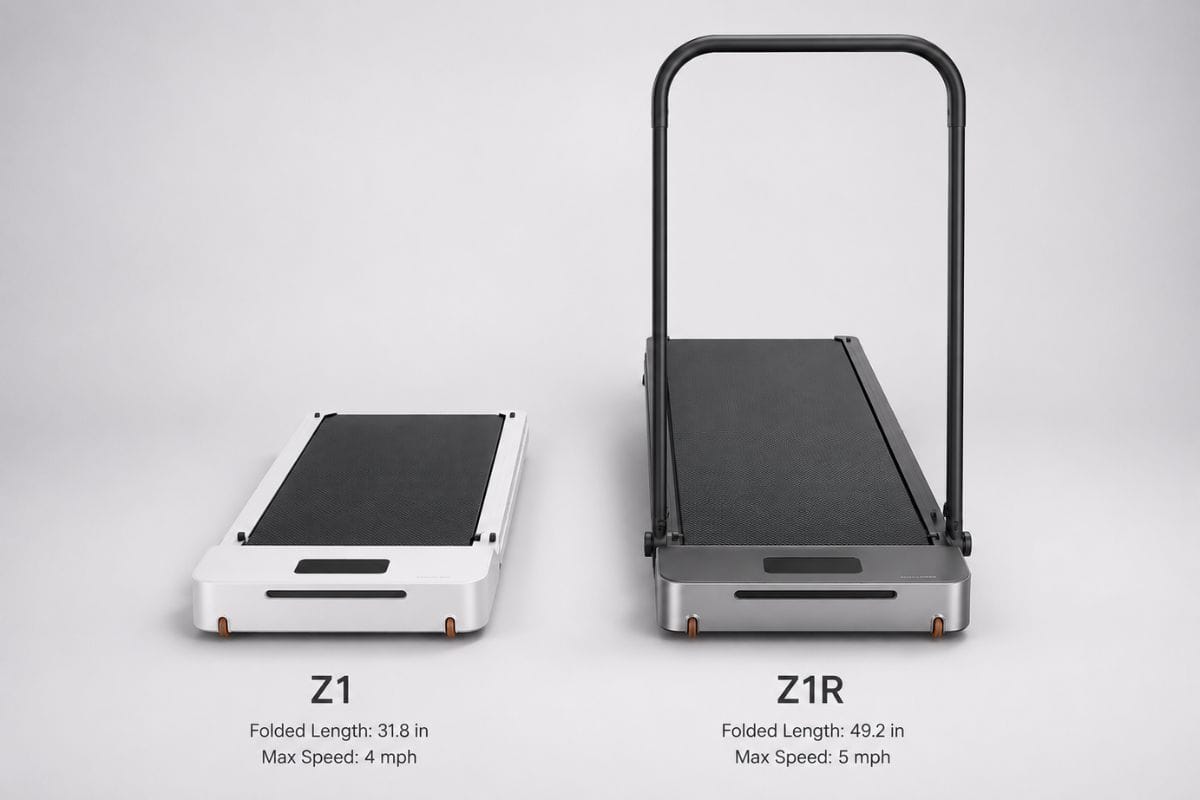
The Z1R adds a removable handrail and a higher 5 mph speed, while the Z1 remains shorter and $100 less expensive.
WalkingPad Z1R vs Z1: Which Should You Buy?
This comparison is simpler than it looks. The motor is identical — 0.75 HP brushless on both. Folded height is essentially the same, 5.5 in vs 5.4 in, so under-bed clearance isn't the differentiator. What actually separates them is folded length (49.2 in vs 31.8 in), top speed (5 mph vs 4 mph), and, of course, the handrail itself.
| Criteria | Z1R | Z1 |
|---|---|---|
| Price | $499 | ~$100 less |
| Motor | 0.75 HP brushless | 0.75 HP brushless |
| Folded height | 5.5 in | 5.4 in |
| Folded length | 49.2 in | 31.8 in |
| Speed ceiling | 5 mph | 4 mph |
| Handrail | Removable | None |
My honest read: the extra $100 makes sense for two people — the person who wants the handrail for longer or faster sessions, and the person who wants that 5 mph ceiling regardless of the rail. If neither of those is you, the Z1 gets you the same motor and nearly the same folded height for less money and a shorter footprint.
Save $100 with the Z1What I Liked
- The removable handrail is a genuine stability upgrade once you're walking at 4–5 mph — I felt the difference in a real way during my 50-minute test session, not a marketing-copy way.
- The 5 mph ceiling is a meaningful step up from the Z1's 4 mph cap — if you're already an active walker, that extra mile per hour changes what kind of workout this machine can deliver.
- Despite the added handrail hardware, folded height stays at 5.5 inches — still comfortably under-bed compatible for most standard frames.
What Annoyed Me
- The folded length is the real annoyance — 49.2 inches versus the Z1's 31.8 inches is a genuine under-bed footprint difference, and it's the trade-off nobody mentions when they're only talking about the handrail.
- The extra 6.7 lb of machine weight is marginal on its own, but if you're pulling this out and sliding it back daily, it's honest to say you'll feel it.
- Like the Z1, there's no FootSense here — you're controlling speed from the remote or app, not with foot taps, which some walkers will miss.
Who Should Buy the WalkingPad Z1R
The longer-session walker: if you're regularly doing 45–60 minute sessions at 3–5 mph, the handrail stops being a novelty and starts being something you actually reach for as fatigue sets in.
The user with mild balance concerns: if you're not ready to commit to a handrail-free machine but still want a slim, foldable profile for a small apartment, this is the middle ground — support when you want it, flat storage when you don't.
The renter who wants both: if you want an under-bed profile AND a speed ceiling above 4 mph, the Z1R is currently the only WalkingPad in this size class that gives you both.
Who Should Save $100 (Z1) or Spend More (A1 Pro / R3)
Get the WalkingPad Z1 review instead if you're WFH desk walking only, never going above 3 mph, and don't need the handrail. Step up to the A1 Pro if you want 300 lb weight capacity and FootSense on a walking-only pad. Go with the R3 Hybrid+ if you want up to 7.5 mph and an actual jogging mode — the Z1R tops out at 5 mph, which is walking territory, not running.
WalkingPad Z1R FAQ
Is the WalkingPad Z1R worth the extra $100 over the Z1?
It depends on how you'll use it. If you walk at 4–5 mph for 45+ minutes or want something to hold onto during longer sessions, yes — the handrail and the extra mile-per-hour speed ceiling justify the price. If you're a slow-speed desk walker who'll never touch the rail, the Z1 gets you the same motor for $100 less.
Does the WalkingPad Z1R fit under a bed?
Height-wise, yes — at 5.5 inches folded, it cleared the 9-inch gap under my bed frame with room to spare. Length is the thing to check: at 49.2 inches, it's significantly longer than the Z1's 31.8 inches, so measure your specific frame before assuming it'll tuck away completely out of sight.
Is the handrail on the Z1R removable?
Yes. It attaches and detaches without any tools, in under a minute in my testing. You can run the Z1R as a handrail-free pad whenever you want, which makes it flexible for switching between WFH desk sessions and longer standalone workouts.
How quiet is the WalkingPad Z1R?
Quiet enough for apartment living. At 3 mph on hardwood floors at 9pm, I heard the same low motor hum as the Z1, with no complaints from my downstairs neighbor. The one thing to watch is a faint click if the handrail isn't fully locked in — seat it properly and it's silent.
What's the difference between the WalkingPad Z1R and Z1?
The Z1R adds a removable handrail, reaches 5 mph instead of 4 mph, and costs about $100 more. The trade-off is a longer folded length — 49.2 inches versus the Z1's 31.8 inches — since the handrail mounting mechanism adds to the footprint. Folded height and motor are essentially identical between the two.
How does the WalkingPad Z1R compare to the A1 Pro?
The A1 Pro holds a higher 300 lb weight capacity and adds FootSense, which lets you change speed with a foot tap instead of the remote or app. The Z1R's edge is the removable handrail and typically a lower price than the A1 Pro. If FootSense and a higher weight capacity matter more to you than the handrail, the A1 Pro is the better fit.
Can I run or jog on the WalkingPad Z1R?
Not really — 5 mph is a brisk walk to light jog pace at best, and the Z1R is built and marketed as a walking pad, not a running treadmill. If jogging is the goal, the R3 Hybrid+ goes up to 7.5 mph with an actual jogging mode.
Final Verdict: Serah's Honest Call
The Z1R is genuinely for longer, faster walkers who want a handrail on standby and don't mind a few extra inches of folded length for it. It's not for the minimalist who's only doing slow desk sessions — that person is paying for hardware they'll never touch. The one honest note I'll leave you with: if you're not sure you'll use the handrail, the Z1 is the smarter $100 save.
Related reading: WalkingPad Z1 review · WalkingPad C2 review · WalkingPad A1 Pro review · foldable treadmill storage · best walking pad for apartments · VersaDesk PowerLift review
I test every piece of gear in my actual apartment — noise, footprint, deposit-safety, and real-world durability. No sponsored samples, no showroom conditions. If I wouldn't buy it for my own 650 sq ft studio, I don't recommend it.
Build Your Dream Home Gym—Without Wasting Space or Money
Join the MiniHomeGym Newsletter for expert reviews, space-saving fitness tips, apartment-friendly workout ideas, practical buying guides, and exclusive deals to help you choose the best compact fitness equipment with confidence.