WalkingPad R3 Hybrid+ Review: I Tested It Against Five Other Models in My Apartment

Last tested and updated August 2026
I'm Serah, and I've spent the last year testing every WalkingPad in the lineup on the same hardwood floors, in the same 800-square-foot apartment, with the same downstairs neighbor who has never once complained — which, if you've read my other reviews, you know is the bar I hold every machine to. This WalkingPad R3 Hybrid+ review is different from the rest, though, because the R3 Hybrid+ is a different machine.
The Z1, Z1R, C2, A1 Pro — those are walking pads. You put them under your desk, you rack up steps while you're on Zoom, and at the end of the day you slide them away. The R3 Hybrid+ is not that. It's a 7.5 mph, 1.0 HP hybrid treadmill that happens to fold flat, and it's built for the renter who wants to actually run without a gym membership. One naming note before we go further: WalkingPad also sells a plain "R3 Hybrid" without side handrails at a slightly lower price — this review covers the Hybrid+ specifically, the version with the rails.
Quick Answer: The WalkingPad R3 Hybrid+ is worth $999 if you jog or run at home, not if you only want passive WFH steps — for that, the C2 does the job for a few hundred dollars less.
WalkingPad R3 Hybrid+ — Serah's Verdict
Rating: 8.5/10
Best for: apartment renters who want both daily walking and real jogging in one foldable machine
Not for: pure WFH desk walkers — the WalkingPad C2 review or A1 Pro does that job for less
Price: $999 (checked August 2026 — WalkingPad runs periodic sales, so it's worth confirming the current price before you buy)
Check current price on WalkingPad.com →
R3 Hybrid+ Specs at a Glance
Model: WalkingPad R3 Hybrid+
- Price: $999
- Motor: 1.0 HP brushless
- Speed range: 1–7.5 mph
- Running area: 47.2 × 17.3 in
- Folded size: 40.3 × 29.9 × 7.7 in
- Unfolded (handrail up): 57.8 × 29.9 × 32.9 in
- Machine weight: 90 lb
- Weight capacity: 265 lb
- App: KS Fit (Bluetooth + Apple Watch)
- FootSense™: Yes (walking mode)
- Foldable side handrails: Yes, adjustable
- Incline: None — no WalkingPad model currently offers incline
- Noise: Under 65 dB
- Safety light bar: Yes
- Assembly: None required
- Warranty: 1 year
Renter flag: that 7.7-inch folded height is above what most standard bed frames clear (8–12 inches is typical). Measure your own clearance before you buy — this is the single most important number on this spec sheet if under-bed storage is your plan.
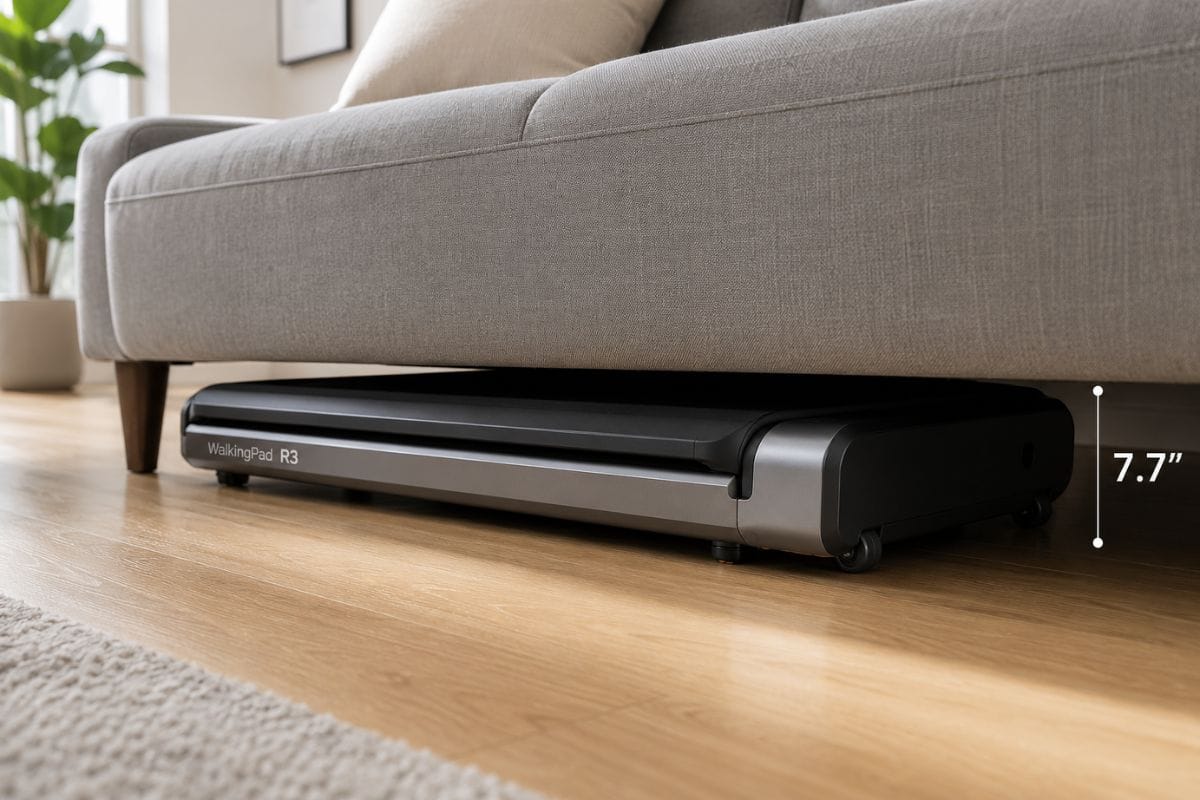
At 7.7 inches thick, the R3 Hybrid+ is a tight squeeze for standard bed frames—make sure to measure your clearance or opt for sofa storage.
The R3 Hybrid+ Is a Different Machine — Understand This Before You Buy
I want to stop you before you scroll to the "what I liked" section, because the biggest mistake someone can make with the R3 Hybrid+ is buying it expecting a bigger version of the C2. It isn't. The C2 is a walking pad that happens to hit 4 mph. The R3 Hybrid+ is a 2-in-1 treadmill — built to run on — that also happens to fold flat enough to live near your furniture.
That distinction shows up in two numbers you can't ignore. First, weight: the R3 Hybrid+ is 90 lb. The Z1 is 51 lb. That's a 39-pound difference you'll feel every single time you pull it out or put it away. Second, folded height: 7.7 inches. Most standard beds clear 8 to 12 inches, which makes the R3 Hybrid+'s fit tight — sometimes too tight. Measure first.
My honest frame after months with this machine: if you only want passive WFH steps, the C2 does that for a lot less, full stop. If you want to actually run in your apartment without leaving the building, the R3 Hybrid+ is the machine that makes that possible.
First Impressions — Unboxing to First Run
No assembly, which every WalkingPad shares, but the R3 Hybrid+'s handrail setup added about ten minutes I didn't budget for — flipping the side bars up, locking them, adjusting height for my own arm length. From unboxing to my first walking-mode session: about 20 minutes.
The 90 lb weight is immediately obvious the first time you move it. The transport wheels help, but they help the way wheels on a heavy suitcase help — you're still muscling it, not gliding it. This is the heaviest machine I've moved in this apartment, and I noticed it in my shoulders after the first week of daily setup and teardown.
The first jog told a different story, though. At 6 mph, the 17.3-inch belt made an immediate difference over the 15.7-inch belts on the budget machines — more margin for a natural stride, less mental math about staying centered. The fold-up side handles, which felt unnecessary in walking mode, earned their place the moment I picked up speed; having something to reach for at 6-plus mph in a small space is genuinely reassuring.
FootSense in walking mode matched my pace smoothly, comparable to what I've felt on the A1 Pro — a real upgrade from the remote-only control on the Z1 and Z1R.
The Apartment Tests
The Noise Test — Most Important for the R3 Hybrid+
WalkingPad rates the R3 Hybrid+ under 65 dB, but that number is a ceiling, not an average, and it matters more here than on any other machine in the lineup because the R3 Hybrid+ is the only one built to go fast.
At 3 mph in walking mode, the R3 Hybrid+ was quiet enough that I could hold a phone call without raising my voice — consistent with every other pad I've tested. At 6 mph in jogging mode, the sound profile changed noticeably: more foot-strike impact, more motor draw, a clear step up from walking-mode noise even if it stayed under the rated ceiling. My downstairs neighbor never flagged it, but I ran evening jogging sessions before 9pm out of caution, not because the spec sheet told me to.
The Storage Test
My bed clearance is 9 inches. The R3 Hybrid+ folds to 7.7 inches, which technically fits — but "technically fits" and "easy daily routine" are different things. Sliding a 90 lb folded treadmill under a bed frame at 7.7 inches, night after night, is a two-handed, get-down-on-the-floor task. If you have sofa clearance instead of bed clearance, that's the easier daily answer for the R3 Hybrid+ specifically — this is the machine's real storage limitation compared to the Z1 or C2.
The Jogging Test
I jogged at 5.5 mph for 20 minutes on hardwood floors at 8pm. The machine stayed stable — no walking, no drift — and vibration was minimal, noticeably less than I expected from a folding treadmill at that speed. FootSense automatic pace-matching, which shines in walking mode, backs off above roughly 4 mph; past that threshold you're setting speed manually, not letting the belt read your stride. That's a reasonable tradeoff for a jogging machine, but worth knowing before you buy expecting hands-free control at running pace.
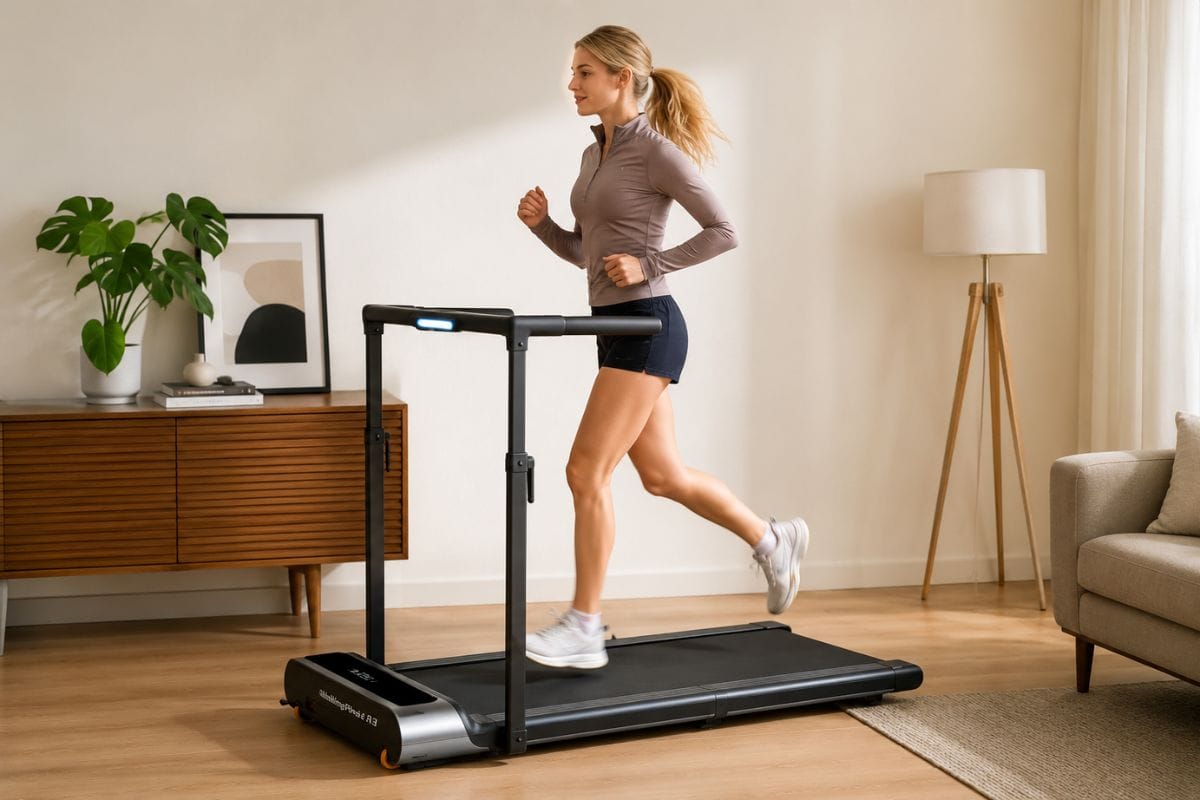
Testing the 7.5 mph speed ceiling: The wider 17.3-inch belt gives you plenty of room to find a natural running stride.
The WFH Desk Test
I also used the R3 Hybrid+ as an under-desk walking pad at 1.5 mph with the handrails folded down. It works, and FootSense still shines here — but the 90 lb pull-out routine changes the daily calculus. On mornings I only wanted a light walking session, I found myself reaching for the C2 instead, simply because it's lighter to move. I'd save the R3 Hybrid+ for intentional workout sessions rather than make it my default daily WFH machine.
How It Rates: Ergonomics, Construction, Ease of Use
Three categories worth calling out on their own, since they're what most buyers actually weigh against each other. Ergonomics: the 17.3-inch belt and adjustable handrails make this the most comfortable WalkingPad I've tested at speed, though the 90 lb frame works against it for daily handling. Construction: stable and essentially vibration-free even at 6 mph on hardwood, with no wobble or belt drift over months of use. Ease of use: FootSense makes walking mode close to effortless, but jogging mode needs manual speed control once you're past roughly 4 mph — so it's not a fully hands-off experience end to end.
What the Extra $600 Over the C2 Actually Buys You
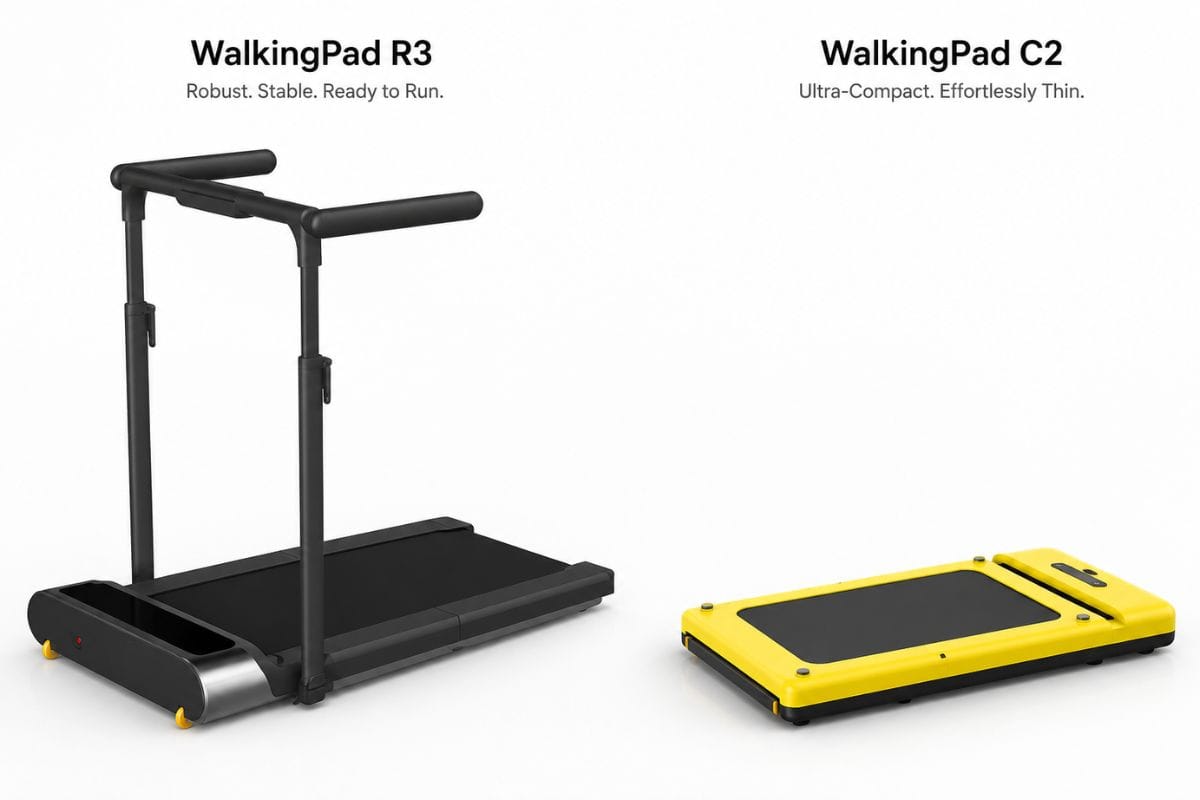
Size and build comparison: The R3 Hybrid+ (left) is built like a tank for running, while the C2 (right) is strictly streamlined for casual under-desk walking.
Short answer: the extra $600 buys nearly double the top speed, a wider belt, side handrails, and FootSense — real upgrades if you run, unnecessary if you only walk.
This is the value conversation that actually matters for this purchase.
- Speed ceiling: 7.5 mph vs 4 mph
- Belt width: 17.3 in vs 15.7 in
- FootSense: yes vs no
- Side handrails: yes vs no
- Weight capacity: 265 lb vs 242 lb
- Machine weight: 90 lb vs ~55 lb
- Folded height: 7.7 in vs ~5 in
- Price: $999 vs $399
If you run, the extra $600 is worth it. If you only walk, it isn't.
What I Liked
The 7.5 mph ceiling is a genuine jogging option, not a marketing spec. I ran real 20-minute sessions at 5.5–6 mph on hardwood with stable footing — this is a machine that can replace a run, not just supplement a step count.
FootSense in walking mode is the best hands-free desk experience in the entire lineup. Pace-matching felt smoother here than on the A1 Pro, with none of the lag I noticed on cheaper pads.
The 17.3-inch belt is a real comfort upgrade. Over longer sessions and for taller users, that extra 1.6 inches over the standard 15.7-inch belt is the difference between confident footing and constant self-correction.
The side handrails earn their existence at jogging speed. They felt unnecessary at 2 mph and reassuring at 6 mph — exactly when you want them.
What Annoyed Me
The 90 lb daily storage ritual is heavier than anything else in the lineup. This is a real consistency risk — on low-motivation mornings, a lighter machine gets used and a heavier one gets skipped.
The 7.7-inch folded height doesn't slide under most standard beds. You need a specific storage plan — sofa clearance, a closet, or accepting the tight fit — before you buy, not after.
At $999, the R3 Hybrid+ is priced against entry-level traditional treadmills like the Sunny Health & Fitness SF-T7515 or NordicTrack's budget tier — machines that typically add incline options the R3 Hybrid+ doesn't have (no WalkingPad model currently offers incline). Those treadmills don't fold flat, though, and for a renter, the fold-flat is still worth the trade-off — you're paying for square footage you get to keep, not for incline training.
Who Should Buy the WalkingPad R3 Hybrid+
The apartment runner who gave up a gym membership and needs a real cardio machine at home will find the 7.5 mph ceiling and stable belt genuinely replace outdoor or gym running sessions.
The person who wants one machine for both WFH walking steps and 3x weekly jogging sessions gets both use cases here, even if the heavier daily handling means saving it more for intentional workouts than constant desk use.
The renter who has sofa clearance, not bed clearance, and doesn't mind a heavier daily storage routine will get the R3 Hybrid+'s full value without fighting its one real limitation.
Who Should Buy Something Else
If you're a pure WFH desk walker, the WalkingPad C2 review at $399 does that job for a fraction of the price — you don't need the R3 Hybrid+'s speed or weight for passive steps. If strict under-bed storage is non-negotiable, the Z1 or Z1R fold to roughly 5.5 inches and will fit where the R3 Hybrid+ won't. If budget is tight but you still want a step up from entry-level, the WalkingPad A1 Pro review at $499 is the middle ground for walking-only use. And if you want even more top-end speed than the R3 Hybrid+ offers, our R3 vs X21 comparison breaks down which faster foldable treadmill actually fits a small space.
WalkingPad C2 — see current price | WalkingPad A1 Pro — see current price | WalkingPad Z1R — see current price
FAQ
Is the WalkingPad R3 Hybrid+ worth $999?
Yes, if you jog or run at home — the 7.5 mph ceiling, wider belt, and side handrails are real upgrades you'll use. If you only want passive walking steps while you work, the C2 gets you there for a fraction of the cost.
Can you run on the WalkingPad R3 Hybrid+?
Yes. It's rated to 7.5 mph, and I tested stable jogging sessions at 5.5–6 mph on hardwood floors with minimal vibration — this is its core purpose, unlike the walking-focused Z1 or C2.
What's the difference between the R3 Hybrid and the R3 Hybrid+?
The Hybrid+ adds foldable side handrails; the standard R3 Hybrid doesn't have them and is priced slightly lower. Everything else in this review — speed, belt size, motor, folded dimensions — applies to both.
Does the WalkingPad R3 Hybrid+ have incline?
No. No WalkingPad model currently offers incline, including the R3 Hybrid+. If incline training is a priority, you'll need to look at a traditional (non-folding) treadmill instead.
Is the WalkingPad R3 Hybrid+ quiet enough for an apartment?
At walking speeds (2–3 mph) it's very quiet. At jogging speeds (6+ mph) it's noticeably louder, though still under WalkingPad's 65 dB rating. I'd avoid late-night jogging sessions out of courtesy.
Does the WalkingPad R3 Hybrid+ fit under a bed?
It's tight for most standard bed frames — it folds to 7.7 inches, and most beds clear 8 to 12 inches. Measure your own space first; sofa storage may be the easier daily option.
WalkingPad R3 Hybrid+ vs C2 — which should I buy?
Buy the R3 Hybrid+ if you want to actually run; buy the C2 if you only want walking steps at your desk. See our full walking pad vs treadmill comparison for more on which category fits your goals.
Final Verdict
The WalkingPad R3 Hybrid+ is the machine for renters who genuinely run, not just walk — the 7.5 mph ceiling, wider belt, and side handrails all point to a real cardio tool, not a step-counter with a higher price tag. The one honest limitation that could be a dealbreaker: that 7.7-inch folded height doesn't clear most standard beds, so you need a storage plan before you buy, not after. For a second opinion beyond my own testing, WalkingPad's broader catalog also carries a strong overall rating on Trustpilot — worth a look if you want more than one data point before you buy.
See the WalkingPad R3 Hybrid+ on WalkingPad.com → See the WalkingPad C2 price →
I test every piece of gear in my actual apartment — noise, footprint, deposit-safety, and real-world durability. No sponsored samples, no showroom conditions. If I wouldn't buy it for my own 650 sq ft studio, I don't recommend it.
Build Your Dream Home Gym—Without Wasting Space or Money
Join the MiniHomeGym Newsletter for expert reviews, space-saving fitness tips, apartment-friendly workout ideas, practical buying guides, and exclusive deals to help you choose the best compact fitness equipment with confidence.